Rare Earth Corridors in Coastal India
Content
- Why in News?
- Introduction
- What are Rare Earth Corridors?
- Target States
- Aim and Policy Alignment
- Key Features
- Significance
Why in News?
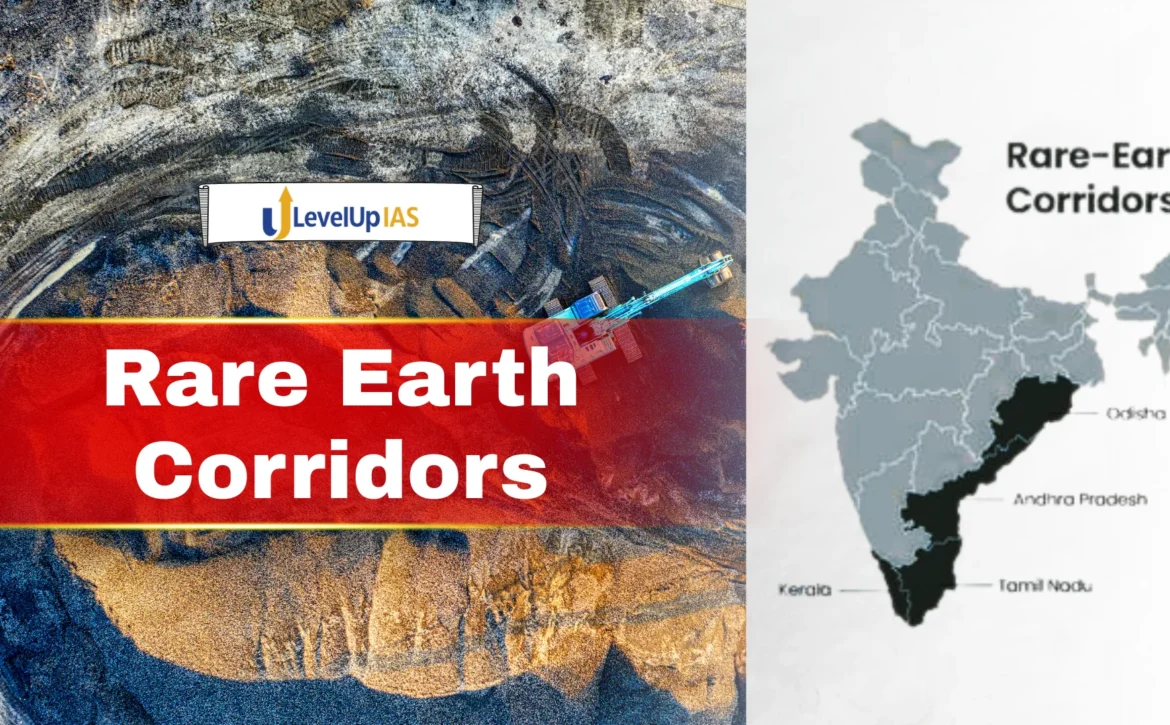
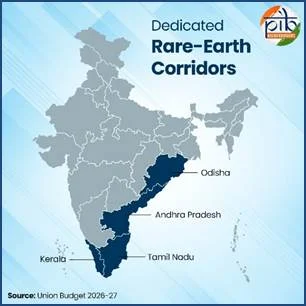
The Union Budget 2026-27 has proposed the establishment of Dedicated Rare Earth Corridors in mineral-rich coastal states such as Odisha, Kerala, Andhra Pradesh, and Tamil Nadu, as part of its broader effort to operationalise the National Critical Minerals Mission. The initiative has gained attention due to its strategic focus on building an integrated domestic value chain for rare earth elements, which are currently dominated by global supply chains centred around China. The move is also aligned with India’s clean energy transition goals and long-term resource security objectives.
Introduction
Rare earth elements have emerged as a critical input for modern industrial economies, particularly in strategic sectors such as clean energy, defence manufacturing, electronics, and advanced technologies. In this context, India’s initiative to establish Dedicated Rare Earth Corridors represents a structural shift from fragmented mineral extraction towards an integrated value-chain-based industrial strategy. Anchored at the state level and aligned with national objectives, these corridors aim to convert India’s geological potential into strategic and economic strength.
What are Rare Earth Corridors?
Rare Earth Corridors are integrated, state-anchored industrial value chains that link the entire lifecycle of rare earths, from mining and mineral separation to processing, research, and final manufacturing. Unlike isolated mining projects, the corridor-based approach emphasizes co-location of activities, enabling seamless movement of raw materials, technology, and skilled manpower across different stages of production.
The corridors leverage India’s coastal mineral wealth, particularly beach sand minerals, to establish a domestically controlled rare earth ecosystem.
Target States for Rare Earth Corridors
The government proposes the corridors in mineral-rich coastal states where rare earth-bearing beach sands are abundantly available.
Target States and Their Significance
| Target State | Strategic Relevance |
| Odisha | Presence of mineral-rich coastal stretches and existing rare earth operations |
| Kerala | Long history of beach sand mineral extraction and refining infrastructure |
| Andhra Pradesh | Coastal mineral deposits suitable for rare earth extraction |
| Tamil Nadu | Extensive beach sand mineral reserves along the coastline |
The selection of these states reflects a resource-based regional development strategy, where natural endowments are combined with industrial clustering. By focusing on coastal states, the initiative optimally utilizes monazite-bearing beach sands, which are the principal source of rare earths in India.
Aim and Policy Alignment
The government has designed the Rare Earth Corridors to fulfil multiple national objectives simultaneously.
Key Aims
- Building a domestic rare earth value chain, reducing reliance on external suppliers.
- Supporting the clean energy transition, where rare earths are essential inputs.
- Operationalising the National Critical Minerals Mission at the state level through tangible infrastructure and industrial clusters.
By decentralising implementation to states while aligning with national missions, the initiative bridges the gap between policy formulation and on-ground execution, a recurring challenge in India’s resource governance.
Key Features of Rare Earth Corridors
1. Integrated Corridor Approach
The corridors co-locate mining, separation, processing, research, and manufacturing facilities within a defined geographical zone. This integration reduces logistics costs, minimizes technological fragmentation, and enhances coordination across the production chain.
2. State-led Execution Model
Unlike purely centralised initiatives, the Rare Earth Corridors emphasize state-level leadership. States play a central role in facilitating value addition, infrastructure development, and industrial clustering, thereby expanding economic benefits beyond national-level policy declarations.
3. Linkage with Incentive Schemes
The corridors are aligned with the Sintered Rare Earth Permanent Magnet (REPM) scheme and sales-linked incentives for integrated manufacturing units. This ensures that mineral extraction is directly linked with downstream manufacturing and market creation.
4. Complementarity with Existing Institutions
The initiative complements the established presence of IREL (India) Limited in Odisha and Kerala, ensuring continuity, institutional memory, and operational expertise.
Significance of Rare Earth Corridors
Strategic and Economic Significance
The corridors aim to reduce India’s import dependence on China, thereby strengthening strategic autonomy in critical mineral supply chains. This has direct implications for national security and defence preparedness, where rare earths are indispensable.
Environmental and Energy Transition Goals
Rare earths are crucial for clean energy technologies. By strengthening domestic supply chains, the corridors support India’s clean energy transition and contribute towards achieving Net Zero Emissions by 2070.
Legal and Institutional Reinforcement
The initiative reinforces reforms under the Mines and Minerals (Development and Regulation) Act, amended in 2023, and strengthens institutional mechanisms under the National Critical Minerals Mission.