Agni-3 Intermediate-Range Ballistic Missile
Content
- Why in News?
- Agni-3 Ballistic Missile
- Key Highlights
- Technical Specifications
- Navigation and Accuracy
- Strategic Forces Command
- Importance for India
Why in News?
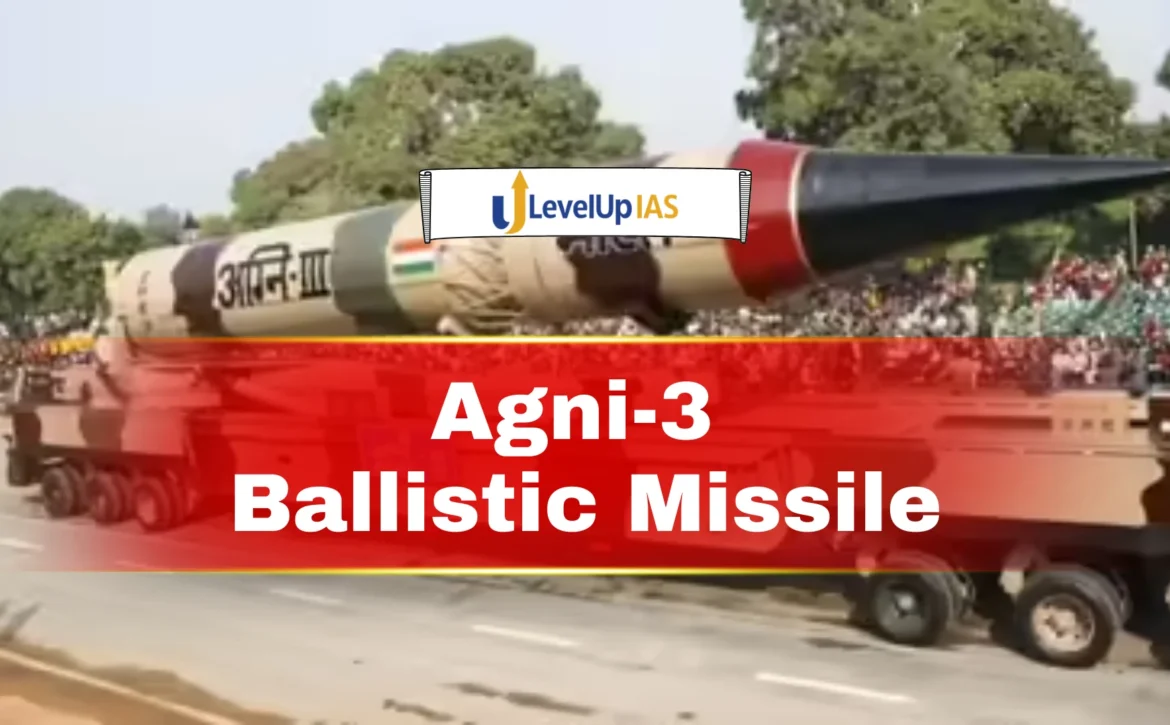
The Intermediate Range Ballistic Missile (IRBM) Agni-3 was successfully test-fired on 06 February 2026 from the Integrated Test Range (ITR), Chandipur, Odisha. Conducted by the Strategic Forces Command, the launch validated all operational and technical parameters, confirming the missile’s reliability as part of India’s nuclear deterrence.
What Is Agni-3 Ballistic Missile?
The Agni-3 missile is a ballistic missile designed for intermediate-range surface-to-surface deployment. This missile has been developed independently by the Defence Research and Development Organisation (DRDO).
Additionally, its main function is to serve as a system for nuclear delivery. As such, it is expected to be vital to India’s strategic defence strategy.
Key Highlights
- This ballistic missile was successfully launched on February 6, 2026, representing a significant achievement in India’s strategic missile development program.
- The launch took place at the Integrated Test Range (ITR) located in Chandipur, Odisha, a leading facility for missile testing that allows for accurate monitoring and assessment of flight performance.
- Notably, the Strategic Forces Command (SFC) employed a road-mobile launcher for the missile launch, underscoring the operational readiness of India’s nuclear forces during standard training exercises.
- Additionally, the use of a road-mobile launcher greatly improves survivability, adaptability, and rapid deployment capabilities in real-world operational situations.
- Following its launch, the missile adhered to its planned trajectory and accurately struck a designated target area in the Bay of Bengal, illustrating a high level of precision.
- The primary goal of the test was to assess all essential operational and technical aspects. In addition, it encompassed flight stability, navigation precision, propulsion efficiency, and the reliability of the entire system.
Collectively, these key points verify that this missile system is entirely operational, dependable, and prepared for combat. In summary, it will strengthen India’s strategic deterrent capabilities.
Technical Specifications of Agni-3 Missile:
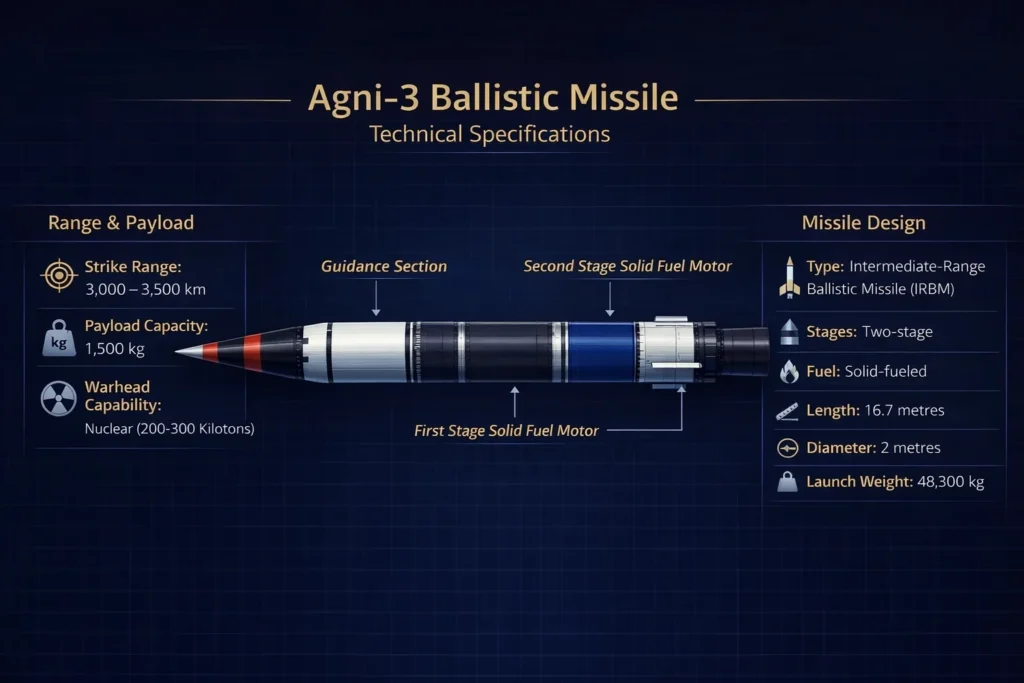
- Agni-III is an Intermediate-Range Ballistic Missile (IRBM) developed by DRDO, with a strike range of about 3,000-3,500 km, capable of carrying a payload of nearly 1,500 kg.
- It is nuclear-capable with an estimated yield of 200-300 kilotons, follows a two-stage configuration with both stages using solid fuel motors, which ensures faster launch readiness, safer storage, and easier maintenance.
- The missile consists of a guidance section for trajectory control, has a total length of around 16.7 metres, a diameter of about 2 metres, and a launch weight of approximately 48,300 kg.
- Strategically, Agni-III forms a crucial part of India’s credible minimum deterrence and second-strike capability, enhancing long-range strategic deterrence rather than battlefield use.
Navigation and Accuracy
According to CSIS, this missile uses a strapdown inertial navigation system (INS) supported by GPS. As a result, the missile achieves an accuracy of around 40 metres Circular Error Probable (CEP), which is extremely precise for a ballistic missile.
Propulsion Technology:
- First Stage: Maraging steel motor case
- Second Stage: Carbon-fibre motor case
- Control System: Thrust Vector Control (TVC)
Together, these technologies improve stability, accuracy, and performance.
What Is Strategic Forces Command (SFC)?
Established on January 4, 2003, the Strategic Forces Command (SFC) oversees the management of India’s strategic weapon systems.
It also encompasses nuclear-capable missiles. Commonly referred to as the Strategic Nuclear Command, it functions under the Nuclear Command Authority.
Most significantly, the stockpile of Indian nuclear warheads falls under its purview. Additionally, it is tasked with the launch of nuclear missiles following authorization from the Nuclear Command Authority.
Importance for India
To begin with, Agni-3 has been operational with the Strategic Forces Command since 2011. In addition, it serves as an essential component of India’s nuclear deterrence, particularly regarding long-range strike capabilities. Furthermore, its successful test demonstrates India’s advancing domestic defence technology and strategic independence.
The successful test of the Agni-3 ballistic missile in 2026 at Chandipur underscores India’s strong strategic missile capabilities. Additionally, it emphasizes the sophistication of navigation systems and the effectiveness of the nuclear deterrence framework.