BRICS Digital Currency Linkage

Content
- Why in News?
- Background
- What is Being Proposed
- Rationale Behind the Proposal
- Potential Benefits
- Challenges and Considerations
- Geopolitical Significance
Why in News?
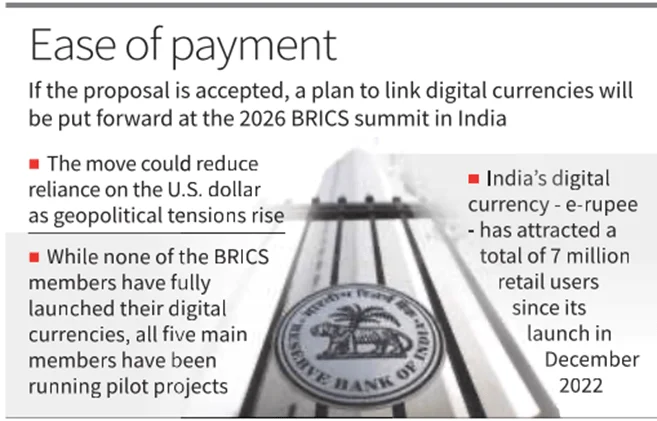
The Reserve Bank of India (RBI) has proposed that BRICS member countries explore linking their Central Bank Digital Currencies (CBDCs) to facilitate smoother, faster and cheaper cross-border trade and tourism payments, thereby reducing reliance on the US dollar and strengthening financial cooperation within the bloc. India is expected to formally place this proposal on the agenda of the 2026 BRICS Summit, which it will host.
Background
- BRICS (Brazil, Russia, India, China, South Africa) represents a major coalition of emerging economies with increasing influence on the global economic and financial architecture.
- The idea of enhancing currency cooperation within BRICS is rooted in the group’s broader objective of reducing dependency on Western-centric financial systems and fostering multipolarity in international finance.
- Historically, BRICS has discussed currency cooperation, including local-currency trade arrangements and a common settlement framework, but significant structural proposals have faced operational and political challenges.
What is Being Proposed?
The RBI’s proposal calls for linking digital currencies issued by BRICS central banks, commonly known as CBDCs to create an interoperable framework for cross-border transactions.
Central Bank Digital Currencies (CBDCs):
- CBDCs are digital forms of a country’s legal tender sovereign money issued by a central bank, as distinct from private cryptocurrencies.
- India’s CBDC is the e-rupee (digital rupee), which is a tokenised digital currency equivalent to fiat and backed by the RBI. It has been under pilot rollout since December 2022 and is advancing in both retail and wholesale formats.
Key Elements of the Proposal
- Interoperability: Ensuring that CBDC systems of BRICS members can communicate and settle payments directly.
- Cross-Border Trade Payments: Enabling traders to settle transactions across countries using linked CBDCs, reducing dependency on correspondent banking systems and the US dollar.
- Tourism Payments: Facilitating easier payments for individuals travelling within BRICS countries by using interoperable digital currency platforms.
- Summit Agenda: RBI has recommended that BRICS CBDC linkage be included in the agenda of the 2026 Summit hosted by India.
Rationale Behind the Proposal
- Reducing Dollar Dominance
- Much of the world’s international trade and financial transactions are conducted in US dollars.
- Reliance on the dollar exposes economies to exchange rate volatility and geopolitical leverage that can be exercised through financial sanctions or policy shifts. By linking CBDCs, BRICS aims to promote alternative settlement mechanisms and reduce conversion costs.
- Enhanced Efficiency
- Cross-border payments today often involve multiple intermediaries and use legacy systems like correspondent banking networks, resulting in delays and high costs.
- Linking CBDCs can enable near-real-time settlements with lower costs by eliminating many intermediaries and directly interfacing digital ledger technologies across jurisdictions.
- Strengthening Financial Cooperation
- Digital currency linkage fosters deeper economic integration among BRICS nations and supports local currency trade settlements, which are already growing within the grouping.
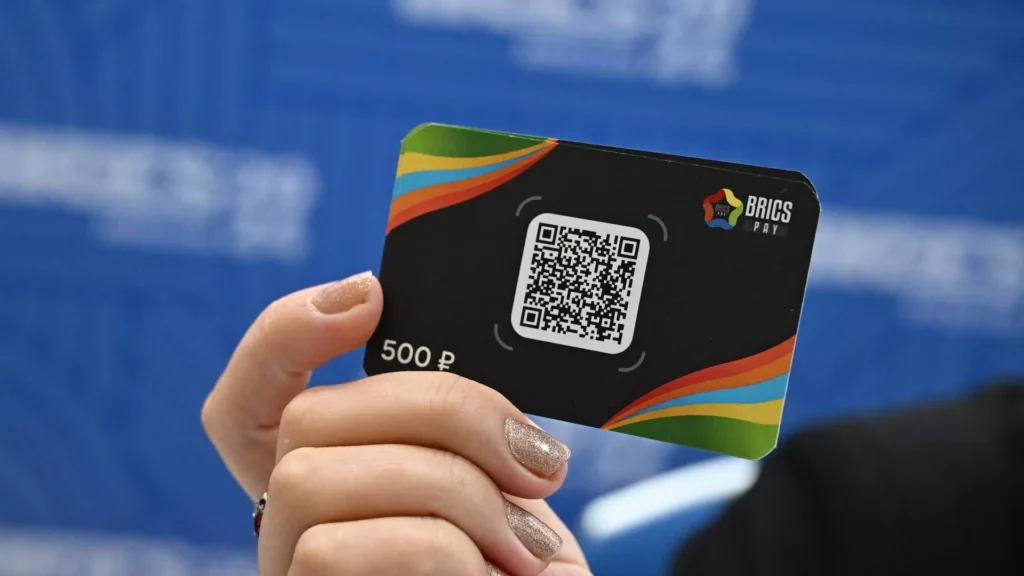
- It aligns with broader BRICS initiatives such as the development of BRICS Pay and local currency settlement arrangements, which aim to deepen financial cooperation and reduce reliance on Western systems like SWIFT.
Potential Benefits
- Lower Transaction Costs
Direct settlement in linked CBDCs can significantly reduce costs associated with currency conversion, correspondent bank fees, and multi-step cross-border procedures. - Faster Settlements
Interoperable CBDCs can facilitate near-instant clearing and settlement, which is especially beneficial for intra-BRICS trade and tourism. - Resilience to External Shocks
A regional digital currency network can insulate participating economies from external financial pressures and geopolitical tensions, enhancing stability. - Promotion of Rupee Usage
Linking India’s e-rupee with other CBDCs can enhance its international usage, supporting the internationalisation of the Indian currency over time.
Challenges and Considerations
Despite its potential, implementing a linked CBDC framework across BRICS faces substantial hurdles:
- Technological Interoperability
- Each member is at a different stage of CBDC development with diverse technology stacks, legal frameworks, and data standards.
- Ensuring seamless interoperability across these systems is both complex and resource-intensive.
- Governance and Regulatory Alignment
- Regulatory structures, privacy standards, anti-money laundering frameworks, and monetary policies vary among BRICS nations.
- Harmonising these to manage cross-border digital money flows without jeopardising national sovereign controls is critical.
- Trade Imbalance Settlement
- Linked CBDCs would require mechanisms to address imbalances in trade for instance, how credits and debits are managed among nations with differing trade volumes.
- Solutions like bilateral foreign exchange swap mechanisms and periodic settlements are being explored.
- Political Will
- Member countries must reach consensus on governance, risk management, and strategic direction, a challenging task given diverse national interests and geopolitical alignments.
Geopolitical Significance
- Multipolar Financial Architecture
- A CBDC linkage among BRICS nations could contribute to multipolar currency mechanisms where multiple regional settlement systems coexist, diluting the dominance of any single currency like the US dollar.
- A CBDC linkage among BRICS nations could contribute to multipolar currency mechanisms where multiple regional settlement systems coexist, diluting the dominance of any single currency like the US dollar.
- Signal to Global Financial Order
- Such an initiative sends a strong geopolitical signal that emerging economies are willing to collaborate on alternative financial infrastructures that prioritise efficiency, resilience, and autonomy over traditional dollar-led systems.
- Such an initiative sends a strong geopolitical signal that emerging economies are willing to collaborate on alternative financial infrastructures that prioritise efficiency, resilience, and autonomy over traditional dollar-led systems.
- India’s Role
- By hosting the 2026 BRICS summit and advancing the CBDC linkage proposal, India positions itself as an advocate for digital payment innovation and internationalisation of its currency, while balancing concerns about outright de-dollarisation with pragmatic economic benefits.
Conclusion
The RBI’s proposal to link BRICS digital currencies reflects an important evolution in multilateral economic cooperation. Although the initiative does not signal an immediate displacement of the US dollar, it lays groundwork for more efficient, sovereign, and resilient cross-border payment systems. Its success will depend on technological interoperability, regulatory consensus, and sustained political commitment within BRICS.
If realised, such a linkage could reshape patterns of international settlement, accelerate digital currency adoption, and enhance financial autonomy for emerging economies within the global economic order.