India AI Impact Summit 2026
Content
- Why in News
- India AI Impact Summit 2026
- Need For the Summit
- Summit Three Sutras
- The Seven Chakras
- Key Highlights of the Summit
- Significance of AI
Why in News
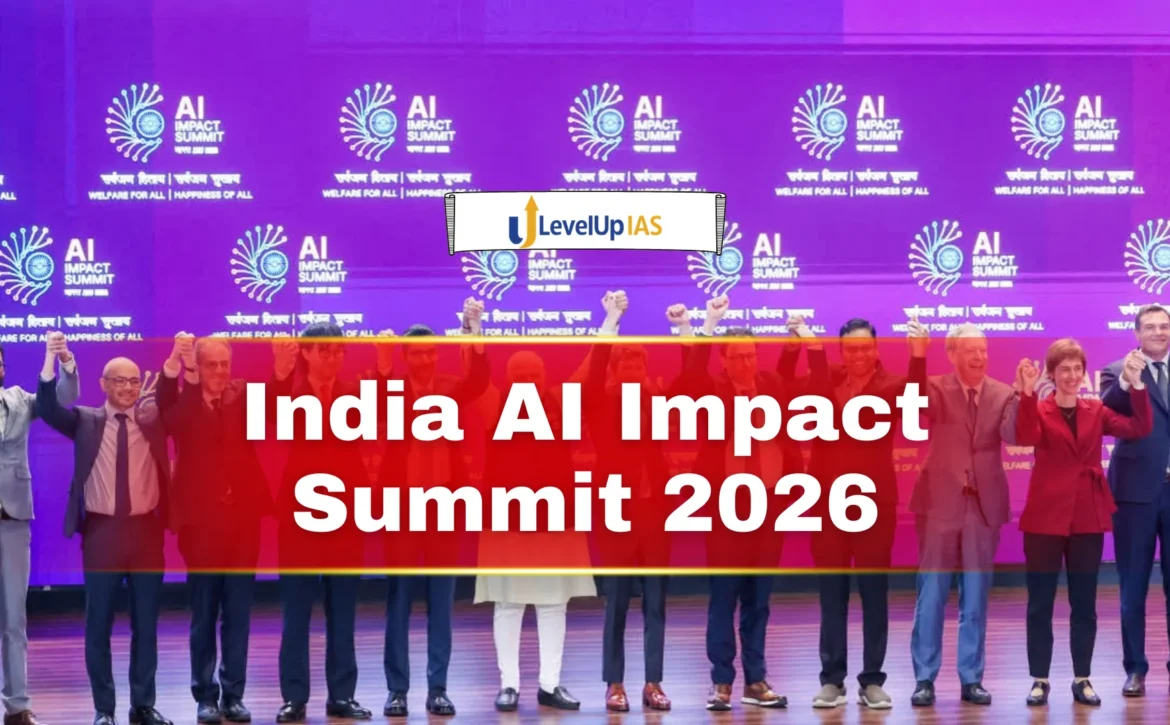
The Ministry of Electronics and Information Technology (MeitY) is organizing the AI Impact Summit 2026 from February 16 to 20, 2026, at Bharat Mandapam in New Delhi. This will mark the inaugural global AI summit taking place in the Global South. The purpose of the summit is to encourage the inclusive and responsible application of AI through international collaboration.
India AI Impact Summit 2026
- Prime Minister Narendra Modi has announced that the India-AI Impact Summit 2026 will take place from February 16 to 20 in New Delhi. This event will mark the first global AI summit hosted by a country in the Global South.
- The summit is a continuation of previous international gatherings such as the UK AI Safety Summit, AI Seoul Summit, France AI Action Summit, and the Global AI Summit on Africa. Its purpose is to go beyond mere dialogue and concentrate on tangible results, enhanced collaboration, and actual advancements in global AI governance.
- The summit intends to ensure that AI fosters inclusive growth, social development, and human-centered innovation, while also safeguarding the environment. Furthermore, it seeks to amplify the voices of developing nations so that the advantages of AI can be more equitably distributed.
- Concurrent with this, it acknowledges issues like unemployment, prejudice in AI systems, and increasing energy consumption. Thus, the summit is centered on implementing tangible actions to handle both the benefits and dangers associated with Artificial Intelligence.
AI Impact Summit 2026 Need
- The Advancement of AI is swiftly reshaping society, the economy, and governance. It presents significant opportunities for growth, particularly in developing nations, by enhancing service accessibility through multilingual and digital platforms.
- In recent years, worldwide initiatives such as the G20 AI Principles, United Nations resolutions, and the Global Partnership on AI (GPAI) have aimed to foster the responsible and ethical application of AI.
- Nevertheless, a “Global AI Divide” persists, with AI resources largely concentrated among a select few developed nations and large corporations. AI also poses challenges such as job displacement, bias, and substantial energy consumption.
- Consequently, there is a critical need for unified global efforts to ensure that AI is inclusive, equitable, and advantageous for everyone.
AI Impact Summit 2026 Three Sutras
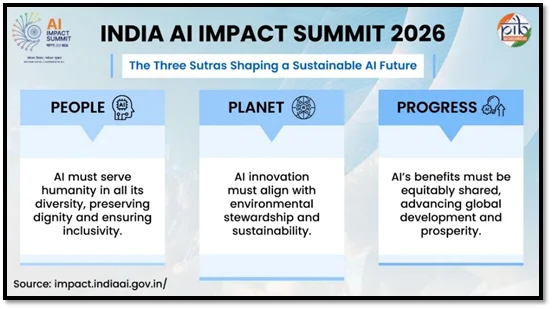
The India-AI Impact Summit is founded on three key guiding principles known as “Sutras.” These Sutras outline how Artificial Intelligence (AI) should be utilized for the greater good through worldwide collaboration.
People
The People Sutra emphasizes the importance of human well-being. It asserts that AI must honor cultural diversity, uphold human dignity, and ensure that everyone is included in its design and application. Technology should prioritize human needs and foster safety, trust, and equitable benefits for society.
Planet
The Planet Sutra underlines the significance of environmental stewardship. It advocates for the responsible application of AI to minimize resource consumption and aid in climate action and ecological preservation. AI development ought to contribute to global sustainability and should not be detrimental to the planet.
Progress
The Progress Sutra focuses on inclusive development. It views AI as a means to foster economic advancement and social improvement. It advocates for equal access to AI resources and promotes the application of AI in areas such as health, education, agriculture, and governance to enhance overall development.
AI Impact Summit 2026: The Seven Chakras of India
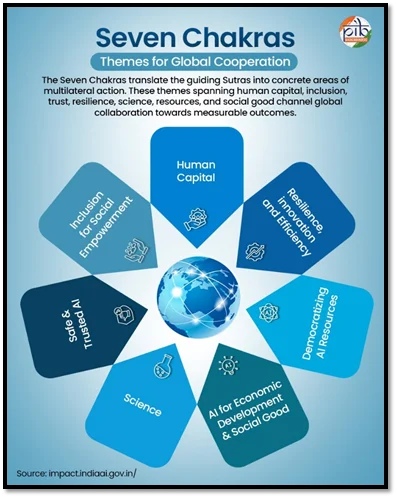
Rooted in the three core principles People, Planet, and Progress.The Summit’s discussions will center on seven essential areas known as “Chakras.” These Chakras symbolize critical aspects of global collaboration to ensure that AI delivers genuine and tangible advantages to society.
- Human Capital: AI is transforming the job landscape by generating new positions while displacing existing ones, leading to the potential for an “AI divide.” The Human Capital Chakra encourages the development of skills, promotes AI literacy, and ensures equitable access to the benefits of AI for all employees.
- Science: AI is revolutionizing scientific research in fields such as healthcare, climate change, and materials science. The Science Chakra encourages worldwide collaboration, the establishment of clear standards, and the application of AI innovations for practical benefits.
- Resilience, Innovation and Efficiency: As the adoption of AI increases, it has the potential to negatively impact the environment and hinder equitable development. The Resilience, Innovation & Efficiency Chakra advocates for sustainable and efficient AI systems that perform effectively even with limited resources.
- Inclusion for Social Empowerment: When utilized inclusively, AI has the potential to enhance social and economic advancement. The Inclusion for Social Empowerment Chakra supports the creation of AI technologies that equitably address the needs of all individuals.
Making AI Resources Accessible to All: AI requires substantial infrastructure, including computing power and data systems, which are predominantly concentrated in a few countries, leading to global disparities. The goal of the Making AI Resources Accessible to All Initiative is to ensure these resources are affordable and available to all nations, allowing everyone to benefit from advancements in AI.
- Fostering Economic Development and Social Welfare: AI has the potential to enhance economic growth and foster social advancement. The Fostering Economic Development and Social Welfare Initiative aims to leverage AI to improve services, boost productivity, and promote equitable and inclusive growth.
Ensuring Ethical and Reliable AI: Advocating for the development of ethical, secure, and trustworthy AI systems that safeguard privacy and minimize bias.
Key Highlights of the AI Impact Summit 2026
- The Prime Minister will inaugurate the AI Impact Expo at Bharat Mandapam, featuring newly developed Indian AI language models, including sovereign AI solutions from Sarvam AI and BharatGen.
- Over 840 exhibitors, comprising national delegations, technology firms, AI startups, and research laboratories, displayed their AI innovations and products.
- The Bharat-VISTAAR (Virtually Integrated System to Access Agricultural Resources) tool will be launched in Jaipur. This AI-driven multilingual platform is designed to assist farmers with crop planning, pest management, weather forecasts, and government initiatives via a 24/7 AI assistant known as Bharati. Initially available in Hindi and English, it will soon offer support for additional regional languages.
- The platform also facilitates collaboration among stakeholders and gathering feedback to enhance agricultural policies and research.
- The India AI Readiness Assessment Methodology (RAM) Report, developed by UNESCO in collaboration with the IndiaAI Mission and Ikigai Law, is set to be released. It will evaluate India’s readiness for ethical and responsible AI while providing policy suggestions. AI4Bharat (IIT Madras) has introduced a new standard for assessing speech recognition systems in 15 Indian languages.
Significance of Artificial Intelligence for India
- Healthcare Transformation: AI strengthens public health systems by enabling early detection of diseases such as TB and cancer, supporting telemedicine outreach in rural and remote regions, improving diagnostic accuracy, and assisting in drug discovery and epidemic prediction, thereby enhancing affordability and accessibility of healthcare services.
- Agriculture and Rural Economy: AI-based technologies assist farmers through real-time weather forecasting, pest and disease alerts, precision farming using drones, and market price prediction. Regional language advisories delivered via mobile platforms improve farm productivity and income stability in rural areas.
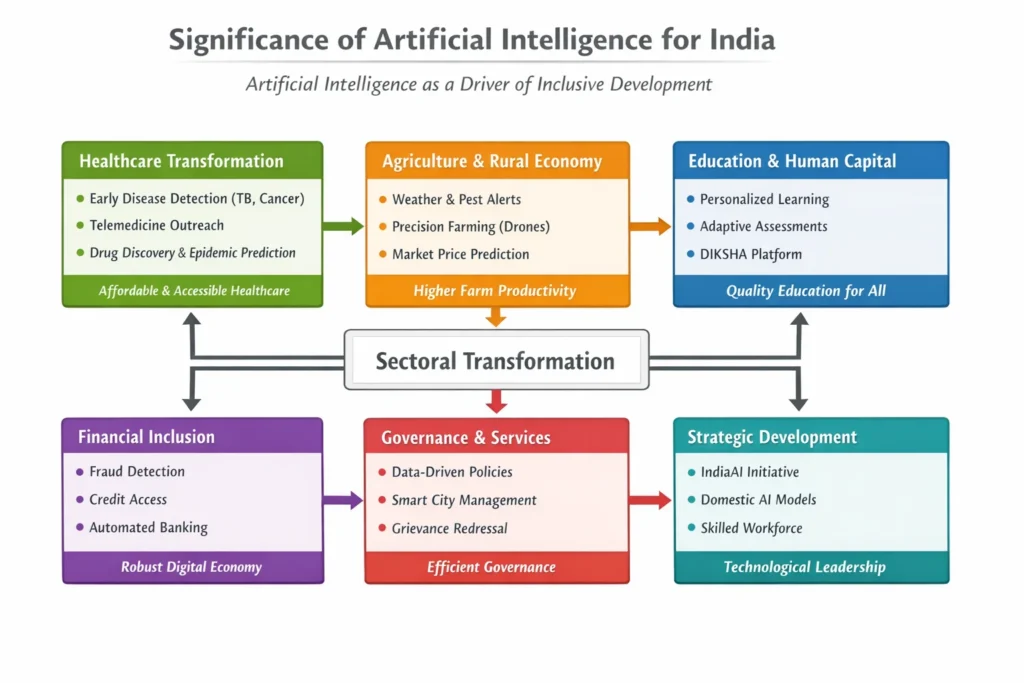
- Education and Human Capital Development: AI enables personalised learning pathways, adaptive assessments, and multilingual educational content. Digital platforms such as DIKSHA enhance equitable access to quality education, particularly for students in underserved regions.
- Financial Inclusion and Digital Economy: AI improves fraud detection in digital payments, expands credit access for underserved populations through alternative data analysis, and supports automated banking services, thereby strengthening India’s digital financial ecosystem.
- Governance and Public Service Delivery: AI enhances administrative efficiency through data-driven policymaking, smart city management, real-time grievance redressal systems, and translation of official and judicial content, improving transparency and citizen-centric governance.
- Strategic and Institutional Development: Recognising AI as a catalyst for economic growth and sustainable development, the Government of India has launched initiatives such as the IndiaAI Mission to build indigenous AI infrastructure, promote domestic AI models, and develop skilled human resources for future technological leadership.