Doctrine Of Separation of Power
Content
- Why in News
- What Is the Doctrine
- Origins and Evolution
- Separation of Powers in the Indian Constitution
- Functional Separation
- Judicial Perspective
- Checks and Balances
- Contemporary Issues
Why in News
The Doctrine of Separation of Powers is a foundational principle in modern democratic statecraft that mandates the division of the state’s power among distinct organs, the Legislature, Executive, and Judiciary to prevent concentration of authority and arbitrary use of power.
While this doctrine was most clearly articulated by the French philosopher Montesquieu in The Spirit of Laws (1748), it has influenced constitutional design worldwide and found expression in the Constitution of India, albeit in a modified form.
What Is the Doctrine of Separation of Powers?
At its core, the doctrine envisages that:
- The Legislature makes laws,
- The Executive implements them, and
- The Judiciary interprets them.
This separation is intended to check the arbitrary exercise of power by any single organ and to safeguard individual liberty and democratic governance. The doctrine also underpins accountability and transparency by ensuring that each organ exercises its constitutional functions without undue interference from others.
Origins and Evolution
The doctrine traces its roots to classical political thought, with early inklings in the works of Aristotle and John Locke, and later refined by Montesquieu, who argued that liberty is best safeguarded when powers are not concentrated in any one body. The US Constitution later institutionalised this doctrine with clear institutional bifurcation among Articles I, II, and III delineating the powers of the Legislature, Executive, and Judiciary respectively.
Separation of Powers in the Indian Constitution
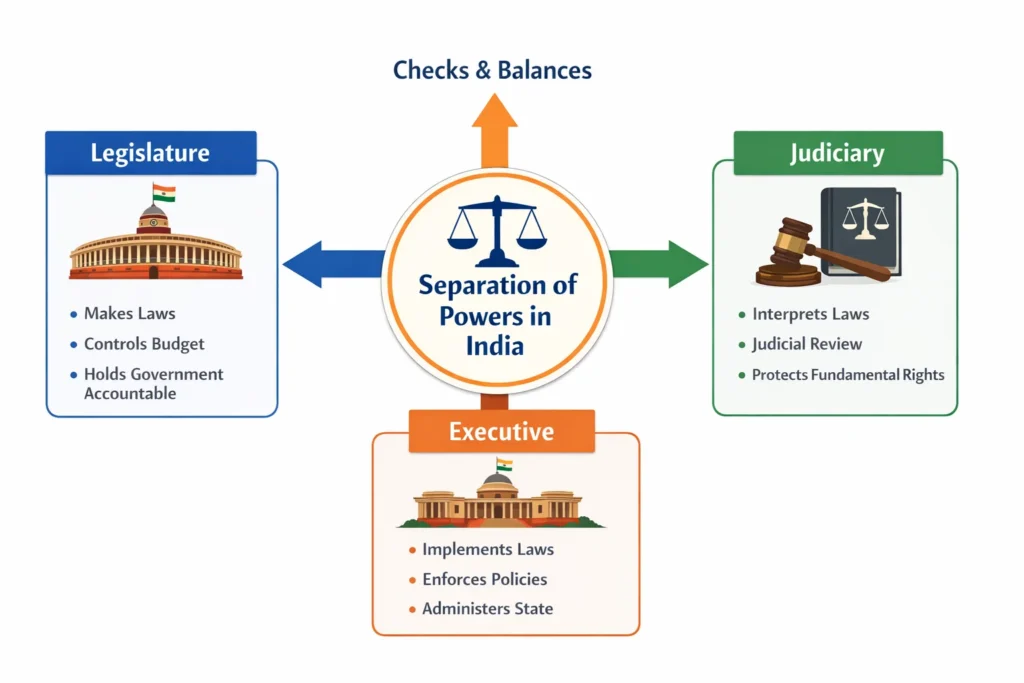
Unlike the US model, the Indian Constitution does not provide a rigid, formal separation of powers. Instead, it embraces a functional separation combined with an intricate system of checks and balances that distribute power while enabling cooperation between the branches.
Constitutional Position
- There is no explicit provision for strict separation of powers in the Constitution. However, separation is implicit in many articles setting out distinct roles for state organs.
- Article 50 directs the state to take steps to separate the Judiciary from the Executive in public services.
- Executive powers are vested in the President/Governor (Articles 53, 154), and Legislative powers in Parliament/State Legislatures (Articles 79, 245).
- Articles 122/212 bar courts from judicial review of legislative proceedings, while Articles 121/211 prevent discussion on judicial conduct in the Legislature.
- Article 361 grants immunity to the President/Governor from court proceedings for official acts, reflecting practical aspects of constitutional duties.
Despite these separate spheres, overlaps exist such as Article 75, which requires that the Council of Ministers (Executive) be drawn from Parliament (Legislature) reflecting the parliamentary form of government in India.
Functional Separation and Overlap
India’s constitutional architecture recognises separation in principle, but allows functional overlap to ensure effective governance:
| Separation Aspect | Distinctive Provision | Functional Overlap |
| Legislature – Executive | Articles 79, 74 | Ministers are part of Parliament; Ordinance power (Article 123) allows the Executive to legislate |
| Judiciary – Executive | Article 50; IPC/CrPC separation measures | Clemency powers of President/Governor (Article 72/161); tribunals with executive members |
| Judiciary – Legislature | Judicial review | Courts interpret laws, sometimes creating new norms through judicial creativity |
This reflects a conscious constitutional choice that incorporates separation of powers with necessary coordination and accountability mechanisms.
Judicial Perspective and Landmark Pronouncements
The Indian Judiciary has played a central role in both interpreting and reinforcing the doctrine:
- Ram Jawaya Kapoor v. State of Punjab (1955): Held that the Constitution does not recognise an absolute separation, but functional differentiation exists.
- Golak Nath v. State of Punjab (1967): Emphasised that organs must function within constitutional limits.
- Indira Gandhi v. Raj Narain (1975): Declared the constitutional clause that sought to immunise electoral disputes unconstitutional, reinforcing that judicial review and separation are part of the Constitution’s basic structure.
- Kartar Singh v. State of Punjab (1994): Reinforced the trichotomy, Legislature makes laws, Executive executes them, Judiciary interprets them.
The Basic Structure Doctrine, propounded in Kesavananda Bharati v. State of Kerala (1973), includes separation of powers as one of the inviolable features of the Constitution, thus preventing any amendment that destroys this balance.
Checks and Balances
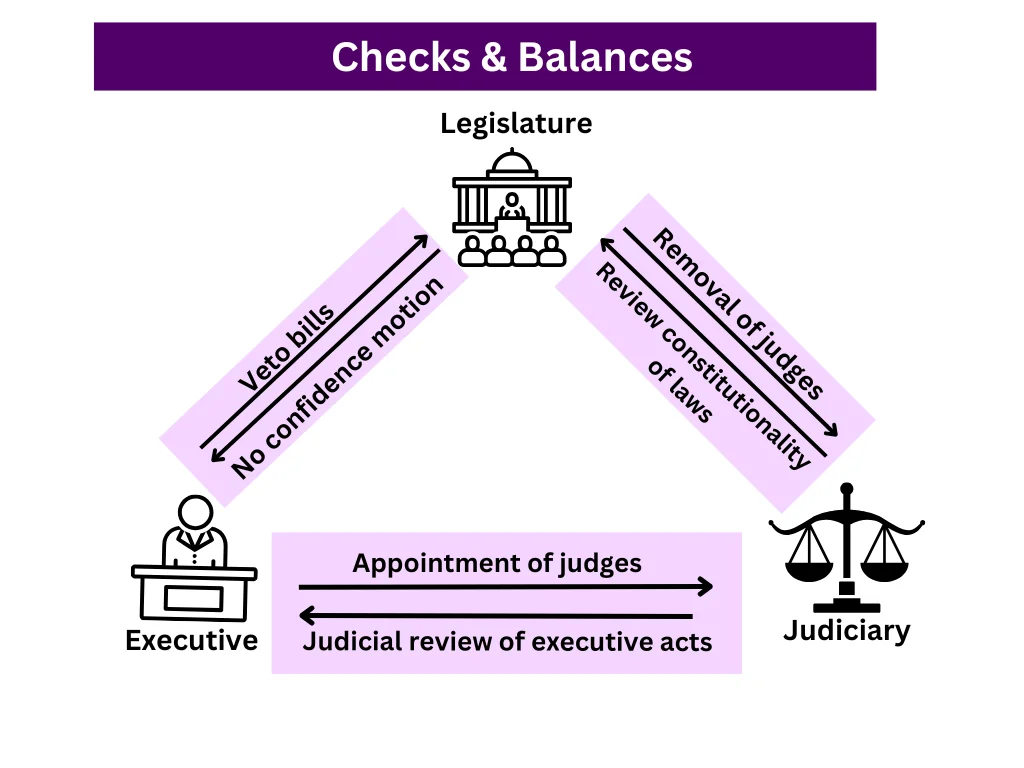
Separation of powers in India operates alongside the Doctrine of Checks and Balances, ensuring that no organ becomes supreme or autocratic. This interdependence allows organs to oversee and restrain one another:
- Legislative checks on Executive: Parliament controls public expenditure, can question executive actions, and remove the government through no-confidence motion.
- Judicial review: Under Articles 32/226, the Judiciary can invalidate laws and executive orders that violate the Constitution.
- Executive checks on Judiciary: President’s clemency powers under Articles 72/161 act as safeguards against judicial errors.
Checks and balances mitigate any undue dominance while preserving institutional autonomy.
Challenges and Contemporary Issues
India’s model, while functional, faces several challenges:
1. Executive Dominance: The intertwined nature of the Executive and Legislature sometimes leads to dominance by the Executive, particularly given the political party system and majority politics.
2. Judicial Overreach: Instances of judicial activism and expansive interpretation under Article 142 raise debates about the Judiciary assuming quasi-legislative or executive roles, testing the boundaries of separation.
3. Delegated Legislation: With increasing delegation of law-making powers to the Executive, there is concern that legislative functions are indirectly exercised by the Executive, raising questions about accountability.
4. Administrative Adjudication: Acts like Jan Vishwas have, in some cases, shifted traditional judicial roles to administrative bodies, stirring debate on separation of adjudicatory functions.
Conclusion
The Doctrine of Separation of Powers, while not rigidly encoded in the Indian Constitution, remains a fundamental principle shaping India’s democratic framework. It recognises distinct spheres for the Legislature, Executive, and Judiciary while allowing necessary overlaps to ensure cooperation and efficiency. Supported by a strong system of checks and balances and reinforced through judicial interpretation, this doctrine prevents the abuse of power and sustains constitutional governance.