Consolidation and Expansion of the Empire under Akbar
Content
- Introduction
- Early Challenges and Military Consolidation
- Administrative Consolidation
- Political Integration
- Religious and Cultural Policies
- Economic and Cultural Consolidation
- Long-Term Impact
- FAQs
Introduction
Jalāl-ud-Dīn Muhammad Akbar, popularly known as Akbar the Great, ascended the Mughal throne in 1556 at the age of thirteen amidst political uncertainty and a fragmented power structure following his father Humayun’s death. Within a few years, he transformed the Mughal polity from a fledgling dynasty into a vast and relatively stable empire that extended across northern, central, and parts of southern India.
Akbar’s reign (1556-1605) marked the age of consolidation in Mughal history, characterised by territorial expansion, administrative centralisation, economic reform, cultural synthesis, and policies of social inclusion that bound diverse communities into a durable imperial framework.
Early Challenges and Military Consolidation
When Akbar inherited the throne, the Mughal state was fragile. Humayun’s brief restoration had left gaps in territorial control, and powerful regional rulers tested imperial authority. The immediate priority was to secure his position and reassert Mughal dominion, beginning with military campaigns that set the stage for future consolidation.
Second Battle of Panipat (1556)
Akbar’s first significant victory came under the regency of Bairam Khan at the Second Battle of Panipat (1556), where Mughal forces decisively defeated Hemu, a Hindu general who had captured Delhi and declared sovereignty. This victory restored Mughal supremacy in the Gangetic plains and secured the political base of Akbar’s empire early in his reign.
Territorial Expansion
Following this foundational victory, Akbar embarked on systematic campaigns of expansion:
- Northern and Central India: Territories such as Gujarat, Jaunpur, and Bengal were brought into the imperial fold through a combination of military action and negotiated submission by local rulers.
- Rajputana: Akbar’s campaigns in Rajasthan were crucial. While some Rajput states were subdued militarily, others entered the imperial framework through alliances and matrimonial ties, as seen with the Amber (Jaipur) dynasty.
- Deccan Penetration: By the end of his reign, Akbar had pushed into the northern Deccan, annexing Khandesh, Berar, and parts of Ahmadnagar, extending Mughal influence toward the southern peninsula.
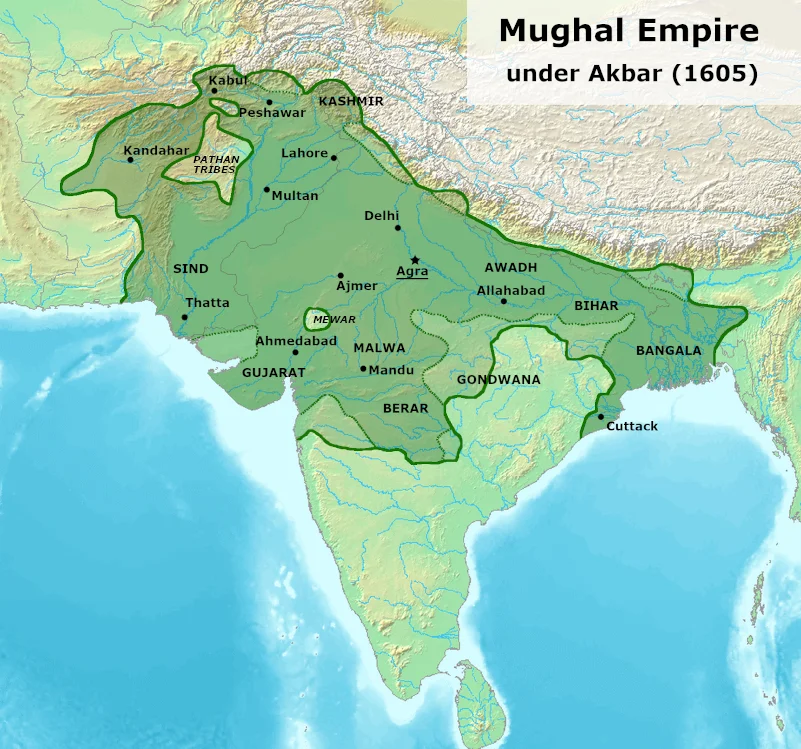
These conquests were not merely territorial grabs.They were strategic efforts to secure trade routes, revenue bases, and military strong-points that prevented resurgence of rival powers.
Administrative Consolidation and Institutional Reforms
Consolidation of territory required an effective administrative framework capable of governing a diverse, multilingual, and multi-religious empire. Akbar’s reforms laid the groundwork for a stable bureaucratic state that endured well beyond his reign.
Centralised Bureaucracy
Akbar developed a highly centralised administration in which authority flowed from the emperor through a structured hierarchy of officials:
- At the apex was the emperor, supported by a council of ministers (Diwan-i-Kul) responsible for key departments such as revenue, military, law, and religious affairs.
- Key offices included the Diwan (finance and revenue), Mir Bakshi (military affairs), Sadr (religious and charitable endowments), and Qazi-ul-Quzat (chief judge) each reporting to the central authority, ensuring coherence and accountability.
Suba System and Provincial Administration
To govern distant regions efficiently, Akbar reorganised his empire into provinces called subas. Each suba was headed by a Subedar (governor) responsible for law and order, revenue collection, and military oversight.
The provinces were further subdivided into sarkars (districts) and parganas (smaller administrative units), creating well-defined channels of governance and accountability.
The administrative hierarchy ensured that no single official could accumulate excessive power. Financial authority (Diwan) and military command (Subedar and Bakshi) were deliberately separated to prevent local elites from challenging central control.
Mansabdari System: Integrating Civil and Military Authority
Akbar’s most enduring administrative innovation was the Mansabdari System, which organised officials into graded ranks based on their status (zat) and the number of troops (sawar) they were required to maintain. This system:
- Merged civil and military functions, creating a loyal, mobile, and disciplined cadre of officers who were directly dependent on imperial appointments rather than hereditary privilege.
- Enabled merit-based promotion and integration of diverse elites, including Rajputs, Persians, Afghans, and local chieftains, into the imperial framework.
- Tied service to salary and military obligation, ensuring the emperor commanded a dependable military force and a competent bureaucracy.
By tying rank and revenue entitlement to imperial service, the Mansabdari system curtailed the tendency of powerful nobles to build independent power bases, a key step in consolidating Mughal authority.
Revenue and Land Administration
Revenue reforms were central to consolidating Mughal power. Under Akbar’s supervision, his finance minister Raja Todar Mal introduced the Dahsala or Bandobast system, which fixed land revenue based on average produce over ten years. This system:
- Reduced arbitrariness in tax collection by classifying land and assessing revenue according to productivity, creating predictability for both the state and cultivators.
- Strengthened the fiscal foundation of the empire, enabling sustained military and administrative expenditure necessary for control over vast territories.
Additionally, the empire undertook systematic land surveys and record-keeping (as reflected in documents like the Ain-i-Akbari), projecting imperial authority into rural India and standardising revenue practice.
Political Integration and Elite Accommodation
Territorial conquest did not automatically translate into political stability; Akbar recognised that the cooperation of local elites was essential for long-term consolidation.
Rajput Policy and Sulh-i-Kul
Akbar’s approach to the formidable Rajput warrior clans was both pragmatic and innovative:
- Some Rajput rulers were defeated militarily, but many were integrated through negotiated alliances and matrimonial ties, most famously with the Amber (Jaipur) dynasty. These alliances gave Rajput elites significant positions in the imperial administration.
- His doctrine of Sulh-i-Kul (universal peace) espoused religious tolerance and non-sectarian governance, signalling respect for diverse faiths and cultural practices.
This policy of inclusion reduced the likelihood of rebellion, fostered loyalty among powerful indigenous elites, and enhanced the legitimacy of Mughal rule in Hindu-majority regions. It reflected a sophisticated understanding of India’s social landscape and the necessity of political integration for imperial consolidation.
Religious and Cultural Policies
Akbar’s religious policies were fundamental to consolidating his empire, whose subjects included Hindus, Muslims, Jains, Christians, and others.
Abolition of Jizya and Non-Discriminatory Practices
- In a bold departure from orthodox practice, Akbar abolished the jizya (tax on non-Muslims) and other discriminatory fiscal measures, making his regime more acceptable to non-Muslim populations.
- He also prohibited forced conversions and promoted cultural exchange by welcoming scholars, theologians, and artists from varied traditions, exemplifying his commitment to an inclusive polity.
Din-i-Ilahi and Intellectual Engagement
Akbar’s intellectual curiosity and desire for social harmony led him to promote religious discourse and ethical synthesis:
- He convened theological debates and engaged with scholars of different religious traditions.
- In 1582, he espoused the idea of Din-i-Ilahi, a syncretic ethical doctrine aimed at transcending sectarian divisions and fostering unity among his subjects.
Though it did not develop into a widespread religion, Din-i-Ilahi symbolised Akbar’s effort to build a cohesive imperial identity that accommodated diversity.
Economic and Cultural Consolidation
The stability brought by Akbar’s reforms energised economic growth and cultural flourishing:
- A stable revenue base allowed for commercial expansion, urban growth, and patronage of arts and crafts.
- Akbar’s courts at Agra, Delhi, and later Fatehpur Sikri, became centres of Indo-Persian culture, synthesising Persian traditions with indigenous artistic and literary motifs.
- His reign saw the rise of painting, architecture, literature, and music that defined the classic Mughal style, integrating Persian, Indian, and Central Asian elements.
This cultural integration reinforced political consolidation by creating shared elite values and symbols transcending regional identities.
Legacy and Long-Term Impact
Akbar’s consolidation of the Mughal Empire had profound long-term consequences:
- His administrative and military reforms became the steel frame of Mughal governance, replicated and refined by successors.
- The policies of elite integration and religious accommodation helped sustain imperial stability for decades after his death.
- Economic regularity and cultural synthesis fostered a resilient civilisational ethos that endured beyond Mughal political dominance.
By the time of Akbar’s death in 1605, the Mughal Empire was a vast, centrally administered polity with a strong revenue base, loyal and integrated elites, and a culture that unified diverse traditions, a rare achievement in premodern Indian history.
Conclusion
The consolidation of the Mughal Empire under Akbar represented a monumental phase in Indian polity, a synthesis of conquest and accommodation, centralisation and cultural integration. Through military success, administrative innovation, inclusive policies, and fiscal stability, Akbar transformed the Mughal state into a durable empire that profoundly influenced the political and cultural landscape of India.
FAQs
Q1. What does consolidation of the empire under Akbar mean?
It refers to the strengthening of Mughal authority through administrative reforms, efficient revenue systems, and integration of diverse regions and elites.
Q2. How did Akbar expand the Mughal Empire?
Through military campaigns, strategic alliances (especially with Rajput states), and incorporation of newly conquered territories into a uniform administrative framework.
Q3. What administrative measures supported imperial consolidation?
Key measures included the Mansabdari system, centralised revenue administration, provincial governance (Subahs), and a policy of religious accommodation.
Q4. Why were Rajput alliances significant?
They ensured political stability, military support, and regional integration, reducing resistance to Mughal rule.
Q5. Why is this topic important for UPSC?
It is central to GS Paper I (Medieval History) and frequently appears in questions on state formation, administration, and imperial integration useful for your detailed, paragraph-style history notes.