Question of the Day-Conduct of election rules 1961
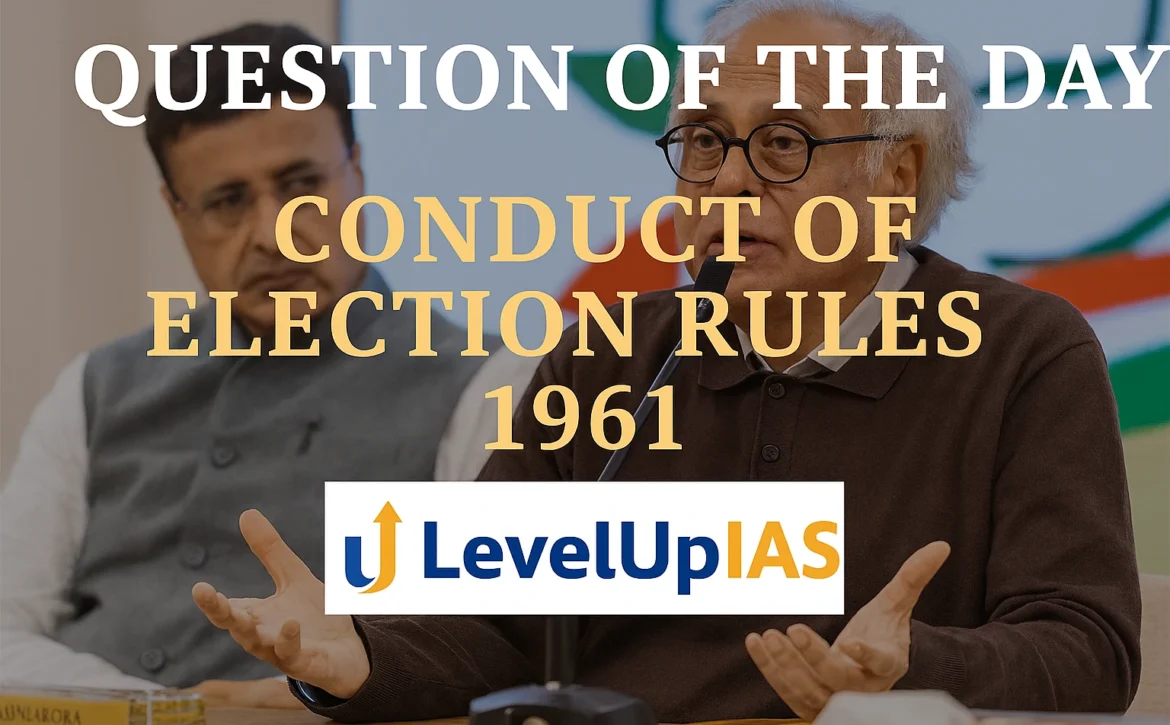
QOTD March 1,2026
With reference to the Conduct of Elections Rules, 1961, consider the following statements:
- It provides detailed procedures for the conduct of elections to Parliament and State Legislatures.
- It lays down provisions regarding postal ballots and proxy voting.
- It prescribes the model code of conduct for political parties.
Which of the statements given above is/are correct?
(a) 1 and 2 only
(b) 2 and 3 only
(c) 1 only
(d) 1, 2 and 3
Answer: (a) 1 and 2 only
Explanation:
Statement 1-Correct
- The Rules were framed under the Representation of the People Act, 1951.
- They provide detailed procedures for nomination, scrutiny, withdrawal, polling, counting, and declaration of results.
- They apply to elections to Parliament and State Legislatures.
Statement 2-Correct
- The Rules contain provisions for postal ballots.
- They provide for voting by service voters and electors on election duty.
- Proxy voting provisions for certain service voters are also included.
Statement 3-Incorrect
- The Model Code of Conduct is not part of these Rules.
- It is issued separately by the Election Commission of India.
- It functions as a set of guidelines, not statutory rules under this Act.
Why in news-
The issue is in news because a petition has been filed in the Supreme Court of India by Congress leader Jairam Ramesh challenging recent amendments to the Conduct of Elections Rules, 1961. The amendments reportedly modify provisions related to public access and inspection of certain election-related documents. The petitioner argues that these changes may reduce transparency and restrict citizens’ ability to scrutinize electoral processes. Concerns have been raised that limiting access to records such as electronic or CCTV footage could affect accountability. The Supreme Court has issued notice to the Centre and the Election Commission seeking their response. The matter has gained attention as it relates to electoral integrity and democratic transparency. Since free and fair elections are part of the basic structure of the Constitution, the case carries significant constitutional importance. Therefore, the issue has become a major political and legal development.
There are more questions from this topic that you should practice to make your concepts stronger.
Practice Questions (PQ)
PQ1. Under the Conduct of Elections Rules, 1961, which of the following categories are entitled to vote through postal ballot?
- Service voters
- Electors on election duty
- Preventive detention detainees
Select the correct answer:
(a) 1 and 2 only
(b) 1 and 3 only
(c) 1, 2 and 3
(d) 2 only
Answer: (c) 1, 2 and 3
Explanation:
Statement 1-Correct
- Service voters include members of the armed forces and certain government employees posted abroad.
- They are allowed to vote through postal ballots.
Statement 2-Correct
- Electors on election duty (e.g., polling staff) may not be able to vote in their constituency.
- The Rules allow them to vote via postal ballot.
Statement 3-Correct
- Persons under preventive detention (not convicted prisoners) are eligible for postal ballot.
- This ensures they are not deprived of their franchise.
PQ2. Which of the following matters are governed by the Conduct of Elections Rules, 1961?
- Form of nomination papers
- Symbols allotted to political parties
- Procedure for counting of votes
Select the correct answer:
(a) 1 and 3 only
(b) 2 and 3 only
(c) 1, 2 and 3
(d) 1 only
Answer: (c) 1, 2 and 3
Explanation:
Statement 1-Correct
- The Rules prescribe specific formats for nomination papers.
- This ensures uniformity and legal validity.
Statement 2-Correct
- The Rules provide procedural aspects relating to allotment and use of symbols.
- The broader framework is guided by the Election Symbols Order.
Statement 3-Correct
- Detailed procedure for counting votes is provided in the Rules.
- It includes counting of postal ballots and EVM votes.
PQ3. Under the Conduct of Elections Rules, 1961, the security deposit made by a candidate is forfeited if:
(a) The candidate withdraws nomination
(b) The candidate fails to secure more than one-sixth of the valid votes polled
(c) The candidate is disqualified before polling
(d) The candidate loses the election
Answer: (b)
Explanation:
Option (1)-Incorrect
- Withdrawal within the prescribed time does not automatically lead to forfeiture.
Option (2)-Correct
- If a candidate fails to secure more than one-sixth of the valid votes polled, the deposit is forfeited.
- This discourages non-serious candidates.
Option (3)-Incorrect
- Disqualification alone does not determine forfeiture under this specific condition.
Option (4)-Incorrect
- Losing the election does not lead to forfeiture if the one-sixth vote threshold is achieved.
Previous Year Question (UPSC Prelims)
Under the Representation of the People Act, 1951, which of the following would lead to the disqualification of a Member of Parliament?
- If he/she voluntarily gives up membership of a political party
- If he/she is absent from all meetings of the House for a period of 60 days
- If he/she is convicted for certain offences
Select the correct answer:
(a) 1 and 2 only
(b) 3 only
(c) 1, 2 and 3
(d) 2 and 3 only
Answer: (c) 1, 2 and 3
Explanation:
Statement 1-Correct
- Voluntarily giving up party membership attracts disqualification under the Tenth Schedule.
Statement 2-Correct
- Continuous absence for 60 days without permission can lead to loss of seat.
Statement 3-Correct
- Conviction for specified offences under the Representation of the People Act, 1951 results in disqualification.