Carbon Capture, Utilisation, and Storage (CCUS) technologies
Content
- Why in News
- What is CCUS
- Key Components
- Significance
- India’s Policy Framework
- Challenges in Implementation
- Way Forward
Why in News
- In Union Budget 2026-27, the Government of India announced a ₹20,000 crore funding plan to promote Carbon Capture, Utilisation and Storage (CCUS) technologies in high-emission industries.
- The policy push aims to accelerate industrial decarbonisation in sectors such as cement, steel, power generation, and refineries, which are considered hard-to-abate sectors in climate policy discussions.
- The initiative aligns with India’s commitment to achieve Net Zero emissions by 2070 and strengthen its climate mitigation strategy.
What is Carbon Capture, Utilisation and Storage (CCUS)?
Carbon Capture, Utilisation and Storage refers to a group of technologies designed to capture carbon dioxide (CO₂) emissions from industrial processes before they enter the atmosphere. The captured carbon is either reused in industrial applications or stored permanently in geological formations.
CCUS is increasingly recognised as an important climate mitigation tool because it enables emission reduction in sectors where renewable energy alone cannot fully eliminate carbon emissions.
Key Components of CCUS Technology
1. Carbon Capture
This stage involves capturing carbon dioxide from industrial emission sources before it is released into the atmosphere.
Major capture methods include:
- Post-combustion capture: CO₂ is separated from flue gases after fossil fuel combustion in power plants.
- Pre-combustion capture: Fossil fuels are converted into hydrogen and CO₂ before combustion, allowing easier carbon separation.
- Oxy-fuel combustion: Fuel is burned in oxygen instead of air, producing a concentrated CO₂ stream that is easier to capture.
These techniques help reduce emissions from industries that rely heavily on fossil fuels.
2. Transportation
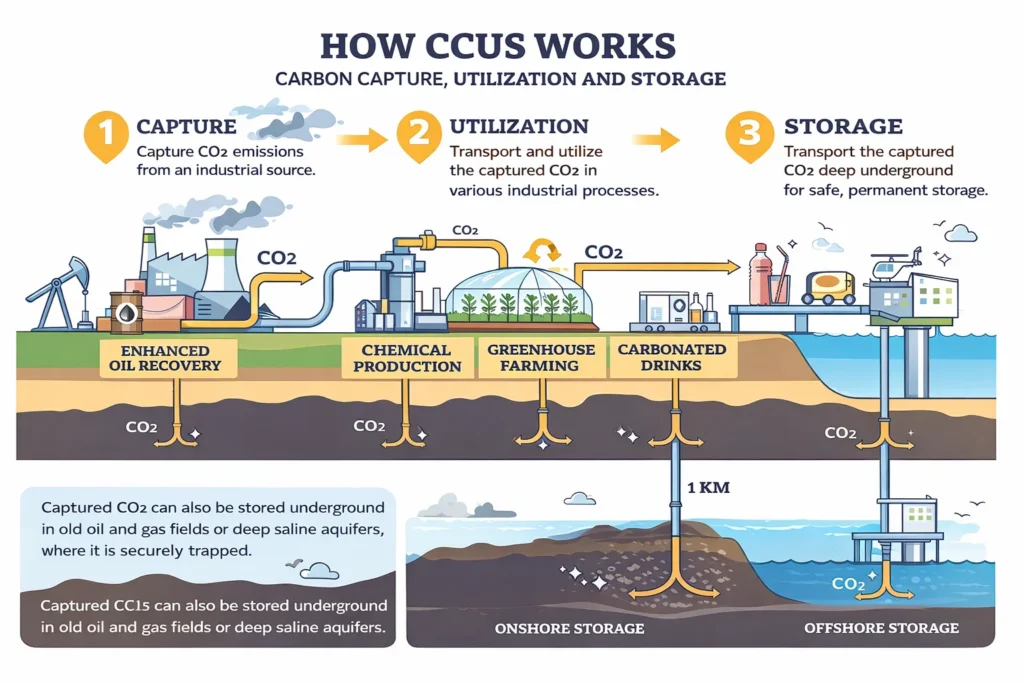
After capture, CO₂ is compressed and transported to storage or utilisation sites.
Transportation methods include:
- Pipelines (most common method globally)
- Ships for offshore transport
- Trucks for short-distance transfer
Proper infrastructure is essential to ensure safe and efficient carbon transport.
3. Utilisation or Storage
Captured carbon can be either reused or stored.
Utilisation of CO₂:
- Enhanced Oil Recovery (EOR)
- Production of synthetic fuels
- Chemical manufacturing
- Carbonated beverages
- Building materials such as carbon based cement
Storage of CO₂:
Carbon dioxide may be stored in deep underground geological formations, including:
- Depleted oil and gas fields
- Deep saline aquifers
- Unmineable coal seams
These formations allow long term carbon sequestration, preventing emissions from reaching the atmosphere.
Significance of CCUS for Climate Action
- Decarbonisation of Hard-to-Abate Sectors: Industries such as cement and steel produce emissions from chemical reactions, which cannot be eliminated through renewable electricity alone. CCUS helps reduce emissions from these sectors.
- Supporting Energy Transition: Many countries still depend on fossil fuels for energy security. CCUS enables gradual transition to low-carbon energy systems while maintaining industrial productivity.
- Achieving Global Climate Targets: Climate models suggest that achieving the goals of the Paris Agreement will require large-scale deployment of carbon removal technologies such as CCUS.
- Enabling Blue Hydrogen: CCUS technology allows production of blue hydrogen, where hydrogen is produced from natural gas while capturing the resulting carbon emissions.
- Development of Circular Carbon Economy: Utilisation of captured CO₂ can create new industrial value chains by converting emissions into useful products.
India’s Policy Framework on CCUS
- India has started developing a policy framework to promote Carbon Capture, Utilisation, and Storage (CCUS) as part of its climate mitigation strategy. Since sectors like power, steel, and cement are difficult to decarbonise, CCUS is being considered an important technological solution to reduce industrial emissions.
- The government, along with institutions such as NITI Aayog, has released policy roadmaps highlighting the role of CCUS in supporting India’s climate commitments under the Paris Agreement. These initiatives emphasise research, pilot projects, and collaboration between industry and research institutions.
- Policy discussions also focus on creating economic incentives through mechanisms like India’s emerging carbon market under the Energy Conservation framework. In the long term, CCUS is expected to complement renewable energy expansion and help India progress towards its net-zero emissions target by 2070.
Challenges in Implementing CCUS
Despite its potential in reducing carbon emissions, the implementation of Carbon Capture, Utilisation and Storage (CCUS) technologies faces several structural and economic challenges.
- One of the most significant constraints is the high cost of capture and storage infrastructure, which makes large-scale deployment difficult for developing economies like India.
- Establishing pipelines, storage reservoirs, and capture facilities requires substantial investment and advanced technological capabilities.
- Another major concern is the availability and safety of geological storage sites. Long-term storage of carbon dioxide in underground formations demands careful monitoring to avoid leakage, environmental risks, and groundwater contamination.
- In addition, regulatory frameworks and clear liability mechanisms for carbon storage are still evolving in many countries.
- Technological limitations also remain an obstacle. Many CCUS technologies are still at the demonstration or early commercial stage, which means efficiency levels vary across projects.
Moreover, industries may be reluctant to adopt such technologies without strong financial incentives, carbon pricing mechanisms, or government support.
Way Forward
- To successfully integrate CCUS into climate mitigation strategies, governments must adopt a multi-dimensional policy approach. Public investment in research and development can help reduce technology costs and improve efficiency.
- Strengthening collaboration between government agencies, research institutions, and private industries will also be crucial for accelerating innovation.
- Another important step is the development of a clear regulatory and policy framework that governs carbon capture, transport, and storage activities.
- Policies such as carbon pricing, tax incentives, and subsidies can encourage industries to invest in CCUS technologies.
- In the long term, CCUS should be integrated with broader climate strategies such as renewable energy expansion, hydrogen production, and industrial decarbonisation. International cooperation and knowledge sharing will further help countries like India adopt best practices and scale up CCUS infrastructure in a sustainable and economically viable manner.