New START Treaty Between the United States and Russia
Content
- Why in News
- Background
- New START Treaty
- Key Provisions
- Russia’s Suspension of Participation
- Expiry of the Treaty in 2026
- Significance
- Concerns
- Implications
- Way Forward
Why in News
The New Strategic Arms Reduction Treaty (New START) between the United States and Russia expired on 5 February 2026, marking the end of the last legally binding nuclear arms control agreement between the world’s two largest nuclear powers.
With the expiry of the treaty, there are no longer any legal limits on the strategic nuclear arsenals of the US and Russia for the first time in over five decades, raising fears of a renewed nuclear arms race and weakening global arms-control architecture.
The development has significant implications for global strategic stability, nuclear non-proliferation, and international security.
Background of US-Russia Nuclear Arms Control
The New START Treaty is part of a broader history of nuclear arms control agreements between the United States and the Soviet Union/Russia during and after the Cold War.
During the Cold War, both superpowers accumulated massive nuclear arsenals, leading to fears of mutually assured destruction. To reduce this risk, several agreements were negotiated, including:
- SALT I (Strategic Arms Limitation Talks), 1972
- SALT II, 1979
- START I, 1991
- Moscow Treaty (SORT), 2002
These treaties aimed to limit or reduce the number of nuclear weapons and delivery systems.
However, many of these agreements have gradually collapsed due to geopolitical tensions. For instance, the Intermediate-Range Nuclear Forces (INF) Treaty collapsed in 2019, and the Open Skies Treaty ended in 2020-22. By the 2020s, New START remained the only major arms-control agreement between the two countries.
Thus, the expiration of New START in 2026 represents the collapse of the final pillar of bilateral nuclear arms control.
About the New START Treaty
- The New START Treaty is formally titled the Treaty Between the United States of America and the Russian Federation on Measures for the Further Reduction and Limitation of Strategic Offensive Arms.
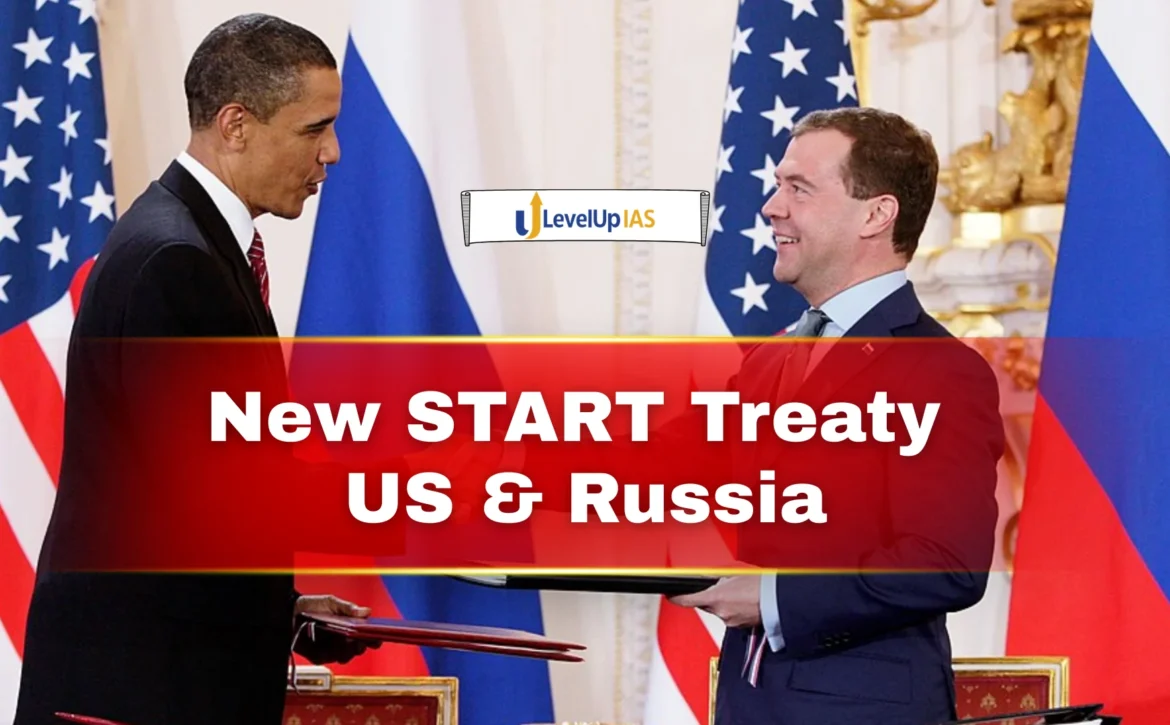
- It was signed on 8 April 2010 in Prague by US President Barack Obama and Russian President Dmitry Medvedev. The treaty entered into force on 5 February 2011 after ratification by both countries.
The agreement replaced earlier arms-reduction treaties and aimed to maintain strategic stability by limiting the deployment of nuclear weapons and delivery systems.
Key Provisions of the New START Treaty
The treaty established several legally binding limits on the nuclear arsenals of the United States and Russia.
1. Limits on Nuclear Warheads: Both countries agreed to deploy no more than 1,550 strategic nuclear warheads.This represented a significant reduction from earlier Cold War levels.
2. Limits on Delivery Systems: The treaty limited the number of deployed strategic delivery vehicles such as intercontinental ballistic missiles (ICBMs), submarine-launched ballistic missiles (SLBMs), and heavy bombers to 700.
3. Cap on Launchers: A maximum of 800 deployed and non-deployed launchers was allowed under the agreement.
4. Verification and Inspection Mechanisms: One of the most significant features of the treaty was its robust verification regime, which included:
- On-site inspections
- Data exchanges
- Notifications about missile movements and deployments
These mechanisms ensured transparency and helped build mutual trust.
5. Duration and Extension: The treaty was originally valid for 10 years (2011–2021).
It allowed one extension of up to five years, which was exercised in 2021, extending the treaty until February 2026.
However, under the treaty provisions, it could not be extended further beyond 2026.
Russia’s Suspension of Participation
- In February 2023, Russia announced that it would suspend its participation in the New START Treaty, citing tensions with the United States over the Ukraine conflict and Western military support for Kyiv.
- Although Russia suspended participation, it stated that it would continue to respect the numerical limits on nuclear warheads, but inspection activities and verification mechanisms were halted.
This suspension significantly weakened the functioning of the treaty even before its formal expiry.
Expiry of the Treaty in 2026
The treaty officially expired on 5 February 2026.
Key consequences of the expiry include:
- End of legally binding limits on US and Russian nuclear weapons.
- Termination of verification mechanisms such as inspections and data sharing.
- Increased uncertainty about the size and deployment of nuclear arsenals.
Russia had earlier proposed that both countries voluntarily continue observing the treaty limits for one year, but no formal agreement was reached.
Thus, the expiration marks a significant setback for global nuclear arms control.
Significance of the New START Treaty
The New START Treaty played a crucial role in maintaining strategic stability between the United States and Russia.
1. Prevented a Nuclear Arms Race: The treaty limited the number of deployed nuclear weapons, preventing uncontrolled expansion of nuclear arsenals.
2. Enhanced Transparency: Verification measures, including inspections and data exchange, helped build confidence between the two countries.
3. Strengthened Global Non-Proliferation Efforts: By reducing nuclear arsenals, the treaty supported the broader goals of the Nuclear Non-Proliferation Treaty (NPT).
4. Maintained Strategic Stability: The treaty ensured that both countries maintained balanced nuclear capabilities, reducing the likelihood of nuclear confrontation.
Concerns After the Treaty’s Expiry
The collapse of the New START Treaty raises several strategic concerns for global security.
- Risk of a Renewed Nuclear Arms Race Without legal limits, the US and Russia could potentially increase the size of their nuclear arsenals.
- Decline of Arms-Control Architecture The collapse of several major treaties in recent years indicates a weakening of the global arms-control system.
- Reduced Transparency The absence of inspections and verification mechanisms increases the risk of mistrust and miscalculation.
- Rising Geopolitical Tensions The deterioration of relations between the US and Russia, particularly due to the Ukraine conflict, has further complicated arms-control negotiations.
- Emerging Nuclear Powers Countries such as China are rapidly expanding their nuclear capabilities, raising questions about the future framework of global arms control.
Implications for Global Security
- The expiration of New START has wider implications for international peace and stability.
- First, the United States and Russia together possess about 90% of the world’s nuclear weapons, meaning their arms-control arrangements have global consequences.
- Second, the absence of legally binding restrictions may encourage modernisation and expansion of nuclear arsenals, increasing the risk of escalation during geopolitical crises.
- Third, the weakening of arms control frameworks may undermine the credibility of international agreements aimed at preventing nuclear proliferation.
- Finally, the absence of transparency measures could increase the likelihood of strategic miscalculations, especially during periods of heightened geopolitical tension.
Way Forward
- To prevent the collapse of global nuclear arms control, several steps may be necessary.
- First, the United States and Russia should resume dialogue on strategic stability and negotiate a successor agreement to New START.
- Second, future arms-control frameworks may need to include other nuclear powers such as China, reflecting the evolving global strategic environment.
- Third, confidence-building measures such as voluntary transparency mechanisms and data exchanges could help maintain stability until a formal treaty is negotiated.
- Fourth, strengthening global institutions such as the Nuclear Non-Proliferation Treaty (NPT) and promoting nuclear disarmament initiatives remain essential for long-term global security.
Conclusion
The New START Treaty (2011-2026) represented the final remaining pillar of nuclear arms control between the United States and Russia. Its expiration in February 2026 marks the end of an era of legally binding limits on the strategic nuclear arsenals of the world’s two largest nuclear powers.
The collapse of this treaty highlights the growing challenges facing the global arms-control architecture amid rising geopolitical tensions. Moving forward, renewed diplomatic engagement and innovative arms-control frameworks will be essential to prevent a renewed nuclear arms race and maintain global strategic stability.