International Emergency Economic Powers Act (IEEPA), 1977
Content
- Why in News
- About the Act
- Historical Background
- Key Features
- Use of the Act
- Recent Legal Controversies
- Significance
- Concerns
- Conclusion
Why in News
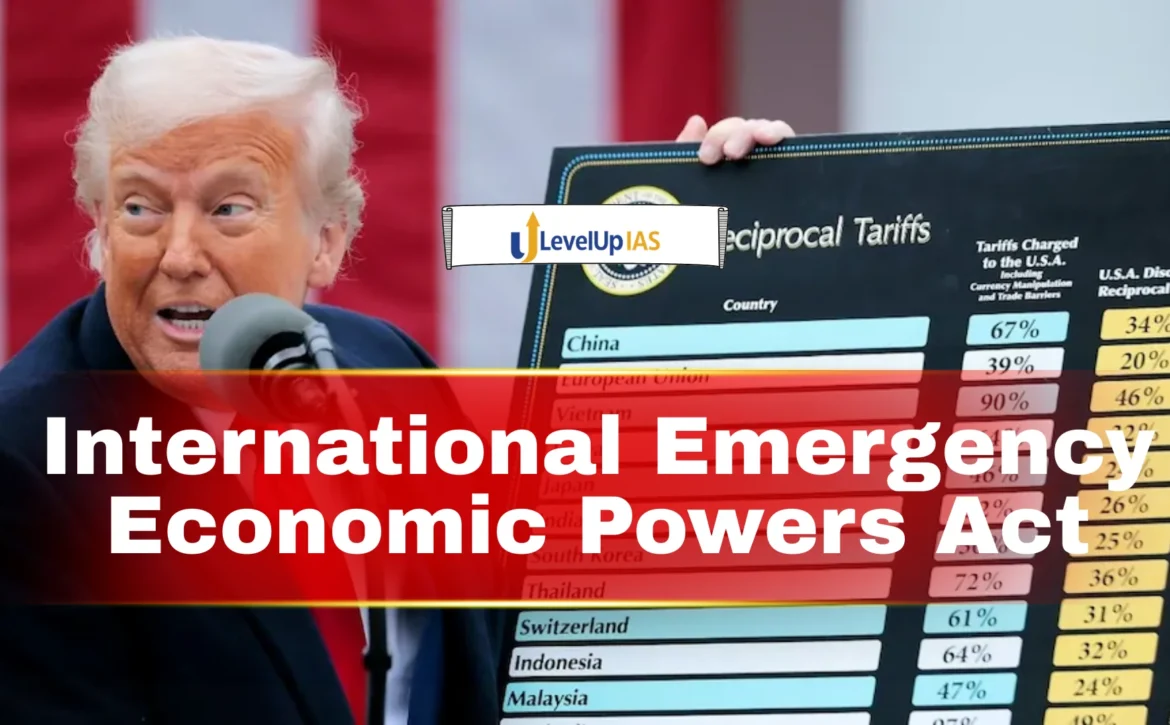
The International Emergency Economic Powers Act (IEEPA), 1977 has recently been in the news after legal challenges in the United States regarding the use of emergency powers to impose trade tariffs. Courts have examined whether the law allows the US President to use emergency powers to impose broad tariffs on foreign countries, raising debates about the limits of executive authority in economic policy.
This has revived global discussions on the use of economic sanctions and emergency powers as tools of foreign policy.
About the International Emergency Economic Powers Act (IEEPA)
- The International Emergency Economic Powers Act (IEEPA) is a United States federal law enacted in 1977 that authorises the President to regulate international economic transactions during a national emergency arising from external threats. The law empowers the executive branch to take economic measures such as sanctions, asset freezes, and restrictions on financial transactions to safeguard national security and foreign policy interests.
- The Act was signed into law by President Jimmy Carter on 28 December 1977 as part of broader reforms aimed at regulating emergency powers and strengthening Congressional oversight.
- Under the provisions of the Act, the President can act when there is an “unusual and extraordinary threat” originating outside the United States that affects its national security, foreign policy, or economy. Once such a threat is declared through a national emergency, the President may regulate or prohibit certain economic transactions involving foreign entities.
Thus, the Act serves as a key legal framework for the United States to conduct economic statecraft, especially through sanctions and financial restrictions.
Historical Background
- The enactment of the IEEPA must be understood in the context of earlier emergency powers legislation in the United States. Before 1977, presidential economic emergency powers were primarily derived from the Trading with the Enemy Act (TWEA) of 1917, which granted broad authority to the executive branch during wartime and later during national emergencies.
- However, over time, concerns emerged regarding excessive executive powers. Investigations in the 1970s revealed that several national emergency declarations had remained in force for decades without proper review. As a response, the US Congress passed the National Emergencies Act (NEA) of 1976, which introduced procedures for declaring and terminating emergencies.
- Subsequently, the IEEPA was enacted in 1977 to replace many of the sweeping economic powers previously available under the Trading with the Enemy Act during peacetime. The new law sought to strike a balance between executive flexibility in crises and democratic oversight by Congress.
Key Features of the IEEPA
The Act provides the US President with several important powers during declared national emergencies involving external threats.
- First, the President may block or freeze assets belonging to foreign governments, individuals, or organisations that are considered threats to national security or foreign policy interests. This mechanism is widely used to impose financial sanctions.
- Second, the law allows the executive branch to regulate international financial transactions, including foreign exchange transfers, banking operations, and investment flows involving targeted entities.
- Third, the President can restrict imports, exports, or other economic transactions with certain countries or organisations if they are linked to security threats such as terrorism, nuclear proliferation, or cyber warfare.
- Another important provision is that the exercise of these powers must be linked to a formal declaration of national emergency under the National Emergencies Act. This ensures that such powers are used only under exceptional circumstances and not as routine economic policy.
- The law also requires periodic reporting to Congress, providing a mechanism for legislative oversight of executive actions taken under the Act.
Use of the Act in US Foreign Policy
Since its enactment, the IEEPA has become one of the most important legal tools for implementing economic sanctions in US foreign policy.
The Act has been used to impose sanctions against hostile states, terrorist organisations, and individuals involved in activities such as nuclear proliferation, cyber attacks, and corruption. After the September 11 attacks, the Act was widely used to freeze the assets of individuals and organisations suspected of financing terrorism.
Over time, successive US administrations including those of George W. Bush, Barack Obama, Donald Trump, and Joe Biden have relied on the Act to implement sanctions regimes targeting countries such as Iran, North Korea, and Russia.
Because of this widespread use, the IEEPA is often regarded as the cornerstone of the United States’ sanctions policy.
Recent Legal Controversies
- The scope of presidential authority under the IEEPA has recently become a subject of legal debate in the United States. In recent years, attempts were made to use the Act to justify the imposition of broad tariffs on foreign countries by declaring economic emergencies.
- However, courts have questioned whether the Act actually grants such powers. Legal experts argue that the Act was primarily designed as a sanctions mechanism rather than a general trade policy tool.
- Some judicial rulings have suggested that using the Act to impose large-scale tariffs may exceed the authority granted by Congress. These developments have raised broader constitutional questions regarding the balance of power between the executive branch and Congress in matters of trade and economic policy.
The outcome of such legal disputes could redefine the future scope of presidential economic emergency powers in the United States.
Significance of the IEEPA
The International Emergency Economic Powers Act plays an important role in modern global geopolitics and economic diplomacy.
- First, it enables the United States to respond quickly to international crises without resorting to military intervention. Economic sanctions imposed under the Act are often used as a tool to pressure states or organisations involved in activities perceived as threats.
- Second, the Act demonstrates how economic instruments can be used to achieve strategic objectives in international relations. Financial sanctions, asset freezes, and trade restrictions can significantly influence the behaviour of targeted actors.
- Third, the law reflects the broader evolution of economic statecraft, where economic measures are increasingly used alongside diplomatic and military tools to pursue national interests.
Concerns and Criticism
Despite its importance, the IEEPA has faced criticism from scholars and policymakers.
- One concern is that the law grants broad discretionary powers to the executive branch, which could potentially lead to misuse or overreach. Critics argue that the vague definition of “unusual and extraordinary threats” may allow the government to justify emergency measures in a wide range of circumstances.
- Another criticism relates to the long duration of national emergencies declared under the Act. Many emergency declarations remain in force for years, raising questions about whether temporary emergency powers are becoming permanent policy tools.
- There are also debates about the impact of economic sanctions on global trade and humanitarian conditions, particularly when sanctions affect ordinary citizens in targeted countries.
Conclusion
The International Emergency Economic Powers Act (IEEPA), 1977 remains one of the most influential legal instruments in US foreign policy and economic governance. By granting the President authority to impose economic restrictions during national emergencies, the Act enables swift responses to international threats while maintaining mechanisms of Congressional oversight.
However, ongoing legal debates and evolving geopolitical challenges continue to test the boundaries of this legislation. The future interpretation of the Act will play an important role in shaping the balance between executive authority, democratic accountability, and the use of economic tools in international relations.