Strait of Hormuz, A Strategic Chokepoint
Content
- Introduction
- Location
- Strategic Importance
- Geopolitical Chokepoint
- Recent News
- Importance for India
- Alternatives to the Strait
- Challenges and Security Concerns
Introduction
The Strait of Hormuz is one of the most strategically important maritime chokepoints in the world. It connects the oil-rich Persian Gulf with the Gulf of Oman, which further opens into the Arabian Sea and the Indian Ocean. Because it serves as the only sea route for exporting petroleum from the Persian Gulf, the strait holds immense geopolitical and economic significance.
The strait has recently come into global focus due to tensions between Iran and the United States, raising concerns that disruptions in the waterway could severely affect global energy supplies.
Location and Geographical Features
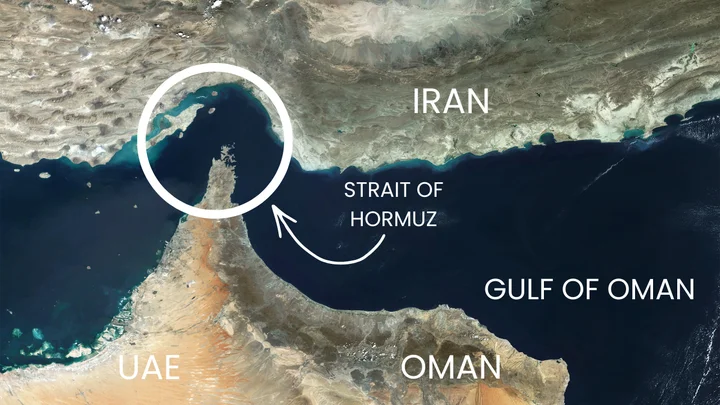
- The Strait of Hormuz lies between the northern coast of Iran and the Musandam Peninsula, which belongs to Oman and the United Arab Emirates. It forms a narrow maritime corridor linking the Persian Gulf to the wider Indian Ocean through the Gulf of Oman.
- Geographically, the strait is approximately 167 km long, and at its narrowest point it is only about 33 km wide, making it extremely vulnerable to military blockades or disruptions.
- Shipping through the strait follows a traffic separation scheme in which vessels move through two narrow shipping lanes in opposite directions. This design reduces the risk of collisions but also highlights the vulnerability of the route because all major tanker traffic must pass through a very limited corridor.
Why the Strait of Hormuz is Strategically Important
The Strait of Hormuz is often described as the world’s most important oil chokepoint. A significant portion of global energy trade flows through this narrow maritime route.
- A large share of global oil exports from countries such as Saudi Arabia, Iraq, Kuwait, Qatar, and the UAE must pass through the strait before reaching international markets. Around one-fifth of global oil consumption and a major share of liquefied natural gas (LNG) shipments transit through the strait every day.
- Because most Gulf countries depend on maritime exports, the strait functions as a critical artery for the global energy system. Any disruption in this route can cause immediate volatility in oil prices and global markets.
Strait of Hormuz as a Geopolitical Chokepoint
Several major oil-exporting and oil-importing countries rely heavily on this maritime route.
- Oil-exporting states such as Saudi Arabia, Iraq, Kuwait, Iran, and the UAE use the strait to transport petroleum to global markets. At the same time, large energy-importing economies such as India, China, Japan, and South Korea depend on these supplies.
- For India in particular, a significant portion of crude oil and LNG imports originates from the Gulf region and must pass through the Strait of Hormuz. This makes the strait crucial for India’s energy security and economic stability.
- A maritime chokepoint refers to a narrow sea passage that is critical for global trade and energy transportation. The Strait of Hormuz is considered the most significant chokepoint due to its combination of narrow geography and massive energy flows.
- Control over this passage gives significant geopolitical leverage. Iran’s location along the northern coast allows it to influence or threaten shipping movements. Analysts often highlight that Iran could potentially disrupt traffic through measures such as naval mines, missile strikes, or harassment of commercial vessels.
Because of this strategic importance, several international naval forces maintain a strong presence in the region to ensure freedom of navigation.
Strait of Hormuz in Recent News
The strait has frequently appeared in global headlines due to geopolitical tensions in West Asia.
- Recent military escalation involving Iran has again raised fears of a blockade or disruption of the strait. Any closure of the passage could halt the transit of nearly 20 million barrels of oil per day, which accounts for roughly 20% of global oil supply.
- Recent conflicts have already reduced shipping activity in the strait and raised insurance costs for oil tankers, highlighting the vulnerability of global energy supply chains.
- Because energy-importing economies depend heavily on this route, instability in the strait can trigger global economic uncertainty and sharp fluctuations in oil prices.
Strategic and Economic Importance for India
- For India, the Strait of Hormuz is particularly significant because of the country’s heavy dependence on imported energy.
- India imports a large portion of its crude oil from the Gulf region. A substantial share of these shipments passes through the Strait of Hormuz before reaching Indian ports. Therefore, any disruption in the strait directly affects India’s energy security, fuel prices, and economic stability.
India closely monitors developments in the region and often engages in diplomatic efforts to maintain stability and ensure uninterrupted maritime trade.
Alternatives to the Strait of Hormuz
Although several alternative routes exist, they cannot fully replace the Strait of Hormuz.
- Some Gulf countries have built pipelines that bypass the strait, such as the UAE’s Habshan-Fujairah pipeline, which allows oil exports through the Gulf of Oman without passing through Hormuz. However, the capacity of such pipelines is limited compared to the massive volume of oil transported through the strait.
As a result, the global energy system remains highly dependent on the continued functioning of this narrow waterway.
Challenges and Security Concerns
Several challenges threaten the stability of the Strait of Hormuz.
- First, the region is located in one of the most geopolitically volatile areas of the world. Rivalries among regional powers and tensions between Iran and Western countries frequently raise fears of conflict.
- Second, the narrow geography of the strait makes shipping highly vulnerable to disruption. Even small-scale military incidents can affect global trade.
- Third, rising insurance costs and security risks during periods of conflict can discourage shipping companies from using the route, thereby affecting global supply chains.
Conclusion
The Strait of Hormuz is not merely a geographical feature but a critical geopolitical and economic chokepoint that connects the energy resources of the Persian Gulf with global markets. Its strategic location between Iran and the Arabian Peninsula makes it central to global maritime trade and energy security.
Recent geopolitical tensions in West Asia have once again highlighted the vulnerability of this narrow waterway. For countries like India that depend heavily on Gulf energy supplies, stability in the Strait of Hormuz remains essential for economic security and international trade.