The Essential Commodities Act, 1955 (ECA)
Content
- Why in News
- Introduction
- Historical Background
- Objectives of the Act
- Key Provisions
- Commodities Covered
- Amendment in 2020
- Significance of the Act
- Criticisms and Challenges
Why in News?
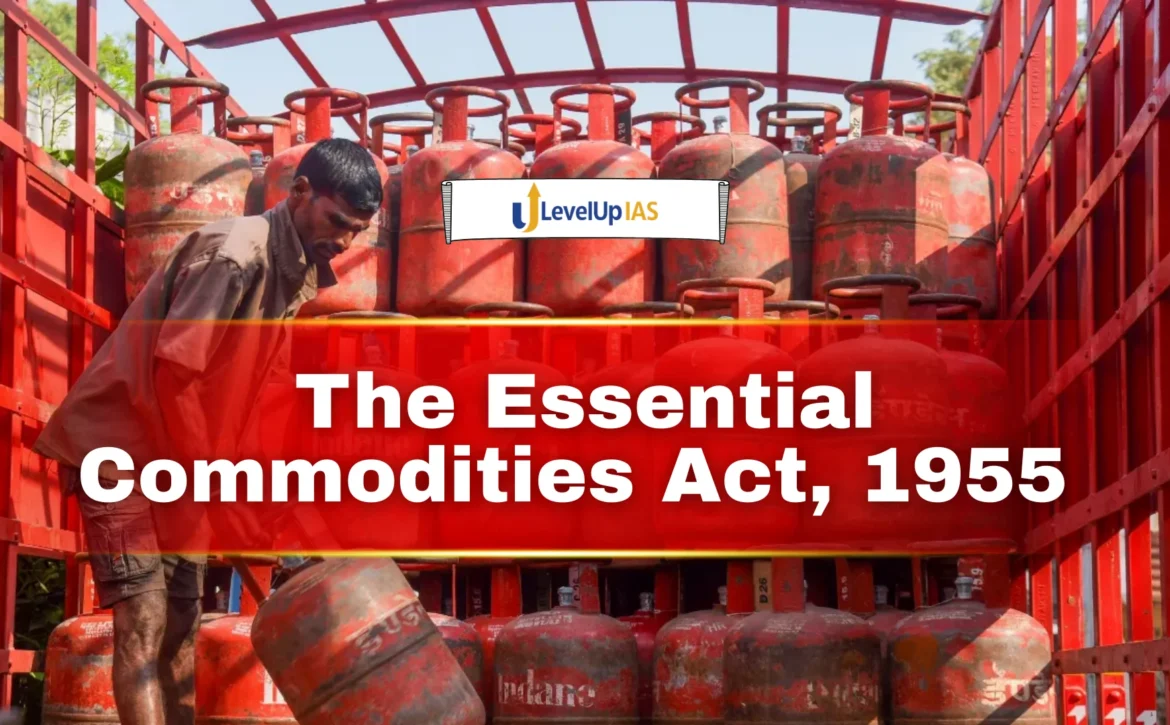
Recently, the Indian government invoked the Act to ensure adequate supply of LPG and natural gas amid disruptions in global energy markets linked to geopolitical tensions in West Asia. The government directed refineries and gas suppliers to prioritize production and allocation for essential sectors such as household cooking gas and transport fuel.
The Essential Commodities Act, 1955 frequently appears in news when the government intervenes to regulate supply and prices of essential goods such as food grains, pulses, onions, or petroleum products.
Introduction
The Essential Commodities Act, 1955 is a major economic regulation law enacted by the Parliament of India to ensure the availability of essential goods to consumers at reasonable prices. The Act empowers the central government to regulate the production, supply, distribution, and trade of commodities considered essential for daily life.
The legislation was introduced in the early years after independence when India faced severe shortages of food and other basic goods. Its primary objective was to prevent hoarding and black marketing while ensuring equitable distribution of essential commodities across the country.
Historical Background
- The Essential Commodities Act emerged during a time when India faced acute food shortages and supply constraints. The government needed legal mechanisms to regulate markets and prevent traders from manipulating prices through hoarding.
- The constitutional foundation for the Act was provided by the Constitution (Third Amendment) Act, 1954, which expanded the scope of the Concurrent List to include trade and distribution of essential commodities. This enabled both the Union and the states to legislate and regulate the supply of important goods.
- When the Act was enacted in 1955, India’s agricultural production was low and the country depended heavily on imports to meet food demand. Therefore, strong regulatory powers were necessary to maintain price stability and protect consumers.
Objectives of the Essential Commodities Act
The Act was designed with several key objectives aimed at safeguarding public welfare and ensuring economic stability.
The first objective is to ensure the continuous availability of essential commodities such as food grains, petroleum products, and medicines. These goods are crucial for the daily life of citizens and for maintaining national economic stability.
Second, the Act aims to control inflation and price volatility by allowing the government to intervene when prices rise sharply due to shortages or market manipulation.
Third, the legislation seeks to prevent hoarding and black marketing, which can artificially create scarcity and lead to excessive price increases.
Finally, the Act enables the government to regulate the supply chain, including production, storage, and distribution, so that essential goods reach consumers in a fair and efficient manner.
Key Provisions of the Essential Commodities Act
The Act provides extensive powers to the government to regulate essential commodities in the public interest.
1. Regulation of Production, Supply and Distribution
Under Section 3 of the Act, the central government can regulate or prohibit the production, supply, and distribution of essential commodities if it considers such regulation necessary for maintaining availability and fair prices. This provision allows the government to issue orders related to production quotas, storage limits, transportation restrictions, and distribution mechanisms.
2. Imposition of Stock Limits
One of the most significant provisions of the Act is the power to impose stock limits. These limits restrict the quantity of a commodity that traders or businesses can store. Stock limits are primarily used to prevent hoarding and ensure that commodities remain available in the market.
3. Control Orders
The government may issue control orders to regulate different aspects of the supply chain. These orders may include restrictions on storage, transport, and sale of essential commodities. State governments are responsible for enforcing these orders through inspections, raids, and penalties against violators.
4. Penalties and Enforcement
Violations of the Act can lead to strict penalties including fines, imprisonment, or confiscation of stocks. These provisions act as deterrents against illegal hoarding and black marketing.
Essential Commodities Covered Under the Act
The Act does not maintain a permanently fixed list of commodities. Instead, the central government has the authority to notify items as essential depending on economic conditions.
Traditionally, commodities covered under the Act have included:
- Food grains such as wheat and rice
- Pulses
- Edible oils and oilseeds
- Sugar
- Fertilizers
- Petroleum and petroleum products
- Drugs and medicines
The flexibility of the Act allows the government to add or remove commodities depending on national needs.
Essential Commodities (Amendment) Act, 2020
A major reform of the Act was introduced through the Essential Commodities (Amendment) Act, 2020, which aimed to liberalize agricultural markets and encourage private investment.
The amendment removed several agricultural commodities such as cereals, pulses, onions, potatoes, edible oils, and oilseeds from routine regulation. These commodities can now be regulated only under extraordinary circumstances, including war, famine, natural calamities, or extraordinary price rises.
The amendment also introduced a price trigger mechanism for imposing stock limits.
- For horticultural produce, stock limits can be imposed when retail prices rise by 100%.
- For non-perishable food items, stock limits can be imposed when prices increase by 50%.
The price increase is calculated based on either the previous year’s price or the average price of the last five years, whichever is lower.
The amendment also exempted processors and value chain participants from stock limits if their stock levels remain within their processing capacity or export requirements.
Significance of the Essential Commodities Act
The Essential Commodities Act continues to play an important role in India’s economic and social framework.
First, it acts as a consumer protection mechanism by ensuring that essential goods remain available at reasonable prices.
Second, the Act enables the government to manage inflation during supply shocks, particularly in essential food commodities such as onions and pulses.
Third, it functions as a deterrent against hoarding and black marketing, which can artificially inflate prices and disrupt markets.
Fourth, the Act provides the government with the ability to intervene during emergencies, including natural disasters, wars, or pandemics.
For example, during the COVID-19 pandemic, items such as face masks and hand sanitizers were temporarily declared essential commodities to prevent hoarding and price manipulation.
Criticisms and Challenges
Despite its importance, the Essential Commodities Act has been criticized on several grounds.
- One major criticism is that excessive market regulation may discourage private investment in agricultural infrastructure such as warehouses and cold storage facilities. Investors may hesitate to invest if stock limits can be imposed unpredictably.
- Another concern is that the Act may distort market signals by interfering with natural supply and demand mechanisms.
- Some critics also argue that frequent government intervention can create uncertainty in agricultural markets, affecting farmers, traders, and supply chain participants.
However, supporters of the Act argue that such regulatory powers remain necessary in a developing economy where supply chains are vulnerable to disruptions and market manipulation.
Conclusion
The Essential Commodities Act, 1955 remains a critical legislative tool for regulating essential goods in India. While economic reforms and the 2020 amendment have attempted to liberalize agricultural markets and encourage private investment, the Act still provides the government with the authority to intervene during crises.
In a country where food security and price stability remain key policy priorities, the Act represents a balance between market freedom and state intervention, ensuring that essential goods remain accessible and affordable for the population.