Terminal High Altitude Area Defence (THAAD)
Content
Why in News?
THAAD has been in news due to its deployment in conflict zones such as West Asia, especially amid rising tensions involving Iran and Israel, highlighting its role in modern missile defence systems.
What is THAAD?
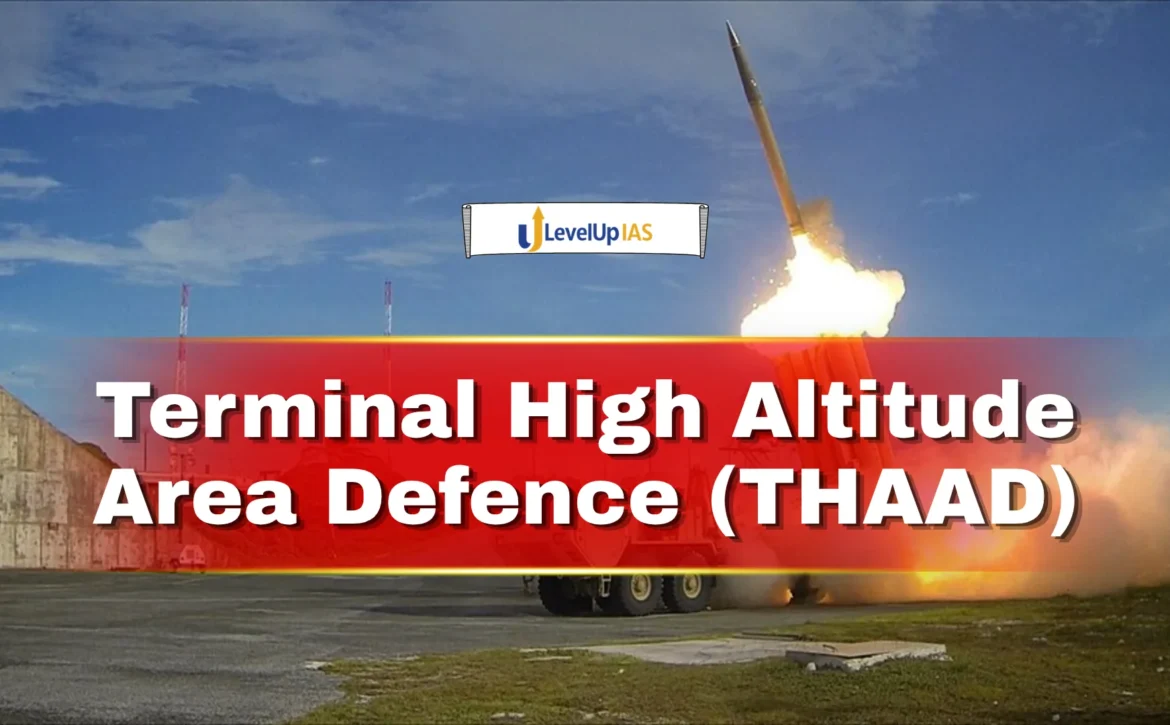
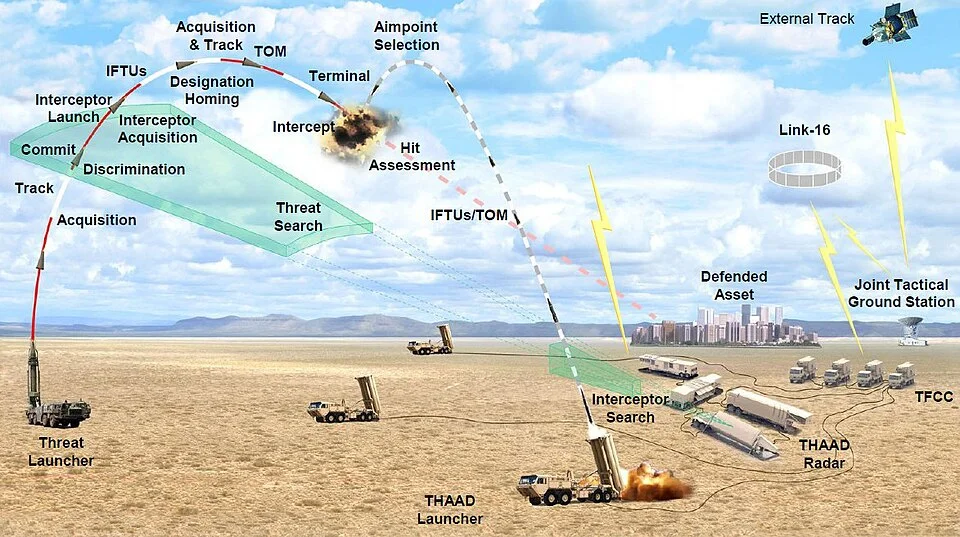
THAAD (Terminal High Altitude Area Defence) is an advanced anti-ballistic missile defence system developed by the United States. It is designed to intercept and destroy short, medium, and intermediate-range ballistic missiles during their terminal phase (last stage of flight).
A key feature that distinguishes THAAD is its ability to operate both inside (endo-atmospheric) and outside (exo-atmospheric) the Earth’s atmosphere, making it a crucial layer in missile defence architecture.
Key Features
- THAAD uses “hit-to-kill” technology, meaning it destroys incoming missiles through direct kinetic impact rather than using explosive warheads. This reduces the risk of dispersing nuclear or chemical payloads.
- The system consists of several integrated components, including interceptor missiles, truck-mounted launchers, a powerful AN/TPY-2 X-band radar, and a command and control unit.
- It has an engagement range of around 150–200 km and can intercept targets at high altitudes, bridging the gap between lower-tier systems like Patriot and higher systems like Aegis.
- The radar system is highly advanced and capable of detecting missile threats at long distances, enabling early tracking and interception.
Strategic Importance
- From a defence perspective, THAAD forms a critical part of a multi-layered Ballistic Missile Defence (BMD) system. It enhances a country’s ability to defend against missile attacks, especially in high-threat regions.
- In international relations, THAAD deployments often create geopolitical tensions. For instance, its deployment by the United States or its allies is often opposed by countries like China and Russia, as it can alter regional strategic balance and surveillance capabilities.
- The system is particularly relevant in regions such as West Asia and East Asia, where missile threats are high. Its deployment signals military preparedness and strategic deterrence.
Limitations
Despite its advanced capabilities, THAAD has certain limitations. It is expensive to deploy and maintain, making it accessible only to technologically advanced countries. Additionally, its deployment can escalate regional tensions and trigger arms races.
Conclusion
THAAD represents a significant advancement in missile defence technology, combining precision, mobility, and high-altitude interception capability. Its growing use in global conflict zones highlights the increasing importance of missile defence systems in modern warfare and international politics.