Appropriation Bill
Content
- Why in News?
- Introduction
- Constitutional Provisions
- Features of the Appropriation Bill
- Procedure for Passing the Appropriation Bill
- Appropriation Bill vs Finance Bill
- Conclusion
Why in News?
The Parliament has passed the Appropriation Bill 2026, with the Rajya Sabha returning it to the Lok Sabha after discussion. The Finance Minister defended the government’s budgeting approach as transparent and realistic, highlighting the importance of parliamentary approval in public expenditure.
Introduction
The Appropriation Bill is a crucial component of India’s budgetary process, as it provides the legal authority to the government to withdraw funds from the Consolidated Fund of India for meeting its expenditure during a financial year. Without the passage of this bill, the government cannot legally spend any money, making it an essential instrument of financial control by Parliament.
Constitutional Provisions
The Appropriation Bill derives its constitutional basis primarily from Article 114 of the Constitution, which mandates that no money can be withdrawn from the Consolidated Fund of India except under an appropriation made by law.
It is also classified as a Money Bill under Article 110, which means it can only be introduced in the Lok Sabha, and the Rajya Sabha has limited powers with respect to it. Additionally, Article 116 provides for a Vote on Account, allowing temporary withdrawal of funds when the Appropriation Bill is yet to be enacted.
Features of the Appropriation Bill
The Appropriation Bill includes both voted expenditure (approved by the Lok Sabha through Demands for Grants) and charged expenditure (which is not subject to vote, such as salaries of constitutional authorities).
A key feature is that no amendments are allowed that would alter the amount or purpose of expenditure once the Demands for Grants have been approved. This ensures that the financial decisions of the Lok Sabha remain final.
Further, the bill contains details of how much money is to be withdrawn and for what purposes, ensuring transparency and accountability in public expenditure.
Procedure for Passing the Appropriation Bill
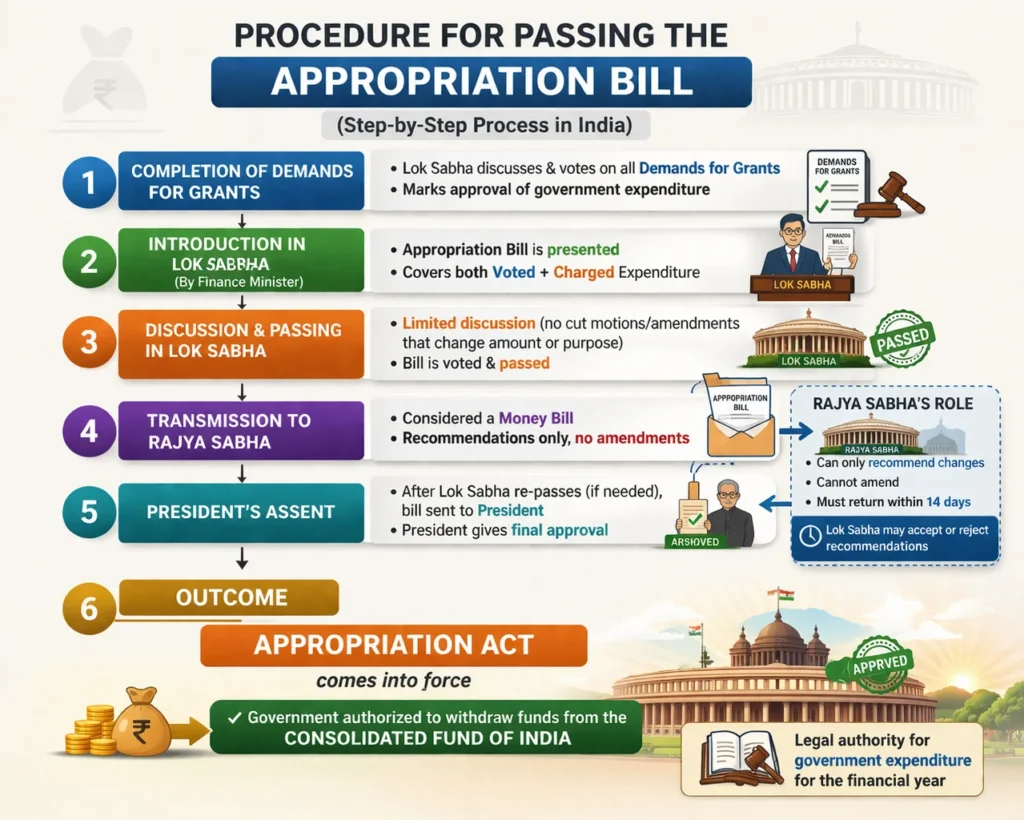
- The Appropriation Bill is introduced in the Lok Sabha after the completion of discussion and voting on the Demands for Grants. Since only the Lok Sabha has the power to vote on demands, this stage reflects the approval of expenditure by the directly elected House. The bill is then formally presented by the Finance Minister as a part of the budgetary process.
- Once introduced, the bill is taken up for consideration in the Lok Sabha. At this stage, the scope of discussion is limited, as the details of expenditure have already been debated during the Demands for Grants. Importantly, no amendments are permitted that would alter the amount or the purpose of expenditure, ensuring that the decisions already taken by the Lok Sabha remain final. After discussion, the bill is put to vote and passed.
- The Appropriation Bill is then transmitted to the Rajya Sabha. Being a Money Bill, the Rajya Sabha does not have the power to amend it; it can only make recommendations. The Upper House must return the bill within 14 days, and the Lok Sabha has the discretion to either accept or reject these recommendations.
- After being passed by Parliament, the bill is sent to the President for assent. Upon receiving the President’s approval, it becomes the Appropriation Act, which provides the legal authority to the government to withdraw funds from the Consolidated Fund of India and incur expenditure for the specified financial year.
Appropriation Bill vs Finance Bill
| Aspect | Appropriation Bill | Finance Bill |
| Purpose | Authorises withdrawal of money from Consolidated Fund for expenditure | Deals with taxation and revenue proposals |
| Stage | After Demands for Grants are passed | Presented along with the Budget |
| Content | Expenditure (voted + charged) | Taxes, duties, fiscal measures |
| Amendments | Not allowed to change amount or purpose | Amendments possible (as per rules) |
| Outcome | Becomes Appropriation Act | Becomes Finance Act |
Conclusion
The Appropriation Bill is a cornerstone of India’s financial governance framework, linking the budget proposals to actual government expenditure. Its passage ensures continuity of governance while reinforcing parliamentary oversight over public finances.
In the context of the Appropriation Bill 2026, it highlights the importance of fiscal transparency, legislative scrutiny, and the constitutional mandate governing public expenditure in India.