India-Canada Uranium Deal 2026

Content
- Why in News?
- Key Features of the Deal
- India’s Dependence on Imported Uranium
- Growing Demand
- Strategic Significance of the Deal
- India’s Global Uranium Supply Network
- Link with India’s Three-Stage Nuclear Programme
- Challenges
- Conclusion
Why in News?
India and Canada have signed a long-term uranium supply agreement, under which the Canadian company Cameco will supply about 22 million pounds ( around 10,000 tonnes) of uranium to India between 2027 and 2035. The deal is valued at approximately 2.6 billion Canadian dollars.
Key Features of the Deal
The India-Canada uranium deal marks a significant step in strengthening India’s nuclear energy programme and energy security. As India aims to expand its nuclear power capacity substantially, securing a stable and diversified supply of uranium becomes critical.
- This agreement is also notable in the context of reviving bilateral relations and enhancing cooperation in the strategic energy sector.
- The agreement ensures a long-term and reliable supply of uranium to fuel India’s nuclear reactors. It covers a period of eight years (2027-2035), thereby providing stability in fuel availability.
- It is India’s second major uranium supply agreement within a short period, following a similar arrangement with Kazatomprom, reflecting India’s strategy of diversifying its import sources.
- The deal also highlights the role of private global suppliers like Cameco in supporting India’s civilian nuclear energy expansion.
India’s Dependence on Imported Uranium
India possesses uranium reserves; however, the quality of domestic uranium ore is relatively low, with concentrations ranging between 0.02% and 0.45%, compared to the global average of 1-2%. In contrast, countries like Canada have significantly higher-grade deposits.
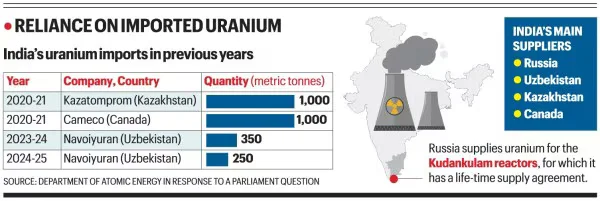
Due to this limitation, over 70% of India’s uranium requirements are met through imports, making external supply agreements crucial for sustaining nuclear power generation.
At the same time, domestic production remains strategically important as it supports India’s nuclear weapons programme and provides a buffer against global supply disruptions.
Growing Demand and Capacity Expansion
India’s current uranium consumption is estimated at around 1,500-2,000 tonnes annually, and this demand is expected to increase significantly with the planned expansion of nuclear energy.
The government aims to increase nuclear power capacity from about 9 GW at present to nearly 100 GW by 2047, as part of its long-term clean energy strategy.
Consequently, uranium demand could rise to around 5,400 tonnes annually, while domestic production is expected to meet only about 30% of the requirement, reinforcing the need for imports.
Domestic Uranium Resources
India’s uranium production is concentrated in states such as Jharkhand and Andhra Pradesh, with additional deposits found in Meghalaya, Rajasthan, and Telangana.
The country’s total uranium resources are estimated at around 4.3 lakh tonnes of ore, with a significant portion already exploited. Ongoing exploration activities across multiple states aim to identify new reserves and enhance domestic production capacity.
Strategic Significance of the Deal
The India-Canada uranium agreement strengthens India’s energy security by ensuring a stable supply of nuclear fuel. It also contributes to the diversification of import sources, reducing overdependence on any single country.
From an international relations perspective, the deal reflects an improvement in India-Canada bilateral ties, especially after a phase of diplomatic tensions. It also underscores the importance of energy diplomacy in securing critical resources.
Furthermore, nuclear energy plays a crucial role in India’s commitment to clean and low-carbon energy transition, making such agreements vital for achieving climate goals.
India’s Global Uranium Supply Network
With this deal, India continues to expand its uranium sourcing network, which already includes countries like Uzbekistan, Kazakhstan, Canada, and Russia.
Russia, in particular, has committed to long-term fuel supply for reactors such as those at Kudankulam. India is also exploring future partnerships with countries like Australia and the United States, along with opportunities for overseas mining.
Link with India’s Three-Stage Nuclear Programme
India’s nuclear energy strategy is based on a three-stage programme, which aims to eventually utilise the country’s vast thorium reserves.
The first stage relies on uranium-based reactors, making uranium supply agreements like the one with Canada essential in the short and medium term.
The second stage involves fast-breeder reactors, while the third stage aims to develop thorium-based reactors, ensuring long-term energy independence. However, progress in later stages remains gradual and technologically challenging.
Domestic Policy Support: Role of Atomic Energy Bill 2025
The India-Canada uranium deal also needs to be seen in the context of evolving domestic policy frameworks such as the Atomic Energy Bill 2025, which aims to modernise India’s nuclear energy sector. The bill seeks to liberalise aspects of nuclear energy development, encourage greater private sector participation, and improve regulatory efficiency.
In this context, securing long-term uranium supply agreements becomes crucial, as policy reforms alone cannot ensure energy expansion without adequate fuel availability. Thus, the external dimension of uranium import agreements and the internal dimension of legislative reforms together form a comprehensive strategy for strengthening India’s nuclear energy capacity.
Challenges
Despite these agreements, challenges remain in terms of high import dependence, fluctuating global uranium prices, and geopolitical risks affecting supply chains.
Additionally, the slow progress of the three-stage nuclear programme delays India’s transition towards thorium-based energy independence.
Conclusion
The India-Canada uranium deal represents a significant step towards strengthening India’s energy security, nuclear capacity expansion, and global partnerships. It highlights the growing importance of strategic resource diplomacy in achieving long-term economic and environmental objectives.