The Collegium System & Appointment of judges

Content
- Why in News?
- Introduction
- Genesis of the System
- Criticism of the System
- Steps Taken to Improve the System
- Way Forward
- Conclusion
Why in News?
The Collegium System continues to remain in focus due to ongoing debates over judicial appointments, transparency, and executive-judiciary relations, along with periodic disagreements between the judiciary and the government regarding appointments and transfers of judges.
Introduction
The appointment of judges in India is a crucial aspect of maintaining the independence of the judiciary, which is a part of the basic structure of the Constitution. Over time, the process has evolved from executive dominance to judicial primacy through judicial interpretation, resulting in the emergence of the Collegium System.
The Collegium System is not mentioned in the Constitution but has developed through a series of landmark Supreme Court judgments.
Constitutional Provisions:
The Constitution lays down the framework for judicial appointments under:
- Article 124 → Appointment of Supreme Court judges
- Article 217 → Appointment of High Court judges
- Article 222 → Transfer of High Court judges
The President appoints judges in consultation with the Chief Justice of India (CJI) and other judges, but the meaning of “consultation” has been interpreted over time through judicial decisions.
Genesis of the Collegium System in India
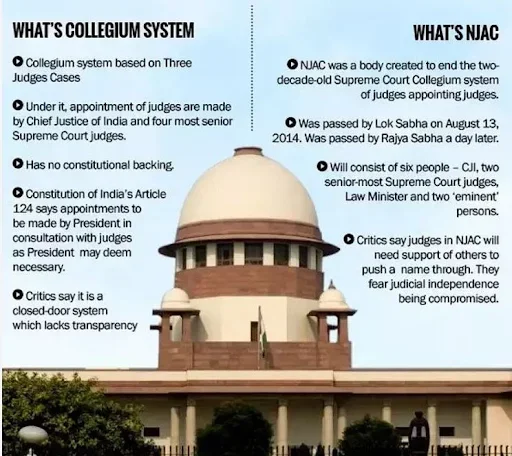
The Collegium System in India evolved through a series of landmark Supreme Court judgments, collectively known as the Judges Cases, which gradually shifted the power of judicial appointments from the executive to the judiciary.
- The process began with the S.P. Gupta v. Union of India (1981), also known as the First Judges Case, where the Supreme Court held that the term “consultation” in judicial appointments did not mean concurrence. This interpretation gave primacy to the executive in the appointment process.
- This position was significantly altered in the Supreme Court Advocates-on-Record Association v. Union of India (1993), known as the Second Judges Case. The Court reversed its earlier judgment and held that consultation effectively meant concurrence, thereby giving primacy to the judiciary. It also established that the advice of the Chief Justice of India (CJI), formed in consultation with 2 senior judges, would be binding on the President.
- The system was further refined in the Third Judges Case (1998), where the Court introduced the concept of a collegium of judges. It ruled that the CJI must consult a group of the four senior-most judges of the Supreme Court, thereby institutionalising a collective decision-making process. It also emphasised that if a significant number of judges expressed dissent, the recommendation should not be forwarded.
- An attempt to replace the Collegium System was made through the National Judicial Appointments Commission (NJAC) Act, 2014, which sought to include members from the executive and civil society. However, in 2015, the Supreme Court struck down the NJAC as unconstitutional, holding that it violated the basic structure doctrine, particularly the independence of the judiciary.
Criticism of the Collegium System
- Despite its role in ensuring judicial independence, the Collegium System has been widely criticised on several grounds. One of the most prominent concerns is the lack of transparency, as the decision-making process is largely opaque and the reasons for selecting or rejecting candidates are not publicly disclosed.
- The system has also been criticised for its inability to address judicial vacancies effectively, leading to a large backlog of cases. Persistent vacancies in High Courts and even in the Supreme Court have raised concerns about efficiency and access to justice.
- Another major criticism relates to allegations of nepotism and favouritism, often described as a “closed-door system.” Observations by bodies such as the Law Commission have pointed towards the influence of personal connections in appointments.
- Further, critics argue that the system undermines the principle of checks and balances, as it largely excludes the executive from the appointment process, thereby reducing accountability.
- There are also concerns regarding the lack of diversity, particularly the underrepresentation of women in the higher judiciary. This raises questions about inclusiveness and representativeness in judicial institutions.
- Additionally, the process of transfer of judges lacks transparency, as reasons are not disclosed, leading to apprehensions regarding arbitrariness and potential impact on judicial independence.
Steps Taken to Improve the System
Several measures have been undertaken to improve the process of judicial appointments.
- The 99th Constitutional Amendment Act, 2014 attempted to replace the Collegium System with the NJAC, but it was invalidated by the Supreme Court.
- Another important mechanism is the Memorandum of Procedure (MoP), which lays down the detailed process for judicial appointments.
- Initially framed in 1999, it provides guidelines for the selection and appointment of judges to the Supreme Court and High Courts, including the role of the Collegium and the executive.
- Following the NJAC judgment, the Supreme Court directed the government to revise the MoP to improve transparency and accountability. Although a revised draft was prepared, it has not been fully finalised or implemented, reflecting ongoing differences between the judiciary and the executive.
Way Forward
- To streamline judicial appointments, there is a need to reform the existing MoP by introducing greater transparency and clearly defined criteria for selection. At the same time, a balanced mechanism ensuring participation of both the judiciary and the executive can strengthen checks and balances without compromising judicial independence.
- Expanding the eligibility criteria to include a wider pool of candidates, including distinguished jurists and members of the Bar, can improve the quality of appointments.
- Ensuring greater diversity, particularly increased representation of women and underrepresented groups, is essential for a more inclusive judiciary.
- Transparency can be enhanced by maintaining records of deliberations, documenting reasons for decisions, and making certain aspects of the process publicly accessible.
- Recommendations by the Law Commission, such as increasing the retirement age of judges and ensuring broader representation in appointments, can also be considered to improve institutional efficiency.
Conclusion
The Collegium System represents a unique evolution of judicial independence in India. While it has successfully safeguarded the autonomy of the judiciary, its limitations highlight the need for balanced reforms that ensure transparency, accountability, and inclusiveness, while preserving the core principle of judicial independence.
Visit LevelUp IAS- Click Here