Socio-Religious Reform Movements
Content
- Introduction
- Background and Causes
- Nature and Characteristics
- Major Socio-Religious Reform Movements
- Role in Social Transformation
- Contribution to Nationalism
- Limitations
- Women and Reform Movements
- Conclusion
- FAQs
Introduction
The socio-religious reform movements of the 19th and early 20th centuries represent a crucial phase in India’s transition from a traditional to a modern society. These socio-religious reform movements emerged as a response to social evils, religious orthodoxy, and colonial critique, and played a significant role in shaping modern Indian consciousness.
They sought to reform Indian society by addressing issues such as caste discrimination, gender inequality, illiteracy, and superstitions, while simultaneously reviving the ethical and philosophical foundations of Indian religions. These movements laid the groundwork for social transformation, national awakening, and the eventual freedom struggle.
Background and Causes
- The emergence of socio-religious reform movements was influenced by a combination of internal and external factors. One of the major drivers was the impact of British colonial rule, which introduced Western education, rational thinking, and modern scientific ideas. This exposure led Indian intellectuals to critically examine existing social practices and institutions.
- At the same time, Christian missionaries criticised Indian society for practices such as sati, child marriage, and caste discrimination, which created a sense of urgency among Indian reformers to defend and reform their traditions.
- The growth of a new middle class, educated in Western thought yet rooted in Indian culture, played a crucial role in initiating reform movements. This class sought to reconcile tradition with modernity and promote a more rational and humane social order.
Nature and Characteristics of Reform Movements
The socio-religious reform movements in India were diverse in nature but shared certain common characteristics.
- They emphasised rationalism, humanism, and social equality, while rejecting blind faith and superstitious practices.
- Many movements aimed at reviving the original purity of religious texts, arguing that social evils had crept in due to misinterpretations over time.
- At the same time, they advocated reforms such as women’s education, widow remarriage, and abolition of caste-based discrimination.
- These movements also utilised modern tools such as print media, education, and public debates to spread awareness and mobilise support.
Major Socio-Religious Reform Movements in India
| Movement / Mission | Founder / Leader | Core Ideas & Objectives (Detailed) |
| Brahmo Samaj | Raja Ram Mohan Roy | -It was one of the earliest reform movements that promoted monotheism and strongly opposed idol worship and priestly dominance. -It worked actively against social evils such as sati, child marriage, and caste discrimination, while advocating women’s rights, widow remarriage, and modern Western education. |
| Arya Samaj | Swami Dayanand Saraswati | -It emphasised a return to the pristine authority of the Vedas as the ultimate source of knowledge. -The movement rejected idol worship and ritualism, promoted social equality, education (especially through Gurukuls), and undertook the Shuddhi movement to reconvert those who had left Hinduism. |
| Prarthana Samaj | Atmaram Pandurang | -Inspired by the Brahmo Samaj, it adopted a moderate reformist approach focusing on social issues such as widow remarriage, women’s education, and abolition of caste restrictions. -It emphasised devotion combined with gradual social reform rather than radical change. |
| Ramakrishna Mission | Swami Vivekananda | -Based on the teachings of Ramakrishna Paramahansa, it propagated the philosophy of practical Vedanta, emphasising service to humanity as the highest form of worship. -It promoted religious tolerance, universalism, and engaged in extensive social service activities like education, healthcare, and relief work. |
| Aligarh Movement | Sir Syed Ahmed Khan | -It aimed at modernising Muslim society by promoting Western scientific education and rational thinking. -It encouraged Muslims to embrace modern knowledge while maintaining their cultural identity, leading to the establishment of the Aligarh Muslim University. |
| Deoband Movement | Darul Uloom Deoband | -It focused on the revival and preservation of Islamic teachings through traditional religious education. -The movement emphasised moral discipline, adherence to Islamic principles, and resistance to Western cultural influence. |
| Singh Sabha Movement | Sikh reform leaders | -It aimed to revive and purify Sikhism by removing superstitions and external influences. -The movement worked to strengthen Sikh identity, promote education, and standardise religious practices and literature. |
| Young Bengal Movement | Henry Louis Vivian Derozio | -It promoted radical ideas of rationalism, free thought, and individual liberty among the youth. -The movement strongly criticised orthodox traditions and encouraged questioning of social and religious practices. |
| Theosophical Society (India) | Annie Besant | -It advocated universal brotherhood, revival of ancient religions and philosophies, and promoted spiritual development. -It also contributed to education and played a role in India’s nationalist awakening. |
| Satyashodhak Samaj | Jyotiba Phule | -It focused on the upliftment of lower castes and challenged Brahmanical dominance. -The movement promoted education among oppressed sections, women’s rights, and social equality. |
| Servants of India Society | Gopal Krishna Gokhale | -It aimed at training individuals for national service and social reform. -The organisation worked in areas such as education, public health, and social welfare with a strong sense of duty towards nation-building. |
| SNDP Movement | Sri Narayana Guru | -It worked for the upliftment of the Ezhava community in Kerala by promoting social equality, education, and reforming caste-based discrimination. -It emphasised the principle of “One Caste, One Religion, One God for mankind.” |
Role in Social Transformation
- The socio-religious reform movements played a foundational role in transforming Indian society by challenging deeply entrenched social hierarchies and orthodox practices. Reformers questioned the legitimacy of rigid caste divisions, untouchability, and hereditary privileges, thereby promoting the idea of social equality and human dignity.
- They were instrumental in addressing major social evils such as sati, child marriage, female infanticide, and restrictions on widow remarriage, which had long constrained societal progress. Through sustained efforts, these movements led to legislative interventions, including the abolition of sati and legalisation of widow remarriage.
- Another crucial dimension of transformation was the spread of modern education, especially among women and marginalised communities. Reformers established schools, colleges, and institutions that combined Western knowledge with Indian values, thereby creating a new class of educated individuals.
- Furthermore, these movements promoted rationalism and scientific temper, encouraging people to question superstitions and blind faith. The use of print media, public debates, and vernacular languages helped in disseminating reformist ideas to a wider audience, thereby laying the foundation of a modern, progressive society.
Contribution to Nationalism
- The socio-religious reform movements significantly contributed to the rise of Indian nationalism by fostering a sense of cultural pride and intellectual awakening. By reinterpreting ancient Indian texts and philosophies in a rational and modern framework, reformers countered colonial narratives that portrayed Indian society as backward and inferior.
- These movements helped in creating a shared cultural consciousness, which transcended regional and sectarian boundaries. This emerging sense of unity became a crucial factor in the development of nationalist sentiments.
- The emphasis on social reform also complemented the political struggle for independence, as both aimed at building a just and equitable society. Many reformers and their followers later became active participants in the national movement, linking social change with political freedom.
- Additionally, institutions established by reform movements became centres for intellectual exchange and political discussion, further nurturing nationalist ideas. Thus, these movements acted as a precursor to organised political resistance against colonial rule.
Limitations of Reform Movements
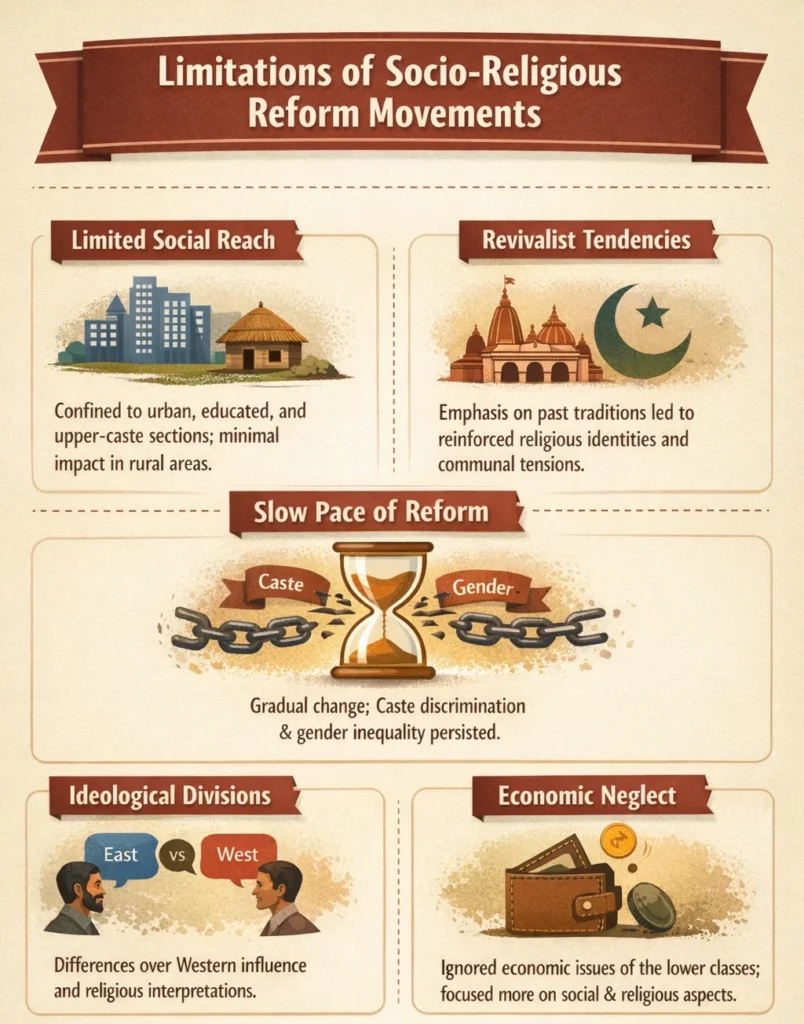
- Despite their significant contributions, the socio-religious reform movements had several limitations that restricted their overall impact. One major limitation was their limited social reach, as many movements were largely confined to urban, educated, and upper-caste sections of society, with minimal penetration into rural areas.
- Some movements also adopted a revivalist approach, emphasising the glorification of past traditions. While this helped in cultural revival, it sometimes led to the reinforcement of religious identities, which later contributed to communal tensions.
- The pace of reform was often gradual, and deeply rooted practices such as caste discrimination and gender inequality continued to persist despite reform efforts. Moreover, there were ideological differences among reformers, particularly regarding the extent of Western influence and the interpretation of religious texts.
- Another criticism is that the movements did not sufficiently address the economic dimensions of social inequality, focusing more on social and religious aspects. As a result, structural issues affecting the lower strata of society remained inadequately addressed.
Women and Reforms Movements
- One of the most important contributions of socio-religious reform movements was the improvement in the status of women. Reformers recognised that no society could progress without addressing gender inequality and therefore prioritised issues affecting women.
- They campaigned against oppressive practices such as sati, child marriage, purdah system, and denial of property rights, which had severely restricted women’s freedom and dignity. The promotion of widow remarriage and raising the age of marriage were significant steps towards social reform.
- Education for women emerged as a central focus, with reformers establishing schools and encouraging female literacy. This helped women gradually enter the public sphere and participate in social and intellectual life.
- However, despite these efforts, progress remained uneven. Women’s participation was still limited, and reforms often reflected a paternalistic approach, where decisions were made for women rather than by them. Nevertheless, these movements laid the foundation for future advancements in women’s rights and gender equality in India.
Conclusion
The socio-religious movements were instrumental in transforming Indian society by promoting rationality, social justice, and human dignity. They played a dual role of reforming traditional practices while preserving the core values of Indian culture. These movements not only addressed social issues but also contributed to the emergence of modern India and the growth of nationalism.
FAQs
Q1. What are socio-religious reform movements?
Socio-religious reform movements were efforts by Indian thinkers and leaders to reform society and religion by removing social evils and promoting progressive values during colonial rule.
Q2. Why did these reform movements emerge in India?
They arose due to social evils (like sati, child marriage, caste discrimination), colonial influence, spread of Western education, and the need for social awakening.
Q3. Who were the key reformers associated with these movements?
Important reformers included Raja Ram Mohan Roy, Swami Dayanand Saraswati, and Ishwar Chandra Vidyasagar.
Q4. What were the major reform movements?
Key movements included the Brahmo Samaj, Arya Samaj, and Prarthana Samaj.
Q5. What were the objectives of these movements?
They aimed to abolish social evils, promote women’s rights, encourage education, and reform religious practices based on rationality and ethics.
Click on the question to see the Answers
Visit LevelUp IAS- Click Here