Ayushman Sahakar Scheme

Content
- Why in News?
- Introduction
- Objectives of the Scheme
- Key Features of the Scheme
- Significance of the Scheme
- Challenges
- Way Forward
- Conclusion
Why in News?
Recently, the Union Minister for Home and Cooperation informed the Rajya Sabha about the implementation and progress of the Ayushman Sahakar Scheme, highlighting its role in strengthening cooperative-led healthcare infrastructure in India.
Ayushman Sahakar Scheme
The Ayushman Sahakar Scheme is a unique initiative aimed at integrating the cooperative sector with healthcare delivery, thereby improving accessibility and affordability of medical services, especially in rural and underserved areas.
It reflects the government’s broader vision of “Sahakar se Samriddhi” (Prosperity through Cooperation) by empowering cooperative institutions to play a significant role in public health.
Objectives of the Scheme
- The scheme seeks to promote affordable, accessible, and holistic healthcare services through cooperative societies. It enables cooperatives to establish hospitals, healthcare centres, and educational institutions, thereby expanding the healthcare ecosystem.
- A key objective is to encourage the promotion of AYUSH systems of medicine, ensuring integration of traditional and modern healthcare approaches.
- The scheme also aligns cooperative efforts with the National Health Policy, strengthening the overall health infrastructure of the country.
- Further, it aims to facilitate the participation of cooperative institutions in the National Digital Health Mission, promoting digitisation, health records, and improved service delivery.
- Overall, the scheme envisions comprehensive healthcare, including services, insurance, education, and allied activities under the cooperative framework.
Key Features of the Scheme
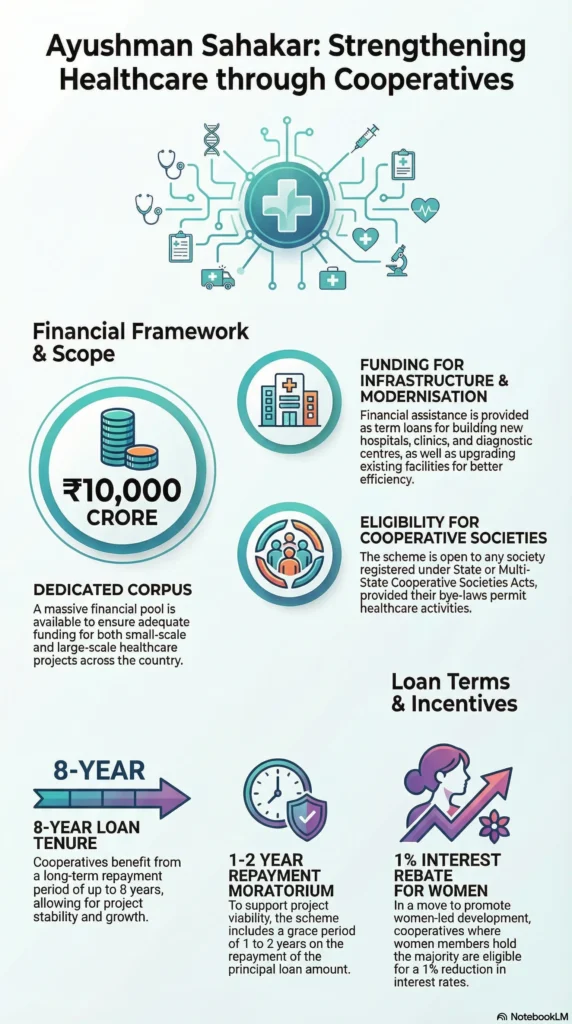
The scheme is open to all cooperative societies registered under State or Multi-State Cooperative Societies Acts, provided their bye-laws allow engagement in healthcare-related activities.
It offers financial assistance in the form of term loans, enabling cooperatives to invest in healthcare infrastructure such as hospitals, clinics, and diagnostic centres.
The loan tenure extends up to 8 years, including a moratorium period of 1-2 years on principal repayment, depending on the project’s viability.
A significant feature is the 1% interest rebate for cooperative societies where women members constitute the majority, thereby promoting women-led development in the healthcare sector.
The scheme is backed by a substantial corpus of ₹10,000 crore, ensuring adequate financial support for large-scale projects.
It also supports the modernisation and upgradation of existing cooperative healthcare facilities, improving their efficiency and service quality.
Significance of the Scheme
- The Ayushman Sahakar Scheme plays a crucial role in bridging healthcare gaps, particularly in rural and semi-urban areas where access to quality healthcare remains limited.
- By leveraging the cooperative model, it promotes community participation and decentralised governance in healthcare delivery.
- The scheme contributes to the achievement of Universal Health Coverage (UHC) by making healthcare more affordable and inclusive.
- It also encourages the integration of traditional medicine systems (AYUSH) with modern healthcare, promoting a holistic approach to health and wellness.
- Additionally, the focus on digital health aligns with India’s efforts to build a technology-driven healthcare ecosystem.
Challenges
Despite its potential, the scheme faces challenges such as limited capacity and managerial expertise within cooperative societies to handle large-scale healthcare projects.
There are also issues related to financial viability, especially in remote areas where revenue generation may be uncertain.
Coordination between cooperative institutions and government agencies needs to be strengthened for effective implementation.
Ensuring quality standards and regulatory compliance in cooperative healthcare facilities is another critical concern.
Way Forward
- To maximise the impact of the Ayushman Sahakar Scheme, there is a need to strengthen the institutional capacity of cooperative societies through training, technical support, and professional management.
- The government should ensure better convergence with existing health schemes such as Ayushman Bharat to avoid duplication and enhance efficiency.
- Encouraging public-private partnerships within the cooperative framework can improve service quality and financial sustainability.
- Further, expanding digital integration and ensuring robust monitoring mechanisms will be essential for transparency and effective service delivery.
Conclusion
The Ayushman Sahakar Scheme represents an innovative approach to healthcare delivery through the cooperative sector. By combining financial support, community participation, and policy alignment, it has the potential to significantly strengthen India’s healthcare system.
However, its success will depend on effective implementation, capacity building, and sustained policy support to ensure accessible, affordable, and quality healthcare for all.
Visit LevelUp IAS- Click Here