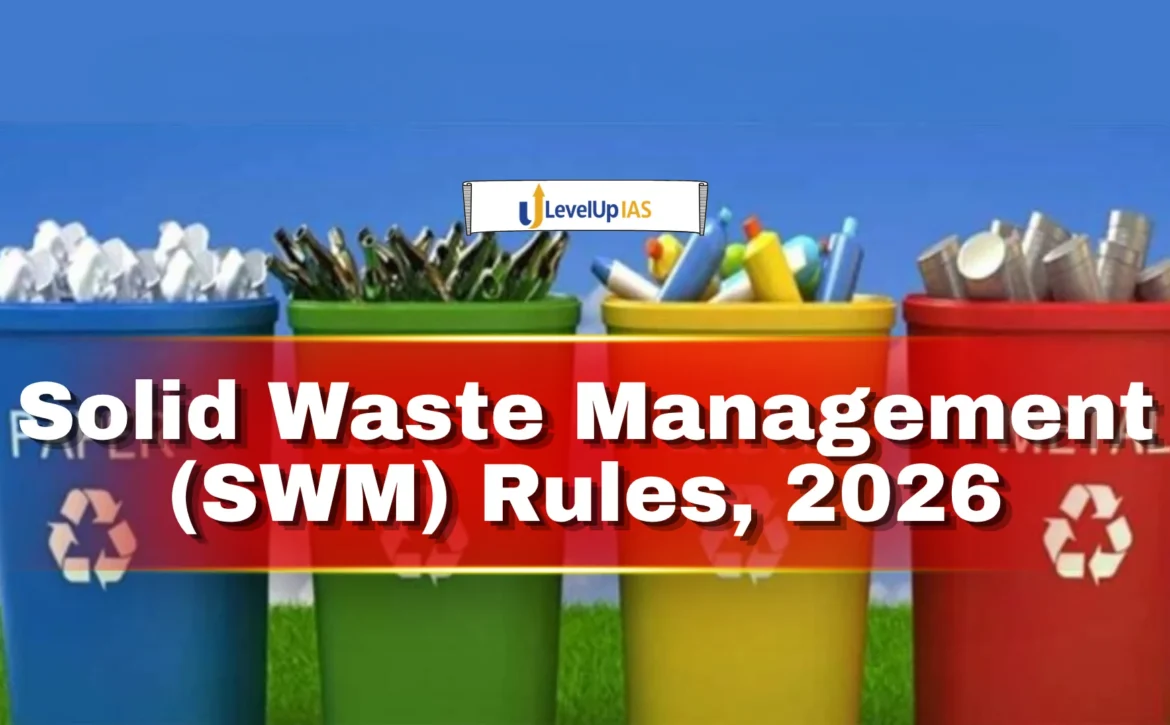
Solid Waste Management (SWM) Rules, 2026
Content
Why in News?
The Ministry of Environment, Forest and Climate Change has notified the Solid Waste Management (SWM) Rules, 2026, replacing the earlier 2016 rules under the Environment (Protection) Act, 1986. The new rules aim to strengthen its segregation, accountability, and circular economy practices across India.
Introduction
The SWM Rules, 2026 mark a significant shift in India’s waste management framework by introducing stricter compliance mechanisms, digital monitoring, and enhanced responsibilities for its generators.
Effective from 1st April 2026, the rules seek to address the growing challenge, as India generates nearly 1.85 lakh tonnes of waste per day
Key Features of SWM Rules, 2026
Four-Stream Segregation at Source
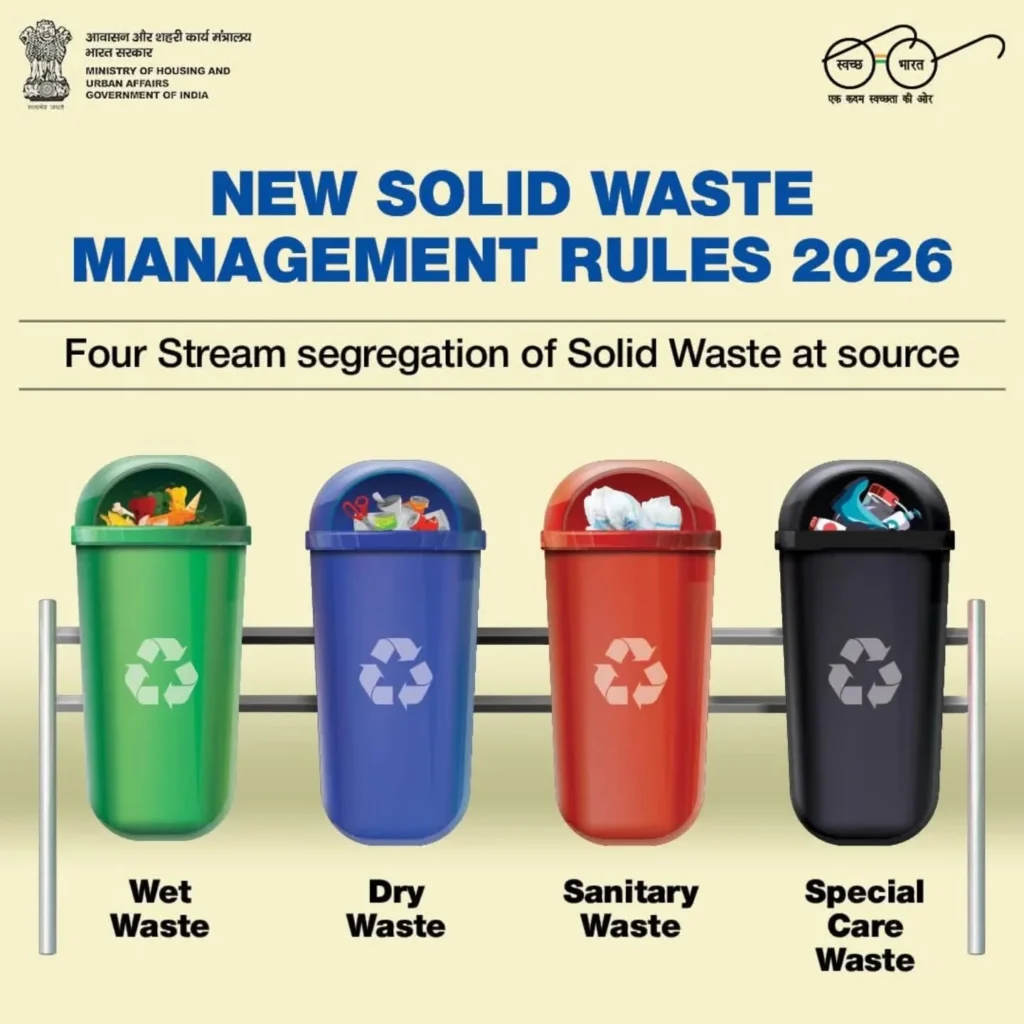
A major reform is the mandatory segregation into four distinct categories wet, dry, sanitary, and special care wastes.
Wet wastes such as food leftovers and organic matter must be composted or bio-methanated, while dry wastes like plastic, paper, and metal must be sent to Material Recovery Facilities (MRFs) for recycling.
Sanitary waste is required to be securely wrapped and handled separately, whereas special care wastes (such as batteries, bulbs, and medicines) must be disposed of through authorised agencies.
This structured segregation aims to improve recycling efficiency and reduce landfill burden.
Polluter Pays Principle
The rules operationalise the Polluter Pays Principle, whereby environmental compensation will be imposed for non-compliance.
Guidelines for penalties will be developed by the Central Pollution Control Board (CPCB) and enforced by State Pollution Control Boards, ensuring accountability at all levels.
Bulk Waste Generators (BWGs) and Responsibility
The rules clearly define Bulk Waste Generators (BWGs) as entities with:
- Floor area ≥ 20,000 sq m
- Water consumption ≥ 40,000 litres/day
- Waste generation ≥ 100 kg/day
These include residential complexes, government buildings, and institutions, which together account for nearly 30% of total waste generation.
A new concept of Extended Bulk Waste Generator Responsibility (EBWGR) mandates such entities to process wet waste on-site or obtain certification if not feasible, thereby decentralising waste management.
Digital Monitoring and Governance
A centralised online portal will track the generation, collection, processing, and disposal, replacing manual reporting with digital audits.
This ensures transparency, real-time monitoring, and improved compliance, strengthening governance mechanisms.
Refuse Derived Fuel (RDF) Mandate
The rules promote the circular economy by mandating industries such as cement and waste-to-energy plants to increase the use of Refuse Derived Fuel (RDF) from 5% to 15% over six years.
RDF, derived from non-recyclables, serves as an eco-friendly alternative to fossil fuels, thereby reducing environmental impact.
Landfill Restrictions and Legacy Waste Management
Landfills are now restricted strictly to non-recyclable and inert waste, with higher charges for its unsegregated disposal.
The rules also mandate time-bound biomining and bioremediation of legacy waste, with quarterly progress reporting, addressing long-standing issues of dumpsites.
Special Provisions for Hilly and Island Regions
Recognising geographical constraints, the rules provide flexibility for hilly areas and islands, allowing local bodies to:
- Levy user charges on tourists
- Regulate visitor inflow based on its management capacity
This ensures sustainable tourism and environmental protection in fragile ecosystems.
Institutional Mechanism
Implementation will be overseen by state-level committees chaired by the Chief Secretary, ensuring coordination among various stakeholders and effective policy execution.
Significance of the Rules
The SWM Rules, 2026 mark a transition towards a scientific, decentralised, and accountable waste management system.
They strengthen the principles of circular economy, sustainability, and resource efficiency, reducing dependence on landfills and promoting recycling and reuse.
The emphasis on digital governance and accountability improves transparency and compliance, while the focus on bulk generators ensures that major waste contributors are held responsible.
Overall, the rules align with India’s broader environmental commitments, including sustainable development and climate action.
Challenges
Despite their comprehensive nature, challenges remain in effective implementation.
Ensuring behavioural change among citizens for proper waste segregation is a major hurdle.
Local bodies may face capacity constraints, financial limitations, and infrastructural gaps, particularly in smaller towns and rural areas.
Monitoring and enforcement of compliance, especially among bulk generators, will require strong institutional mechanisms.
Way Forward
- To ensure success, there is a need to strengthen awareness campaigns and citizen participation, promoting segregation at source as a social responsibility.
- Local bodies should be supported with financial resources, technical expertise, and infrastructure development.
- The government must ensure strict enforcement and regular monitoring, supported by digital tools and data analytics.
- Encouraging public-private partnerships and innovation in waste processing technologies can further enhance efficiency.
Conclusion
The Rules, 2026 represent a significant step towards modernising India’s waste management system. By emphasising segregation, accountability, and circular economy principles, the rules provide a comprehensive framework to address the growing challenge.
However, their success will depend on effective implementation, institutional capacity, and active public participation, making it a critical reform in India’s environmental governance.
Visit LevelUp IAS- Click Here