Drain of Wealth Theory, Modern History
Content
- Introduction
- Concept and Explanation
- Background and Causes
- Mechanism of the Drain
- Causes Behind the Drain
- Impact on Indian Economy and Society
- Political and Nationalist Significance
- Critical Evaluation
- Conclusion
- FAQs
Introduction
The Drain of Wealth Theory occupies a central place in the economic critique of British colonial rule in India. It provided the first systematic explanation of how colonialism led to India’s poverty and underdevelopment. Propounded by Dadabhai Naoroji in 1867, the theory argued that a significant portion of India’s wealth was being transferred to Britain without any adequate economic return. This concept transformed the nationalist movement by giving it a strong economic foundation.
Concept and Explanation
The Drain of Wealth Theory essentially refers to the unrequited transfer of resources from India to Britain. Unlike normal trade, where goods are exchanged with mutual benefit, the colonial relationship ensured that wealth flowed out of India without corresponding inflow.
Naoroji first articulated this idea in his paper “England’s Debt to India” and later elaborated it in his famous book “Poverty and Un-British Rule in India” (1901). He estimated that nearly one-fourth of India’s revenue (around $12 million annually at that time) was being drained to Britain.
This continuous outflow weakened India’s economy, reduced capital formation, and led to chronic poverty.
Background and Causes
Before the Battle of Plassey, the British East India Company followed a normal trade pattern where bullion flowed into India. However, after acquiring political power, the nature of economic relations changed fundamentally.
India became a colony serving British interests, and wealth began to flow outward. Early Indian thinkers like Raja Ram Mohan Roy first raised concerns about economic exploitation. Later, economists such as M.G. Ranade and R.C. Dutt expanded this critique.
By the late 19th century, the Drain Theory had gained wide acceptance, and even the Indian National Congress adopted it officially in 1896, linking it to poverty and famines in India.
Mechanism of the Drain
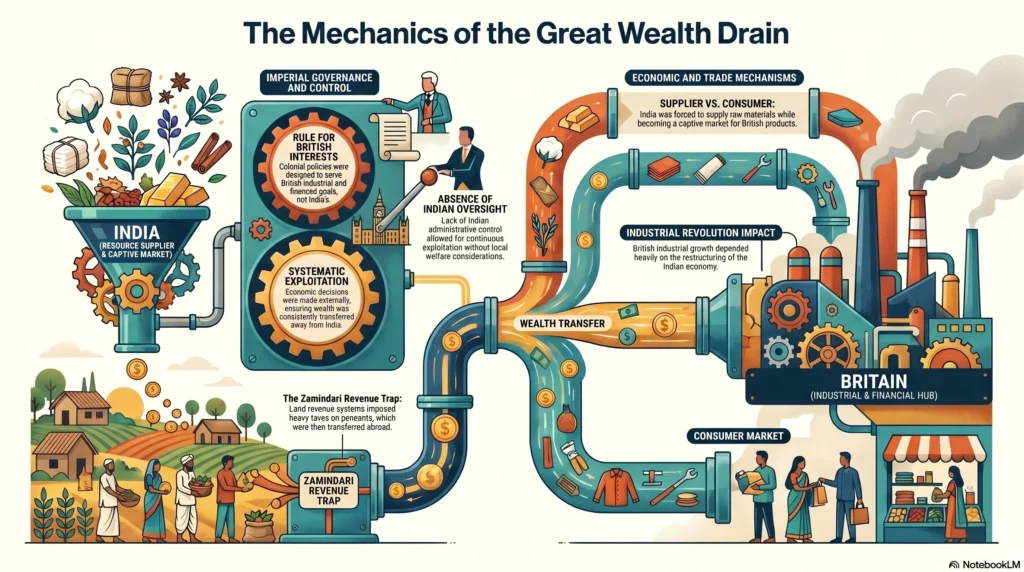
The drain was not a single channel but a systematic process operating through multiple mechanisms.
A major component was the remittance of salaries, pensions, and allowances of British officials working in India, which were sent back to Britain. Similarly, profits earned by British investors in railways, plantations, and trade were repatriated rather than reinvested in India.
Another crucial element was the “Home Charges”, which included expenses incurred in Britain for India, such as administrative costs, interest on public debt, and payments to the India Office in London.
India also bore the burden of military and administrative expenditure, including wars fought outside India for British imperial interests. These costs were financed through Indian revenues, placing a heavy strain on the economy.Additionally, the colonial trade structure ensured that India exported raw materials at low prices while importing finished goods at high prices, creating a non-equivalent exchange system that further drained wealth.
Causes Behind the Drain
The drain was rooted in the very structure of colonial rule. British economic policies were designed to serve the industrial and financial interests of Britain, not India.
The land revenue systems like Zamindari imposed heavy taxes on peasants, much of which was transferred abroad. The industrial revolution in Britain depended heavily on Indian raw materials and markets, turning India into a supplier of raw goods and a consumer of British products.
The absence of Indian control over administration meant that economic decisions were taken without considering Indian welfare, leading to continuous exploitation.
Impact on Indian Economy and Society
The consequences of the drain were deep and long-lasting. The continuous outflow of wealth led to widespread poverty and frequent famines, as resources that could have been used for development were siphoned off.
India’s traditional industries, especially textiles, declined sharply due to competition from cheap British imports, resulting in deindustrialisation and unemployment.
Economic growth remained stagnant because of the lack of capital investment within the country. As pointed out by Romesh Chandra Dutt, nearly £20 million annually was being drained from India in the early 20th century.
The tax burden on Indians increased significantly, while public spending on welfare remained minimal. This created a situation where India became economically dependent on Britain for capital, technology, and manufactured goods.
Political and Nationalist Significance
The Drain of Wealth Theory played a crucial role in shaping the Indian national movement. It exposed the economic exploitation inherent in colonial rule, shifting the focus from mere political grievances to economic injustice.
Leaders used this theory to mobilise public opinion and demand reforms. It strengthened the argument for self-rule (Swaraj) by demonstrating that economic progress was impossible under foreign domination.
The theory also influenced British policymakers to some extent, leading to the establishment of the Royal Commission on Indian Expenditure (1896), although its impact remained limited.
Critical Evaluation
While the Drain Theory was highly influential, some critics argue that it may have overestimated the scale of economic drain or overlooked certain benefits like infrastructure development. However, these arguments do not negate the broader reality of colonial exploitation.
Modern historians largely agree that the theory correctly identified the structural imbalance in colonial economic relations, even if precise estimates varied.
Conclusion
The socio-religious movements were instrumental in transforming Indian society by promoting rationality, social justice, and human dignity. They played a dual role of reforming traditional practices while preserving the core values of Indian culture. These movements not only addressed social issues but also contributed to the emergence of modern India and the growth of nationalism.
FAQs
Q1. What is the Drain of Wealth Theory?
The Drain of Wealth Theory explains how India’s wealth was systematically transferred to Britain without adequate returns during colonial rule.
Q2. Who propounded the Drain Theory?
The theory was articulated by Dadabhai Naoroji, who is often called the “Grand Old Man of India.”
Q3. What were the main causes of the drain?
Major causes included:
Payments for imports and administrative expenses abroad
Salaries and pensions of British officials paid from Indian revenues
Profits of British companies
Remittances by British personnel
Q4. What were the effects of the Drain of Wealth?
It led to poverty, underdevelopment, decline of traditional industries, and economic stagnation in India.
Q5. How did the theory contribute to Indian nationalism?
It exposed the exploitative nature of British rule and became a strong economic critique, inspiring early nationalist leaders.
Click on the question to see the Answers
Visit LevelUp IAS- Click Here