Ecological Pyramids, UPSC
Content
- Introduction
- Concept
- Types of Ecological Pyramids
- Significance of Ecological Pyramids
- Limitations
- Conclusion
- FAQs
Introduction
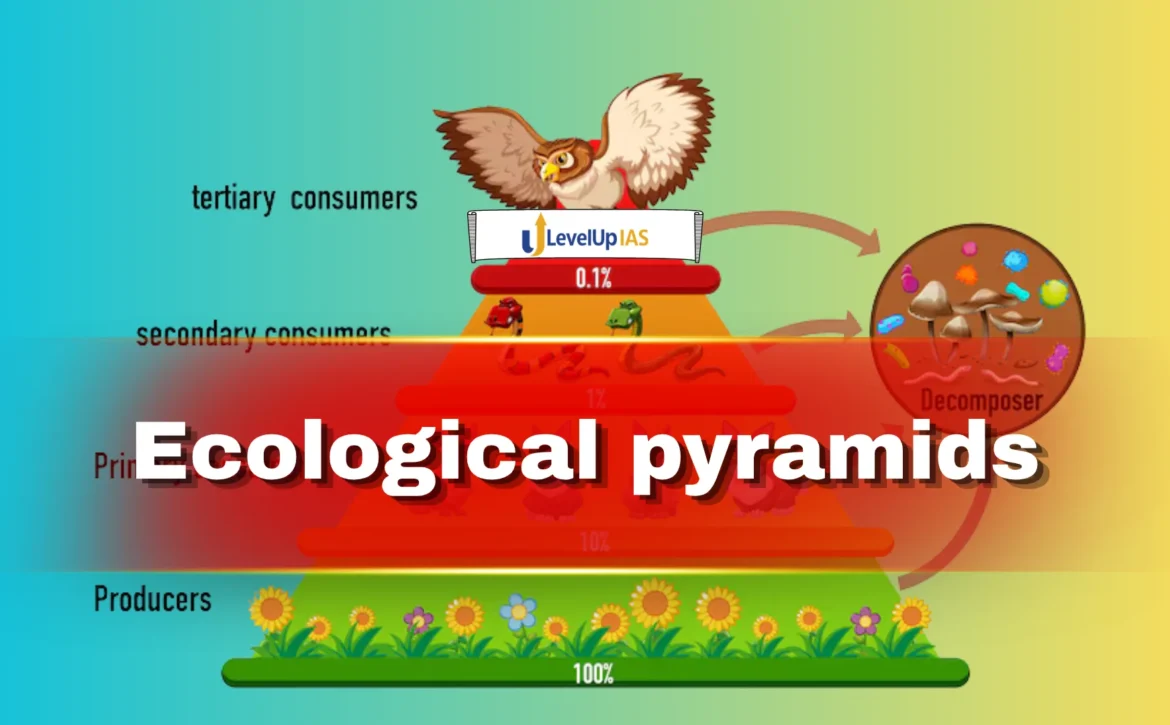
Ecological pyramids, also referred to as energy or trophic pyramids, are graphical representations that depict the distribution of energy, biomass, and number of organisms across different trophic levels in an ecosystem. These pyramids begin with producers forming the base and extend upward to primary, secondary, and tertiary consumers, ultimately culminating in top predators at the apex. The concept was first systematically explained by Charles Elton in the 1920s, and it remains fundamental in understanding ecosystem structure and function.
At their core, ecological pyramids highlight a crucial ecological principle, the inefficiency of energy transfer across trophic levels. Only a fraction of energy is passed from one level to the next, which explains why higher trophic levels sustain fewer organisms.
Concept
An ecological pyramid is essentially a simplified model that demonstrates how ecosystems are structured and how energy flows within them. It visually represents three key ecological parameters: number of organisms, biomass, and energy content. These pyramids provide insights into feeding relationships and ecological efficiency but should be understood as simplified models that do not capture the full complexity of natural ecosystems.
Types of Ecological Pyramids
Ecological pyramids are broadly classified into three types based on what they measure, numbers, biomass, and energy. Each type provides a different perspective on ecosystem functioning.
1. Pyramid of Numbers
The pyramid of numbers represents the number of individual organisms present at each trophic level in a given area. Its shape varies depending on the nature of the ecosystem and the size and reproductive capacity of organisms.
(a) Upright Pyramid of Numbers
In an upright pyramid of numbers, the number of individuals decreases progressively from lower to higher trophic levels. This is the most commonly observed form and is typical of grassland and aquatic ecosystems.
In a grassland ecosystem, producers such as grasses are present in very large numbers, forming a broad base. Herbivores like insects are fewer, followed by even fewer secondary consumers such as frogs and birds. At the top, apex predators like hawks or foxes are very limited in number. This pattern reflects the natural decline in population size as energy availability decreases at higher trophic levels.
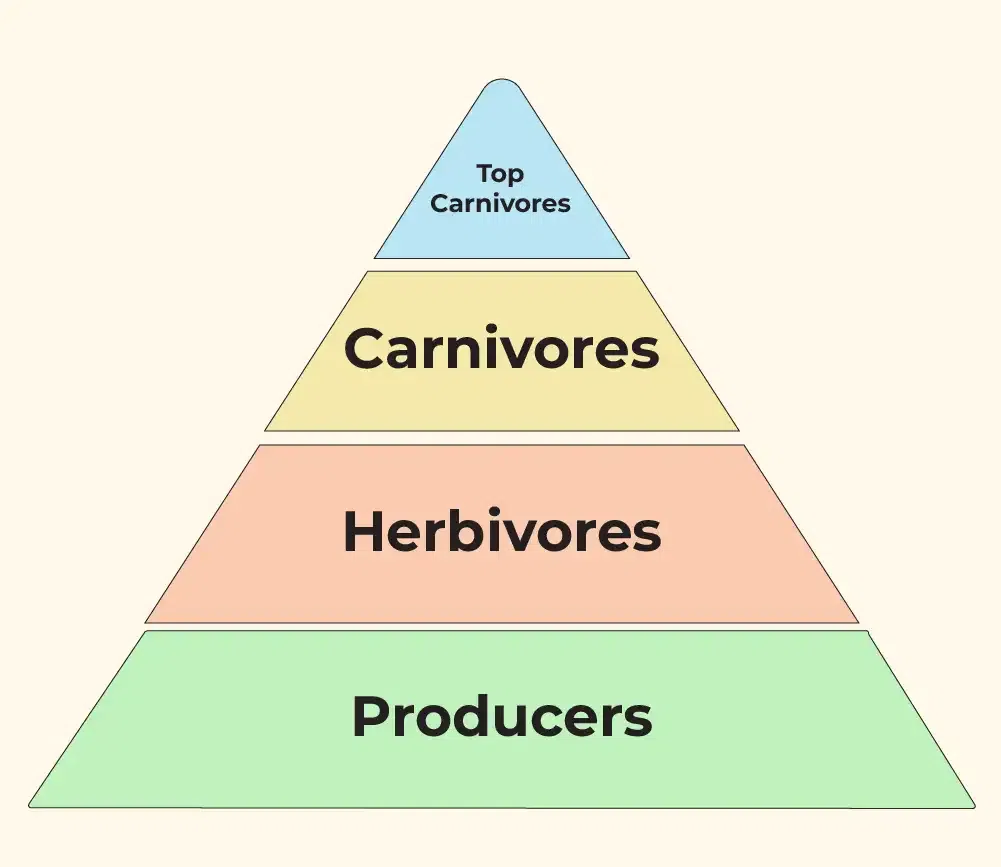
A similar pattern is observed in aquatic ecosystems, where phytoplankton form the base with very high numbers, followed by zooplankton, small fish, and finally large predatory fish. The upright structure highlights the dependence of higher trophic levels on a large base population of producers.
(b) Inverted Pyramid of Numbers
In an inverted pyramid of numbers, the number of individuals increases as we move from lower to higher trophic levels. This pattern is less common and is typically seen in parasitic food chains.
For example, a single large tree (producer) may support numerous birds (primary consumers), which in turn host an even greater number of parasites such as lice or ticks. These parasites may further support a larger population of hyperparasites like bacteria or fungi. Thus, the number of organisms increases at successive trophic levels, resulting in an inverted pyramid.
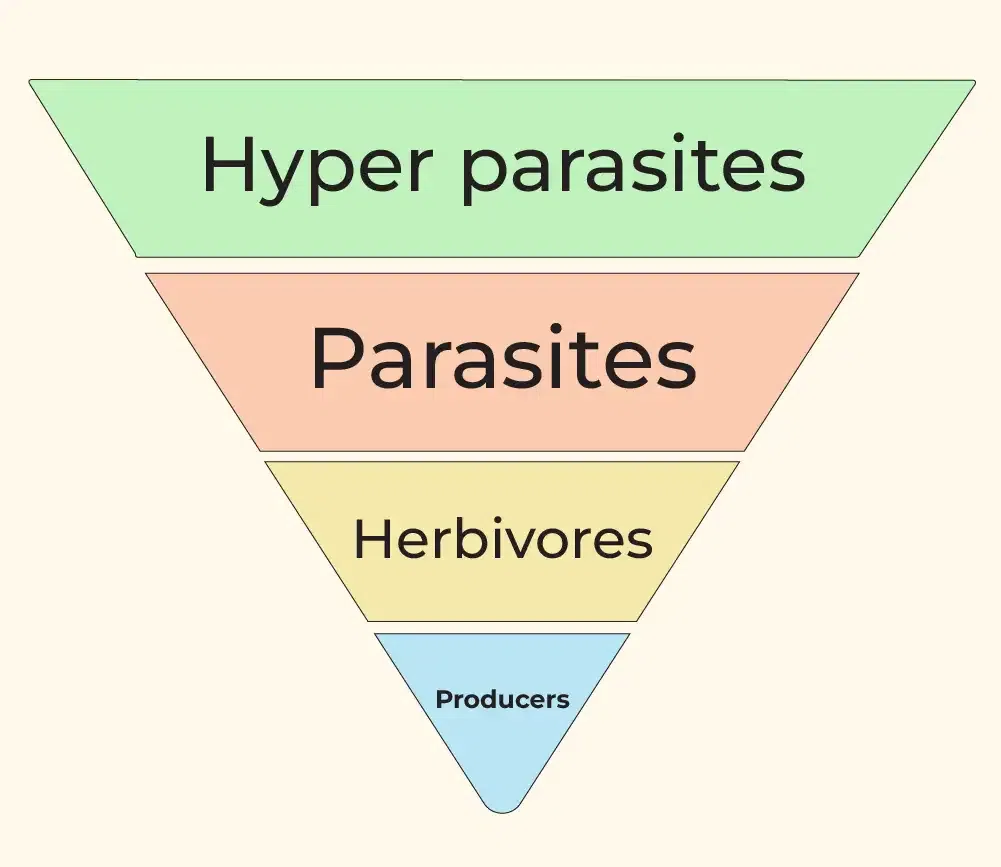
This type of pyramid demonstrates that numerical strength alone does not always reflect ecological importance or energy flow.
2. Pyramid of Biomass
The pyramid of biomass represents the total mass of living organisms (dry weight or calorific value) at each trophic level in a given area at a specific time. Its shape varies between terrestrial and aquatic ecosystems.
(a) Upright Pyramid of Biomass (Terrestrial Ecosystem)
In terrestrial ecosystems such as forests and grasslands, the pyramid of biomass is typically upright. Producers like trees, shrubs, and grasses accumulate the largest biomass, forming a broad base. Herbivores feeding on these plants have comparatively lower biomass, followed by even smaller biomass at the level of carnivores and top predators.
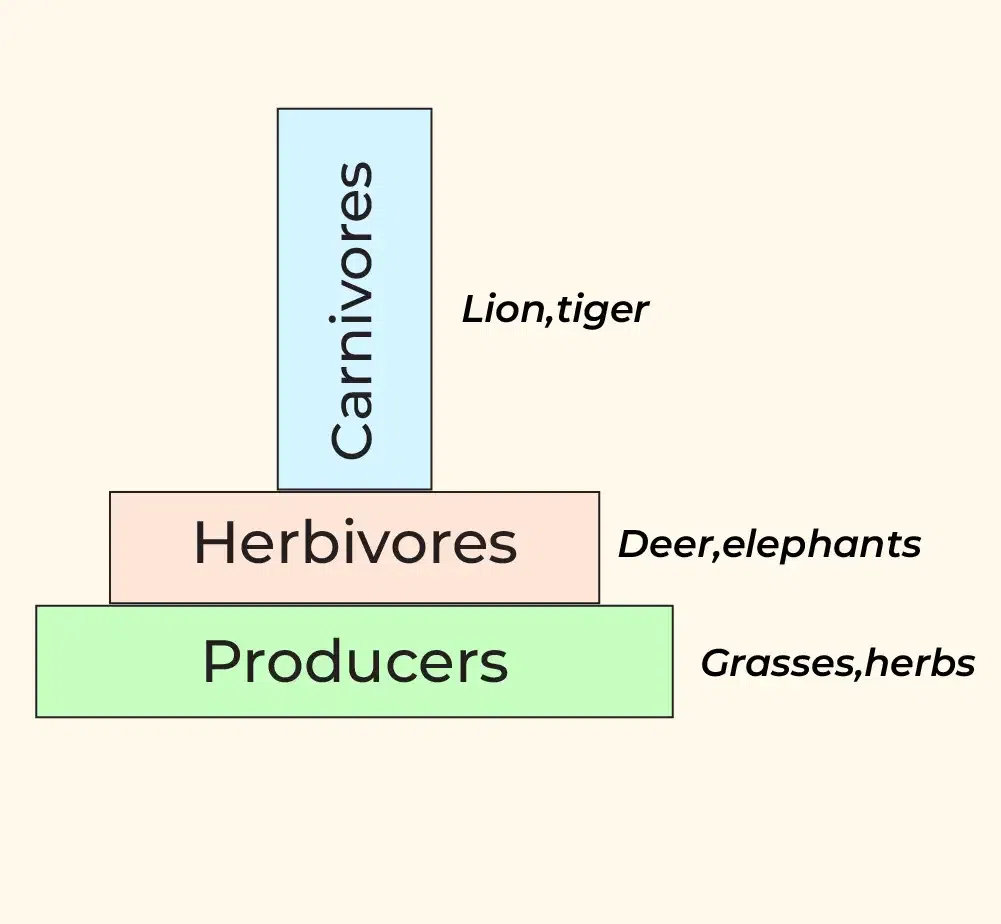
This structure reflects the gradual loss of energy at each trophic level, which limits the biomass that can be supported at higher levels. The upright pyramid of biomass is therefore consistent with the principles of energy transfer and ecological efficiency.
(b) Inverted Pyramid of Biomass (Aquatic Ecosystem)
In aquatic ecosystems, the pyramid of biomass is often inverted. Primary producers such as phytoplankton have a very small standing biomass at any given time due to their rapid turnover rate. However, they reproduce quickly and are continuously consumed by zooplankton.
As a result, the biomass of consumers (zooplankton and fish) at a given moment may exceed that of producers, leading to an inverted structure. Despite this inversion, the system remains stable because of the high productivity and rapid regeneration of phytoplankton.
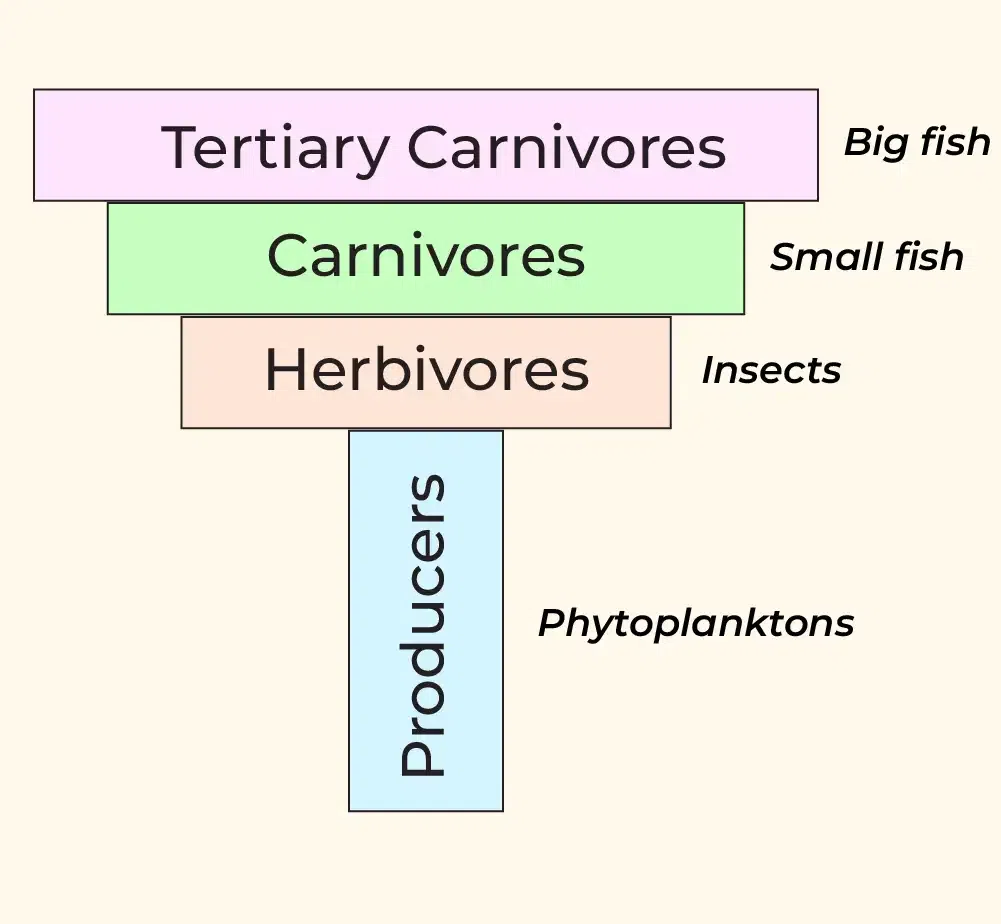
This type of pyramid highlights the importance of productivity rather than standing biomass in maintaining ecosystem balance.
3. Pyramid of Energy
The pyramid of energy is considered the most accurate and scientifically reliable representation of ecological relationships. It depicts the flow of energy through each trophic level over time, usually expressed in units like kcal/m²/year.
En+1≈0.1EnE_{n+1} \approx 0.1 E_nEn+1≈0.1En
This representation reflects the well-known “10% law” of energy transfer, which states that only about 10% of energy at one trophic level is transferred to the next higher level, while the rest is lost as heat due to metabolic processes.
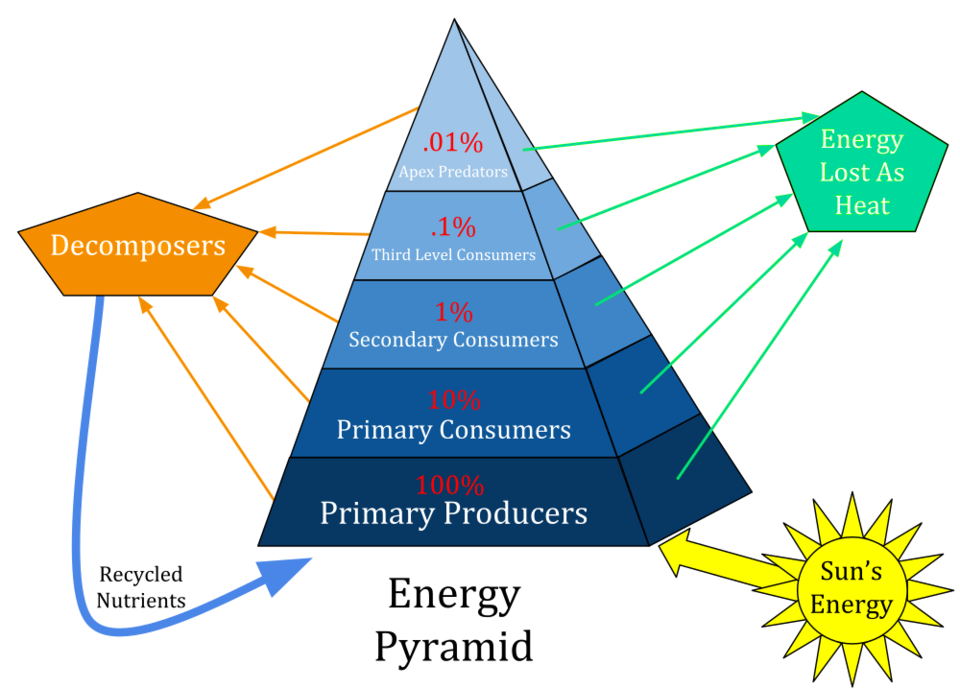
Unlike pyramids of numbers and biomass, the pyramid of energy is always upright. This is because energy flow is unidirectional and continuously diminishes at higher trophic levels, making it impossible for higher levels to have more energy than the lower ones.
The pyramid of energy also enables comparison across ecosystems and provides a functional understanding of productivity and ecological efficiency.
Significance of Ecological Pyramids
Ecological pyramids play a crucial role in understanding ecosystem functioning. They provide insights into energy transfer and highlight the inefficiency inherent in trophic relationships. By illustrating how energy diminishes at each level, they explain why food chains are generally short and why apex predators are fewer in number.
These pyramids also help in assessing ecosystem health. Any disturbance at one trophic level, such as overexploitation of predators or decline in producers, can have cascading effects on other levels. Thus, ecological pyramids serve as valuable tools in environmental monitoring and conservation planning.
Additionally, they are useful in studying the impact of environmental changes such as pollution, climate change, and habitat destruction on ecosystem stability.
Limitations of Ecological Pyramids
Despite their importance, ecological pyramids have certain limitations. They simplify complex food webs into linear food chains, ignoring the fact that many organisms occupy multiple trophic levels. For instance, omnivores cannot be easily placed in a single category.
Another major limitation is the exclusion of decomposers such as bacteria and fungi, which play a vital role in nutrient cycling but do not fit neatly into the pyramid structure. Moreover, ecological pyramids do not account for seasonal variations or temporal changes in ecosystems, making them static representations of dynamic processes.
They also fail to capture interactions such as competition, mutualism, and parasitism, which are integral to ecosystem functioning.
Conclusion
Ecological pyramids provide a foundational framework for understanding the structure and functioning of ecosystems. They clearly demonstrate the hierarchical organization of trophic levels and the progressive loss of energy as it flows through the system. While they offer valuable insights into ecological relationships, their simplified nature necessitates careful interpretation, especially when dealing with complex real-world ecosystems.
FAQs
Q1. What are ecological pyramids?
Ecological pyramids are diagrams that show the relationship between different trophic levels in terms of number, biomass, or energy.
Q2. What are the types of ecological pyramids?
There are three main types:
Pyramid of Energy
Pyramid of Numbers
Pyramid of Biomass
Q3. What is a pyramid of numbers?
It represents the number of individuals at each trophic level. It can be:
Inverted (e.g., a tree supporting many insects)
Upright (e.g., grassland ecosystem)
Q4. What is a pyramid of biomass?
It shows the total biomass (dry weight) of organisms at each trophic level. It may be upright (terrestrial ecosystems) or inverted (aquatic ecosystems).
Q5. What is a pyramid of energy?
It represents the flow of energy through trophic levels and is always upright due to the Second Law of Thermodynamics.
Effusive (quiet lava flows)
Click on the question to see the Answers
Visit LevelUp IAS- Click Here