INS Aridhaman
Content
Why in News?
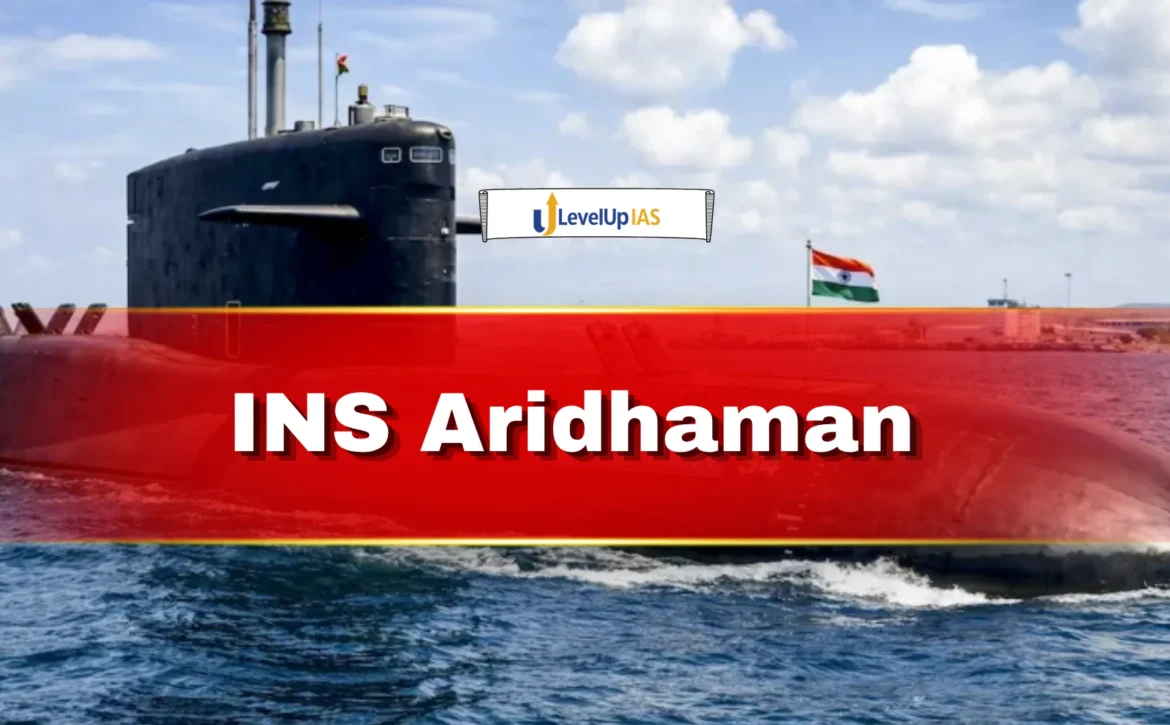
India has recently inducted INS Aridhaman, its third nuclear-powered ballistic missile submarine (SSBN), into the Indian Navy. The induction marks another significant milestone in India’s maritime security architecture and strengthens the country’s nuclear deterrence capabilities. Developed under India’s indigenous submarine-building programme, INS Aridhaman enhances the survivability and credibility of India’s nuclear forces and reinforces the sea-based leg of the country’s nuclear triad.
The commissioning of INS Aridhaman is particularly important in the context of India’s “No First Use” nuclear doctrine, as it significantly improves the nation’s assured second-strike capability.
Background: India’s SSBN Programme
India’s nuclear submarine programme was initiated under the Advanced Technology Vessel (ATV) Project, one of the country’s most ambitious defence projects. The objective was to develop indigenous nuclear-powered submarines capable of carrying nuclear weapons and operating undetected for extended durations.
The Arihant-class submarines represent the outcome of this programme. INS Aridhaman is the third SSBN in this class, following INS Arihant, commissioned in 2016, and INS Arighaat, commissioned in 2024.
The project has been developed at the Ship Building Centre in Visakhapatnam with substantial contributions from Indian scientific and defence institutions, particularly the Bhabha Atomic Research Centre.
Key Features of INS Aridhaman
INS Aridhaman is a more advanced platform compared to its predecessors and incorporates several technological improvements.
The submarine has a displacement of approximately 6,000 tonnes on the surface and around 7,000 tonnes when submerged. It is powered by an 83 MW pressurised water reactor developed by BARC, enabling prolonged underwater operations without the need for refuelling.
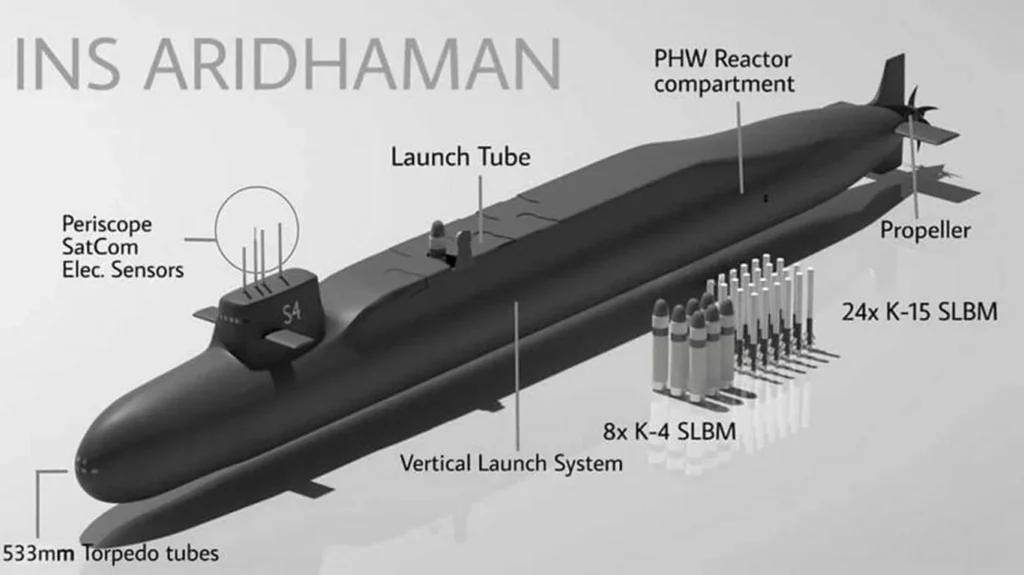
One of the most significant improvements is its enhanced missile-carrying capacity. Unlike INS Arihant and INS Arighaat, INS Aridhaman is equipped with eight vertical launch system tubes, allowing it to carry a larger number of submarine-launched ballistic missiles (SLBMs).
The submarine can deploy both K-15 Sagarika missiles with a range of about 750 km and the longer-range K-4 Missile with a range of approximately 3,500 km. The K-4 significantly enhances India’s ability to strike strategic targets while remaining in safe waters.
To improve stealth and survivability, INS Aridhaman is equipped with anechoic tiles that reduce acoustic signatures and advanced sonar systems that enhance underwater situational awareness.
Role in India’s Nuclear Triad
The induction of INS Aridhaman further strengthens India’s nuclear triad, which refers to the capability to launch nuclear weapons from land, air, and sea.
India’s land-based nuclear deterrent is primarily maintained through the Agni series of ballistic missiles. The air-based component is delivered through aircraft such as the Rafale and Su-30MKI. The sea-based leg is provided by Arihant-class submarines carrying nuclear-capable SLBMs.
Among the three components, the sea-based deterrent is considered the most survivable because submarines can remain hidden underwater for long periods, making them difficult to detect and destroy. This ensures that even if India suffers a nuclear attack, it retains the ability to respond effectively.
Significance
The induction of INS Aridhaman places India among a select group of nations possessing an operational sea-based nuclear deterrent. Countries with this capability include the United States, Russia, United Kingdom, France, and China.
The submarine enhances India’s strategic stability in the Indo-Pacific region and contributes to deterrence by ensuring that any adversary must account for India’s survivable nuclear forces. It also demonstrates India’s growing technological capabilities in nuclear propulsion, missile systems, and naval engineering.
Conclusion
The induction of INS Aridhaman marks a major advancement in India’s maritime and nuclear capabilities. As the third Arihant-class SSBN, it strengthens the sea-based component of India’s nuclear triad and significantly enhances the country’s second-strike capability. Equipped with greater missile capacity, improved stealth features, and indigenous nuclear propulsion technology, INS Aridhaman represents a crucial step in India’s journey toward a credible and survivable nuclear deterrent. Its commissioning not only boosts national security but also reinforces India’s status as a major maritime power in the Indo-Pacific region.
Visit LevelUp IAS- Click Here