Mastering the Optional: 300+ Marks in Sociology
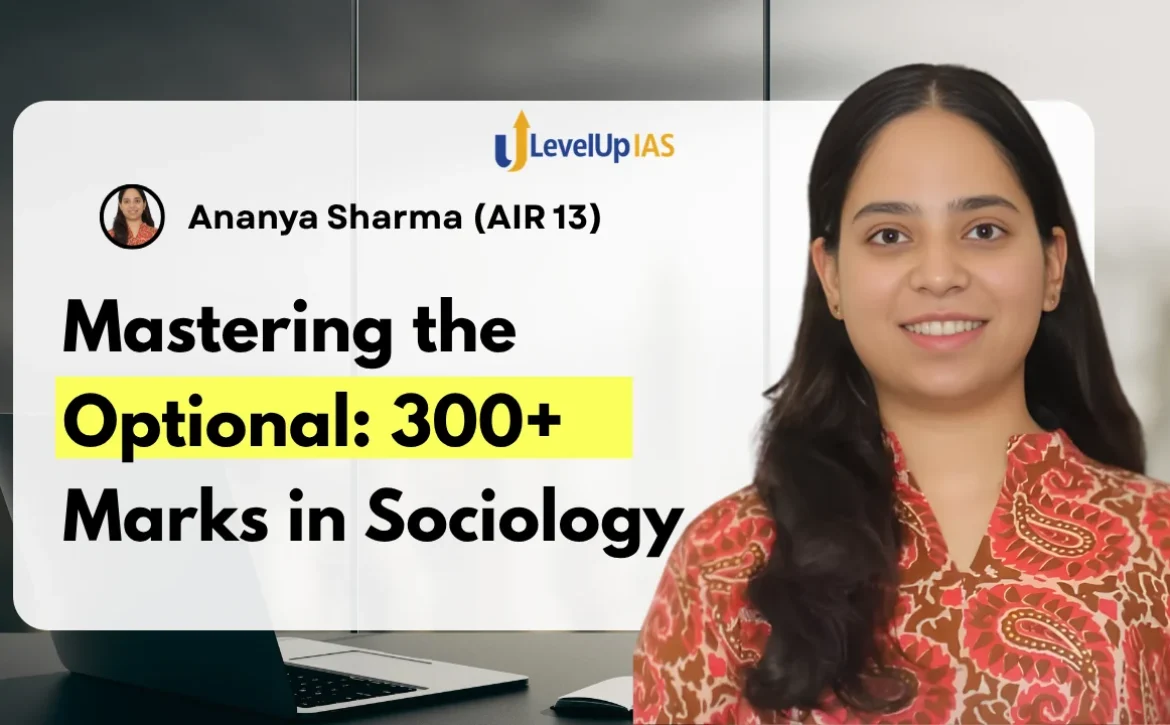
Intro – Ananya Sharma
- UPSC Rank: Secured All India Rank (AIR) 13 in the UPSC Civil Services Examination 2025
- Optional Subject: Sociology
- Place of Study: Completed schooling at Daly College, Indore, Madhya Pradesh.
- Graduation: B.A. (Hons.) in Economics.
- University/College: Graduated from Hindu College, Delhi.
- Background: Economics graduate who transitioned into full-time UPSC preparation. Her success has been attributed to disciplined self-study, structured mentorship, consistent answer-writing practice, and conceptual clarity across all stages of the examination.
Scoring above the 300-mark threshold in a UPSC optional subject is often considered the “holy grail” for aspirants. For Ananya Sharma, who secured AIR 13 and scored 301 marks in Sociology, this achievement was not the result of a complex, resource-heavy approach. Instead, it was built on a foundation of extreme simplification, logical interlinking, and a departure from the “point-dropping” style typical of General Studies (GS).
In this article, we break down Ananya’s comprehensive strategy for mastering Sociology, from note-making frameworks to her unique “voice note” revision method.
The “First-Attempter” Mindset: The Power of Simplicity
Ananya attributes much of her success to a simple philosophy: Simplicity is the key. Despite the vast amount of material available, she focused on making the concepts simple to understand for herself and easy for the examiner to evaluate. By writing like a “first attempter” without the baggage of previous failures or overly complex academic opinions, she was able to focus purely on the essence of the subject. She emphasizes that even if you read 10,000 words on a topic, your job is to distill and write the essence in 250 words.
The Note-Making Framework: Building Logic, Not Just Content
To avoid being overwhelmed by Paper 1 material, Ananya developed a consistent framework for her notes. She categorized every major topic into four or five broad headings:
- The “What”: Clear, concise definitions.
- Causes and Factors: Understanding the intellectual roots (e.g., the debate between Hegel and Marx on idealism vs. materialism).
- Contemporary Relevance: Finding modern-day applications for classical theories.
- Interlinkages: Connecting the topic with other sociological concepts.
For example, when studying Marxist historical materialism, she didn’t just stop at 19th-century theory. She linked it to the digital economy, where data has become the new means of production, creating “data capitalists” and “data proletarians”. She further added layers by interlinking it with dependency and development theory, discussing how global supply chains reflect the core-periphery model.
Avoiding the “Over-Familiarity” Trap
One of the most profound insights Ananya shares is the danger of over-familiarity with Previous Year Questions (PYQs). When candidates see a familiar question, they often dump a pre-prepared answer from their notes rather than addressing the specific demand of the question.
Ananya advises against being over-excited by familiar phrasing. Instead, candidates must use their conceptual understanding and answer-writing skills to address the nuances of what is actually being asked. This requires breaking down a question into subheadings to ensure no part of the prompt is ignored.
Making Answers “Sociological”: Moving Beyond GS Style
A common pitfall for aspirants is writing Sociology answers that look identical to GS Paper 1 (Society) answers. Ananya notes that while the topics may overlap such as urbanization or marriage the treatment must be different. To make an answer sociological, you must:
- Use specific keywords: Terms like “horizontal and vertical solidarity” or “historical materialism” distinguish an optional paper from a GS paper.
- Substantiate and Explain: In GS, you might name-drop an example or use a flowchart. In Sociology, professors want to see well-explained, legible prose.
- Substantive Sentences: Rather than using arrows and bullet points that leave the interpretation to the examiner, you must complete your sentences and substantiate your arguments. An optional answer should feel like a “mini-essay”.
The Role of Thinkers: Supporting Actors, Not Heroes
Surprisingly, Ananya warns against the pressure of quoting a specific number of thinkers. In her view, the argument is the hero, and the thinker is merely a supporting actor. She often put thinkers in brackets as a supporting point rather than making them the focal point of the answer. For contemporary topics like the New Education Policy (NEP), she suggests that if a thinker doesn’t fit naturally, it is better not to force one.
Revision and Recall: The Voice Note Method
Traditional rote learning can be stiff and exhausting. Ananya innovated by using voice notes on WhatsApp. She created a personal channel where she recorded herself explaining concepts (like functional vs. feminist theories of religion) using only keywords. During her breaks, she would pace around her room and listen to these notes.
She also utilized the Feynman Technique: recording a voice memo explaining a complex concept in simple terms. If she stammered or struggled to explain it fluently, she knew there was a gap in her understanding that needed plugging.
The “Static Cake” and the “Current Cherry”
Ananya argues that you do not need to prepare exclusive “Sociology current affairs”. Instead, current events should be used as a “cherry on the top” of a static “cake”.
- Static Foundation: 95% of the marks come from a strong understanding of static topics.
- Strategic Integration: If marriage is discussed, you might mention the “wedding industry” as a billion-dollar commercial event to show the shift from religious sacrament to commercialization.
Conclusion: Trusting the Process
Finally, Ananya emphasizes the importance of courage and confidence. She avoided pre-preparing introductions and conclusions because they often forced her to deviate from the question’s actual demand. Instead, she relied on her practice to craft them on the spot, ensuring they remained relevant to the body of her answer.
By trusting her base notes (primarily IGNOU and crash course material) and focusing on the demand over the notes, Ananya Sharma demonstrated that a clear, simple, and logical approach is the most effective path to a 300+ score in Sociology
To know her strategy in detail, watch the video – https://youtu.be/J9fpNlqQ-2U?si=zzTCiztbts1JG6GQ
Visit LevelUp IAS- Click Here