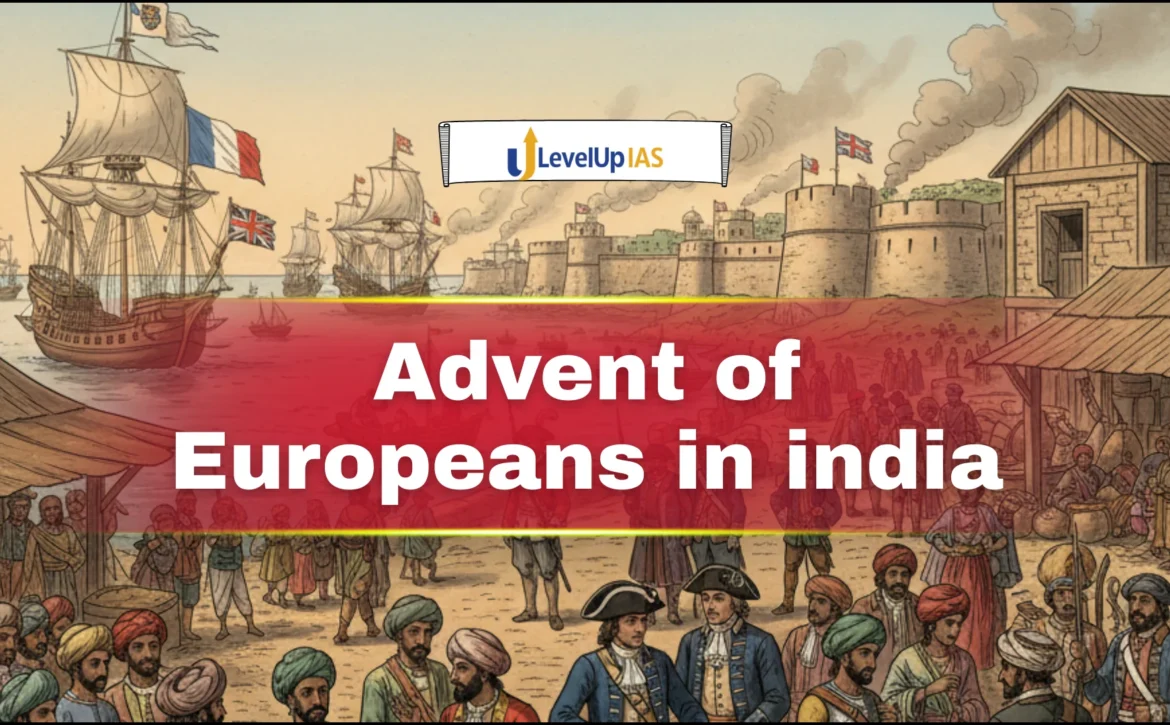
Advent of Europeans in India (Portuguese, Dutch, English, French, Danish)
Content
- Introduction
- The Advent of Europeans in India
- The Advent of the Portuguese
- The Advent of the Dutch
- The Advent of the English
- The Advent of the French
- The Advent of the Danes
- Reasons for English Success Over Other Europeans
- FAQs
Introduction
In the late fifteenth century, the Portuguese explorer Vasco da Gama arrived on the Indian shores, establishing the first maritime link between Europe and the Indian subcontinent. His voyage initiated a new era of European presence in India. Soon after, other European powers such as the Dutch, English, and French followed, intensifying competition for trade supremacy and territorial influence.
The foundation of trading posts and early colonial settlements opened a fresh phase in Indian history, one shaped by expanding global interactions and the eventual rise of British colonial dominance. The coming of Europeans significantly transformed India’s social, economic, and political structures.
The Advent of Europeans in India
The entry of Europeans marked a major turning point in Indian history.
- Vasco da Gama’s Arrival (1498): His landmark journey established the first direct sea route between Europe and India. This moment became the doorway for European trade expansion and future colonial ambitions.
- Entry of Other European Powers: The Portuguese were soon joined by other European competitors eager to control the profitable spice trade, resulting in trading posts and defensive fortifications across the coastline.
- Impact on India: European arrival brought cultural exchanges, economic shifts, diplomatic tensions, and conflicts with Indian rulers setting the stage for several centuries of foreign influence and eventual British rule.
The Advent of the Portuguese
The Portuguese were the first Europeans to arrive in India, marking the beginning of European colonial presence in the subcontinent.
Reasons Behind the Portuguese Voyage
- Shift in Trade Routes: Following the decline of the Roman Empire and the fall of Constantinople in 1453, Arab powers gained control over Egypt and Persia, dominating the established routes to India. Europeans lost easy access to Indian goods.
- Spirit of Exploration: The 15th century saw a strong European desire for adventurous sea expeditions, fuelled by Renaissance curiosity and improvements in navigation and shipbuilding.
- Treaty of Tordesillas (1494): This treaty divided the non-Christian world between Spain and Portugal, granting Portugal authority over eastern regions, including routes to India.
Important Portuguese Governors
Vasco da Gama
- Arrived in Calicut (Kozhikode) in 1498, welcomed by the Zamorin, whose kingdom prospered through trade.
- Faced resistance from Arab traders who feared losing their commercial dominance.
- The Portuguese sought to monopolise eastern trade, leading to growing tensions.
- Returned in 1501 but met opposition from the Zamorin for trying to sideline Arab merchants.
Francisco de Almeida (1505–1509)
- Appointed Governor in 1505 to expand Portuguese influence and weaken Muslim trade networks.
- Faced threats from the Zamorin and the Mamluk Sultan of Egypt.
- Suffered naval defeat at Diu in 1507 but regained control in 1508.
- Introduced the Blue Water Policy, emphasising Portuguese naval supremacy.
- Cartaze System: A naval trade pass issued to regulate and control maritime activities in the Indian Ocean.
Alfonso de Albuquerque (1509–1515)
- Strengthened Portuguese control by establishing bases at strategic Indian Ocean entry points.
- Introduced permits for non-Portuguese vessels and regulated shipbuilding hubs.
- Captured Goa (1510) from the Sultan of Bijapur, India’s first major European-controlled territory since Alexander’s era.
- Encouraged settlement of Portuguese men in India, promoting intermarriage and local integration.
- Abolished sati in areas under his authority.
Nino da Cunha (1529–1538)
- Shifted the Portuguese headquarters from Cochin to Goa.
- Acquired Bassein in 1534 but relations deteriorated with Gujarat, leading to Bahadur Shah’s death in 1537.
- Tried to expand Portuguese influence in Bengal by settling traders in Hooghly.
Decline of the Portuguese
By the 18th century, Portuguese strength in India weakened due to:
- Loss of local strategic advantages with emerging powers in Egypt, Persia, North India, and the rise of the Marathas.
- Maratha capture of Salsette and Bassein (1739).
- Increasing resentment caused by Portuguese religious policies, Jesuit influence, anti-Muslim stance, and strict conversion practices.
- Growing hostility from Hindu communities.
Significance of the Portuguese
- Emergence of Naval Power: Their arrival marked a shift towards European maritime dominance.
- New Trade Systems: They ignored existing trade norms and built their own structure across the Indian Ocean.
- Military Innovation: Introduced matchlocks, body armour, and ship-mounted artillery.
- Advanced Maritime Techniques: Built robust, multi-decked ships capable of carrying heavy armaments.
- Organisational Strength: Developed dockyards, arsenals, navigation systems, and mapping practices.
- Religious Policies: Initially tolerant toward Hindus but later grew intolerant, especially after the Goa Inquisition.
- Agricultural Impact: Introduced key crops such as chillies, potatoes, tomatoes, pineapple, papaya, and cashew nuts, which became integral to Indian cuisine and agriculture.
The Advent of the Dutch
- The Dutch entered India with strong commercial intentions.
- Dutch East India Company (1602): Formed by merging regional companies; empowered to wage war, sign treaties, acquire land, and build forts.
- They gained control over Masulipatnam (1605) and set up a major settlement at Pulicat (1610).
The Advent of the English
In 1599, English merchants formed the future English East India Company.
- Charter of 1600: Queen Elizabeth I granted them exclusive trading rights in the East Indies for 15 years, later extended indefinitely.
Expansion in Western and Southern India
- Captain Hawkins (1609): Tried to gain trading rights at Jahangir’s court but failed due to Portuguese pressure.
- Masulipatnam (1611–1616): English began trading and established a factory.
- Battle of Surat (1612): Captain Thomas Best defeated the Portuguese; in 1613, Jahangir allowed an English factory at Surat.
- Bombay (1662/1668): Given as dowry to Charles II, later transferred to the Company.
- Madras (1639): Fortified factory built with Golconda ruler’s permission; became the Company’s headquarters in South India.
Expansion into Bengal
- 1651: Shah Shuja permitted English trade for an annual fee.
- William Hedges: Tried to secure a fortified base; clashes followed with Shaista Khan.
- Job Charnock (1690): Negotiated establishment of a factory at Sutanuti.
- Fort William (1700): Formed by acquiring Sutanuti, Gobindapur, and Kalikata later the capital of the Bengal Presidency.
The Advent of the French
- Though interested since the early 16th century, the French came late.
- French East India Company (1664): Created under Louis XIV with a 50-year monopoly.
- Reorganised in 1720; strengthened under Lenoir and Dumas.
- Lost several early settlements during wars with the Dutch and the War of Spanish Succession.
- Pondicherry (1674): Became the core of French influence in India.
The Advent of the Danes
- Danish East India Company (1616): Established factories at Tranquebar and later Serampore.
- Their settlements never became commercially significant.
- In 1845, Danish factories were sold to the British.
- Danes are remembered more for missionary activity than trade.
Reasons for English Success Over Other Europeans
The remarkable success of the English over other European powers in India resulted from a combination of structural, military, economic, political, and socio-religious factors. These advantages, both inherent and historically evolved, enabled the English East India Company to steadily outcompete the Portuguese, Dutch, French, and Danes in the Indian subcontinent.
Structure and Nature of the English Trading Company
- The English East India Company differed significantly from other European companies in its organisational structure.
- It was managed by a Board of Directors (the Court of Directors) elected annually by shareholders.
- The system of joint-stock ownership, strict auditing, and shareholder oversight made the company more accountable, financially stable, and professionally managed.
- Decision-making was also more collective and transparent, reducing corruption and improving long-term planning compared to other European companies that were tightly controlled by monarchies or aristocracies.
Naval Superiority
- Britain possessed the most powerful and technologically advanced navy in Europe.
- The Royal Navy’s victories such as the defeat of the Spanish Armada (1588) and later the French navy at the Battle of Trafalgar (1805), demonstrated consistent maritime dominance.
- This superiority ensured:
- safer sea routes for English ships
- uninterrupted supply of reinforcements and goods
- the ability to protect their trading posts and challenge rivals effectively
- No other European power in India could match the scale, discipline, or firepower of Britain’s naval fleet.
Impact of the Industrial Revolution
- England entered the Industrial Revolution earlier than any other European nation.
- This transformation led to major advancements in:
- textile manufacturing
- metallurgy and weapon production
- steam technology
- agricultural productivity
- As a result, British goods became cheaper, more abundant, and technically superior, enabling them to dominate global trade.
- Industrial strength also enabled the company to supply its armies with better firearms, cannons, uniforms, and logistics, contributing to battlefield superiority.
Military Skill, Discipline, and Leadership
- British soldiers were known for exceptional discipline and professional training.
- They efficiently adapted to Indian climatic and geographical conditions.
- British commanders implemented innovative military tactics such as:
- the use of line infantry formation
- strategic deployment of artillery and musketry
- effective logistical planning and communication
- With these advantages, small British contingents could often defeat much larger armies of Indian rulers or rival Europeans.
Stable and Strong Government Backing
- Britain maintained a relatively stable political environment, unlike other European nations facing upheavals.
- Monarchs and governments extended strong political, financial, and diplomatic support to the English East India Company.
- In contrast:
- France underwent the French Revolution, Napoleonic wars, and internal instability.
- Portugal and Spain suffered economic decline and lost global significance.
- The Dutch Republic faced repeated wars with England and internal political struggles.
- France underwent the French Revolution, Napoleonic wars, and internal instability.
- This stability allowed Britain to focus on expanding its commercial and territorial influence in India without major disruptions.
Lesser Zeal for Religion
- Compared to the Portuguese, Spanish, and Dutch, the English displayed limited religious aggression.
- They did not actively impose Christianity or interfere heavily in local religious matters.
- This relatively tolerant approach made English presence more acceptable to Indian rulers and merchants.
- The absence of harsh religious policies helped the British build long-term alliances and avoid the hostility that other Europeans faced.
Effective Use of Debt Markets
- One of Britain’s greatest strengths was its advanced financial system, particularly its ability to raise money through public debt.
- The establishment of the Bank of England (1694) allowed the British government to borrow vast sums at low interest rates.
- This financial power enabled Britain to:
- fund long wars
- maintain a large navy and army
- support the East India Company during military conflicts
Other European nations lacked this strong financial infrastructure, limiting their ability to sustain expansive overseas operations.
FAQs
1. Who were the first Europeans to arrive in India?
The Portuguese were the first Europeans to reach India, with Vasco da Gama landing at Calicut in 1498.
2. Why did Europeans come to India?
They came primarily for the spice trade, commercial profit, geographical exploration, and to break the Arab-Venetian monopoly over Asian trade.
3. What were the major European companies established in India?
The Portuguese Estado da Índia, Dutch VOC, English East India Company, French East India Company, and Danish East India Company.
4.Why did the Dutch decline in India?
They focused more on the East Indies (Indonesia), faced competition from the English, and gradually withdrew from Indian territories.
5. What were the major trading centres of Europeans in India?
Calicut, Goa, Cochin (Portuguese); Pulicat, Nagapattinam (Dutch); Surat, Madras, Bombay, Calcutta (English); Pondicherry, Mahe (French); Tranquebar, Serampore (Danish).
Click on the question to see the Answers