Applied Ethics: Its Different Aspects
< General Studies Home Page
Content
- INTRODUCTION
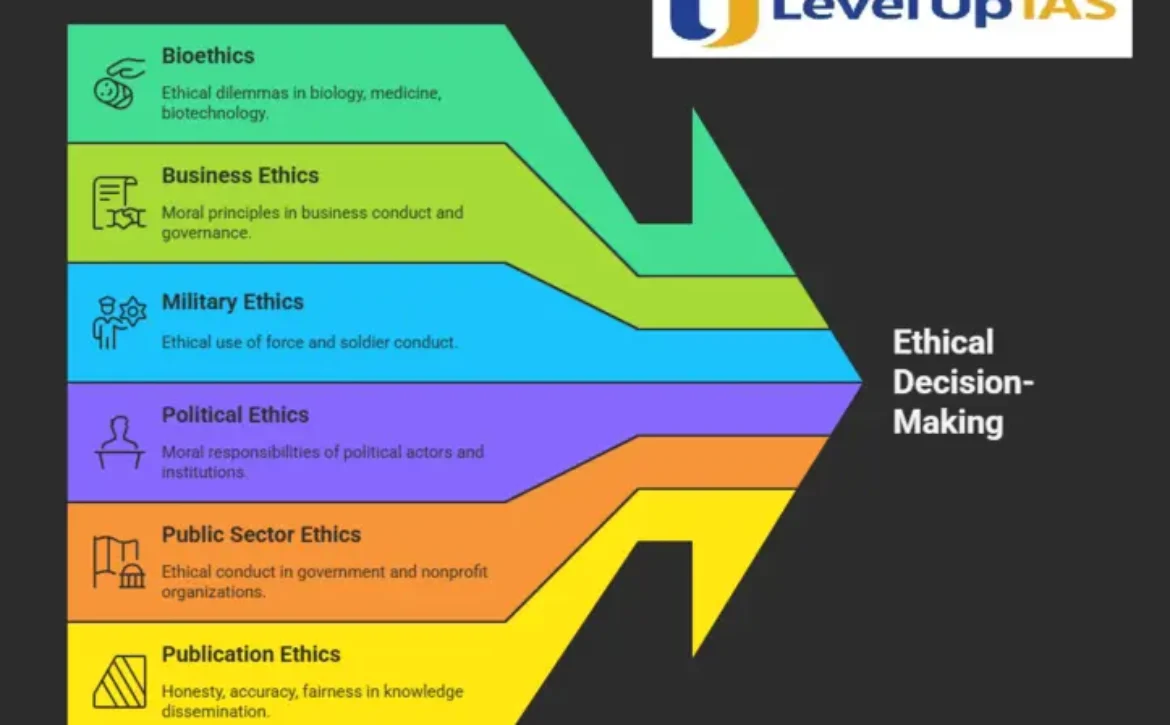
- BIOETHICS
- BUSINESS ETHICS
- MILITARY ETHICS
- POLITICAL ETHICS
- PUBLIC SECTOR ETHICS
- PUBLICATION ETHICS
- ENVIRONMENTAL ETHICS
- ETHICS IN JOURNALISM
- ETHICS IN SPORTS
- CYBER-ETHICS
- FAQs
Introduction
Applied ethics bridges theory and practice. It uses ethical principles to address real-world problems. Examples include environmental ethics, which examines responsibilities of governments and corporations in tackling pollution.
BIOETHICS
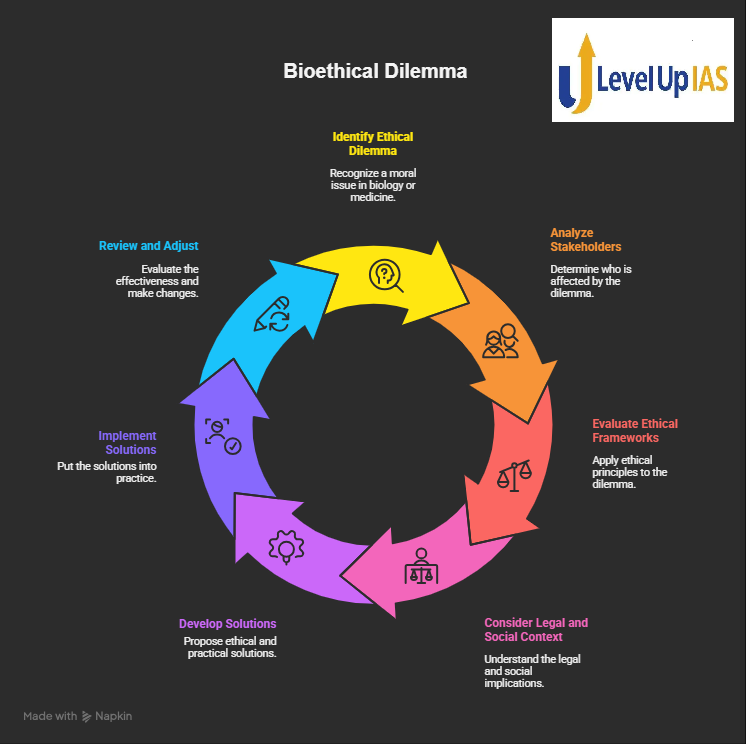
Bioethics is the branch of ethics that deals with moral dilemmas arising from developments in biology, medicine, and biotechnology. It examines how advances in life sciences intersect with law, politics, philosophy, and society. Modern bioethics also addresses emerging technologies that may reshape human life and biological systems in the future. Key areas of concern include:
1. Abortion
It refers to the termination of pregnancy by removing an embryo or fetus before it can survive outside the womb. A natural abortion is called a miscarriage.
Ethical debates:
- The fetus belongs to the human species; deliberately ending its life is equated with murder.
- Matters of life and death are considered divine, beyond human interference.
- Pregnant women have the right to self‑determination.
- Children born with disorders deserve a dignified life.
- The state has a duty to provide maternity support.
- The fetus itself has a right to life.
- Technology and concerns: Ultrasound and amniocentesis allow sex determination before birth. In countries like India, this has led to sex‑selective abortions, disproportionately targeting female fetuses.
2. Animal Rights
The belief that non‑human animals deserve to live freely and have their fundamental interests—such as avoiding pain—respected equally to those of humans.
Debate: Biocentrism (life‑centered ethics) vs. anthropocentrism (human‑centered ethics) remains central to discussions on granting rights to animals.
3. Biological Patents
Legal rights granted for inventions in biology, giving patent holders exclusive control over their use for a limited time.
Scope: Includes biotechnologies, genetically modified organisms, and genetic material.
Ethical issues:
- Natural resources as shared heritage.
- Rights of local communities to benefit from their environment.
- Fairness and justice for indigenous populations.
- Maximizing welfare for the greatest number of people.
4. Bio‑piracy
The exploitation of indigenous knowledge of nature for profit without proper consent or compensation.
Example: Pharmaceutical companies patenting medicinal plant knowledge originally developed by indigenous communities.
Concerns:
- Loss of recognition and benefits for local populations.
- Widening inequality between biodiversity‑rich developing nations and corporations in developed countries.
- Unequal sharing of burdens and benefits.
5. Cloning
Types:
- Therapeutic cloning: Producing tissues or organs for medical treatment, reducing reliance on transplants and immunosuppressive drugs.
- Reproductive cloning: Allowing infertile couples to have genetically related children.
Arguments in favor: Compassion for patients, right to a dignified life, and medical innovation.
Concerns:
- Safety risks and potential misuse (e.g., cloning humans for organ harvesting).
- Social and family integration of clones.
- Religious objections: some see cloning as interfering with divine will, while others support its life‑saving potential.
- Animal cloning: Criticized due to high rates of malformation and suffering. Food from cloned animals, though approved by regulators like the US FDA, faces opposition over safety concerns.
6. Euthanasia
The intentional ending of life to relieve suffering, often referred to as “good death.”
Legal status:
- Voluntary euthanasia (with patient consent) is legal in some countries.
- Non-voluntary (consent unavailable) and involuntary (against patient’s will) euthanasia are illegal everywhere, often equated with murder.
Ethical debates:
- Supporters emphasize autonomy, relief from pain, and dignity.
- Opponents stress the sanctity of life, medical duty, and moral responsibility.
Opposition references:
- Hippocratic Oath (400 BCE): “I will give no deadly medicine…” though modern versions vary.
- Declaration of Geneva (1948): Upholds respect for human life, drafted after Nazi medical crimes.
- International Code of Medical Ethics (2006): Physicians must respect human life.
- Buddhism: Views euthanasia and assisted suicide as acts of killing, causing grief and hindering spiritual growth.
7. Exorcism
Exorcism refers to religious or spiritual practices aimed at removing supposed demons or spirits from individuals or places believed to be possessed.
Methods: Depending on tradition, this may involve rituals, oaths, or invoking divine authority to command the entity to leave.
Historical context: Found across cultures and religions, exorcism is an ancient practice embedded in belief systems.
Ethical concerns:
- Ensuring mentally ill patients receive proper medical care instead of being subjected to harmful rituals.
- Protecting the dignity and rights of individuals.
- Preventing discrimination and ensuring justice in cases where spiritual practices overlap with medical conditions.
8. Human Experimentation
Human experimentation refers to research conducted on people, often without consent, which has historically raised serious ethical concerns.
Examples of unethical practices (especially in the 20th century):
- Infecting individuals with dangerous diseases.
- Exposing subjects to chemical or biological weapons.
- Radiation experiments and toxic chemical injections.
- Surgical trials without consent.
- Torture and interrogation studies.
- Use of mind‑altering substances.
Victims: Frequently children, the sick, mentally disabled persons, prisoners, and marginalized communities.
Issues:
- Many experiments were disguised as “medical treatment.”
- Programs were often secretive, with details revealed only decades later.
- Raises questions of consent, justice, and exploitation of vulnerable groups.
9. Stem Cell Research
Stem cell research explores the use of stem cells for medical purposes, but controversy arises when human embryos are involved.
Embryonic stem cells: Their use involves creating and destroying embryos, which is ethically debated.
Less controversial sources:
- Adult stem cells.
- Amniotic stem cells.
- Induced pluripotent stem cells (iPSCs).
- Umbilical cord blood, breast milk, and bone marrow.
- Ethical debate: Balancing medical progress with respect for human life and dignity.
10. Surrogacy
Surrogacy is an arrangement where a woman carries a pregnancy for intended parents.
Types:
- Commercial surrogacy: Surrogate receives monetary payment.
- Altruistic surrogacy: Surrogate is compensated only for medical and reasonable expenses.
Reasons for surrogacy:
- Medical inability to conceive.
- Risks to maternal health.
- Preferred option for same‑sex couples.
- Ethical questions:
- Risk of exploitation and commodification of women’s bodies, especially in unequal power dynamics.
BUSINESS ETHICS
Business ethics, also called corporate ethics, is a branch of applied ethics that studies moral principles and dilemmas arising in the business world.
Scope:
- Applies to both individuals and organizations.
- Covers all aspects of business conduct, including decision‑making, corporate governance, consumer relations, and workplace behavior.
Purpose: Ensures that profit‑making activities align with fairness, responsibility, and respect for stakeholders.
MILITARY ETHICS
Military ethics deals with moral questions related to the use of force and the professional conduct of soldiers.
Framework: Often guided by Just War Theory, though interpretations vary across nations and traditions.
Key concerns:
- Laws of war and their legitimacy.
- Justification for initiating armed conflict.
- Rules on who may be targeted in warfare.
- Ethical use of weaponry and its collateral impact.
- Treatment of prisoners of war.
- Addressing violations of wartime laws.
POLITICAL ETHICS
Politics (from Politika, meaning “affairs of the cities”) is the process of collective decisionmaking within communities or states. Political ethics examines the moral responsibilities of political actors and institutions.
Challenges:
- Politics requires responsibility from citizens, leaders, parties, media, judiciary, and civil society.
- Public trust in politics is often low due to corruption and self‑interest.
- Lack of ethics in politics can lead to populism, authoritarianism, or dictatorship.
- Movements for ethical politics: Examples include the Arab Spring, India’s anti‑corruption campaigns, European technocratic governments, African leadership initiatives, Latin American citizen movements, and North American social media activism.
Areas of political ethics:
- Ethics of process (office ethics): Standards for public officials and their methods.
- Ethics of policy (public policy ethics): Judgments about laws and policies.
Principles of politics:
1. Limiting power through rule of law, institutions, fair competition, and modesty.
2. Accountability to the common good and smooth transitions of power.
3. Effectiveness and efficiency in governance, preventing corruption and misuse of resources.
Core values in politics:
- Identity with diversity.
- Peace and security.
- Responsibility and freedom.
- Equity and fairness.
- Solidarity with disadvantaged groups.
- Sustainability in managing natural resources and public goods.
PUBLIC SECTOR ETHICS
A branch of political ethics focusing on the responsibilities of public administrators.
Core idea: Public officials act as stewards of the people, ensuring decisions and actions serve the public interest.
Application: Guides ethical conduct in government and nonprofit organizations, emphasizing transparency, accountability, and fairness in service delivery.
PUBLICATION ETHICS
Principles that govern the writing and publishing of professional and academic work.
Key issues:
- Plagiarism: Using another’s ideas or work without proper credit. Editors must ensure originality before publication; plagiarized works may be retracted.
- Publication bias: Favoring certain results while ignoring others, which can lead to misleading conclusions. Best practice requires balanced representation of all relevant findings.
- Research misconduct: Includes falsifying or fabricating data to fit hypotheses. Such practices undermine scientific integrity.
- Patient rights in medical research: Publications must protect anonymity and respect healthcare rights.
Purpose: Ensures honesty, accuracy, and fairness in disseminating knowledge.
ENVIRONMENTAL ETHICS
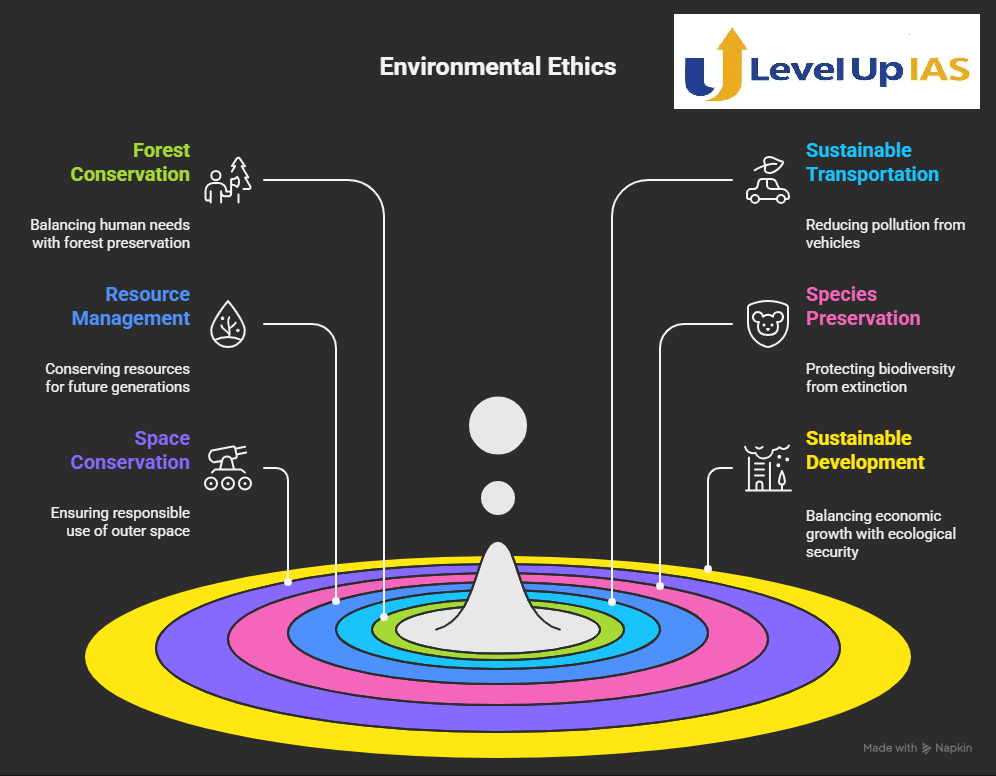
Environmental ethics is a branch of philosophy that expands the scope of moral concern beyond humans to include the natural world. It influences multiple disciplines such as environmental law, sociology, ecological economics, ecotheology (religion–nature relations), ecology, and geography.
Key Ethical Questions
- Should forests be cleared for human consumption?
- Is it ethical to continue producing gasoline‑powered vehicles despite pollution concerns?
- What responsibilities do we hold towards future generations in conserving resources?
- Is it morally acceptable to cause species extinction for human convenience?
- How should humanity use and conserve outer space for sustaining and expanding life?
- How can sustainable development balance present needs with long‑term ecological security?
Environmental Ethics in Indian Tradition
- Vedic Philosophy: Since ancient times, Indian thought emphasized living in harmony with nature. Saints and sages resided in forests, producing spiritual texts like the Vedas, Upanishads, Smritis, and Dharmashastras, all of which reflected reverence for natural elements.
- Sacred Attitude: Nature—trees, rivers, mountains, animals, air (vayu), water (jal), and earth (prithvi)—was considered divine and worthy of worship. Protecting them was seen as a sacred duty.
- Principles in Hindu Thought:
- Respect and protection of nature.
- Non‑violence (Ahimsa paramo dharma) extended to animals, plants, and all living beings.
- Violence (Hinsa) was condemned; abstaining from meat was both a moral duty and spiritual discipline.
- Purity of thought, speech, and environment was emphasized.
- All forms of life—human and non‑human—were considered equal, reflecting the sanctity of life principle.
Contemporary Challenges
1.Industrialization and rapid development have weakened traditional values of coexistence with nature.
2.Humans increasingly view themselves as masters of the universe rather than part of it.
3.Despite awareness of pollution and ecological damage, sensitivity towards environmental protection has declined.
4.Environmental Ethics in the Indian Constitution
India’s constitutional framework reflects its cultural heritage of tolerance, non‑violence, and compassion for all living beings.
• Article 48‑A: Directs the State to protect and improve the environment and safeguard forests and wildlife.
• Article 51‑A(g): Makes it the duty of every citizen to protect and improve the natural environment—including forests, rivers, lakes, and wildlife—and to show compassion towards living creatures.
ETHICS IN JOURNALISM
Journalistic ethics deal with the responsibilities of the press, which today includes both print and electronic media. In India, freedom of the press is considered part of the freedom of speech and expression under Article 19(1)(a) of the Constitution. However, Article 19(2) allows reasonable restrictions, meaning press freedom is not absolute.
The press plays a vital role in democracy by ensuring the free flow of information and ideas, enabling citizens to make informed decisions. Yet, several ethical challenges undermine this role.
Major Ethical Issues in Journalism
1. Paid News
Originated during the liberalization era of the 1990s, when market pressures influenced reporting.
Journalists and media houses sometimes published favorable stories about companies or political candidates in exchange for money or equity.
Example: During elections, newspapers carried promotional stories predicting victories for candidates without genuine news value.
Such practices compromise credibility and mislead the public.
2. Private Treaties
Some media houses entered into agreements where companies gave them equity in return for advertising space.
This blurred the line between editorial content and corporate interests.
Reports favorable to genetically modified crops, for instance, were linked to such arrangements, raising concerns about lobbying and manipulation of public opinion.
3. Blackmail and Extortion
Instances where media executives demanded money from corporations in exchange for toning down negative coverage.
Such practices amount to misuse of journalistic power and erode public trust.
4. Weak Regulation
The Press Council of India (PCI) has been criticized for failing to act decisively against unethical practices like paid news.
Reports exposing malpractice were often suppressed to protect the image of media houses.
This regulatory gap allows unethical practices to continue unchecked.
5. Flawed Audience Measurement
Surveys and ratings systems often provide misleading data about readership and viewership.
Manipulation of television ratings, including bribing households with monitoring devices, distorts the true picture of media reach.
Such flaws affect advertising decisions and credibility.
6. Deceptive Reporting
The media sometimes presents half‑truths or sensationalized stories, which can be more harmful than outright falsehoods.
Yellow journalism thrives on exaggeration, scandal, and sensational headlines rather than well‑researched reporting.
This undermines the democratic role of the press.
7. Media Trials
Commentary on ongoing court cases can influence public opinion and even judicial outcomes.
While freedom of speech is protected, it must be balanced against the right to life and liberty under Article 21.
India requires a middle path between the British ban on sub‑judice commentary and the U.S. allowance of such discussions.
8. Trivialization of News
Excessive focus on entertainment, celebrity gossip, astrology, and sports overshadows pressing socio‑economic issues.
This creates a disconnect between media priorities and the struggles of ordinary citizens.
Ethical journalism demands prioritizing issues of public importance.
Role of Media in Society
Historically, the press acted as a voice of the people against feudal and despotic rulers.
In Europe and America, print media fueled revolutions and democratic movements, earning the title of the Fourth Estate.
In modern times, radio, television, and the internet expanded this role.
In India, the media carries the responsibility of combating regressive ideas like casteism and communalism, while promoting awareness, modern values, and social justice.
By empowering citizens with knowledge, the media strengthens democracy and national progress.
ETHICS IN SPORTS
Focuses on the belief that winning is the ultimate goal.
Encourages bending or exploiting rules to gain an advantage, often disregarding fairness or safety.
Key principles:
- Winning matters above all.
- Cheating is acceptable if undetected.
- The end result justifies the means.
Examples:
- Pretending to be injured or fouled.
- Assuming referees alone are responsible for enforcing rules.
- Jumping the start in races.
- Altering equipment (e.g., modifying a cricket bat).
- Using performance‑enhancing drugs.
- Intimidating or mocking opponents.
Sportsmanship:
- Views competition as a way to build honor, virtue, and character.
- Winning is important, but only when achieved with integrity.
- Core virtues: fairness, integrity, responsibility, respect.
- Promotes mutual trust and respect among athletes and society.
- Encourages personal growth and moral development beyond the playing field.
- Bracketed Morality Debate
- Some argue sports exist in a separate moral space where aggression and victory are the only values.
Example: An athlete may act violently during a game but remain gentle in daily life, justified by the “win‑at‑all‑costs” mindset.
Ethical perspective: Rejects this view, insisting that rules, respect, and fair play are essential. True competition honors both the game and the opponent.
CYBER-ETHICS
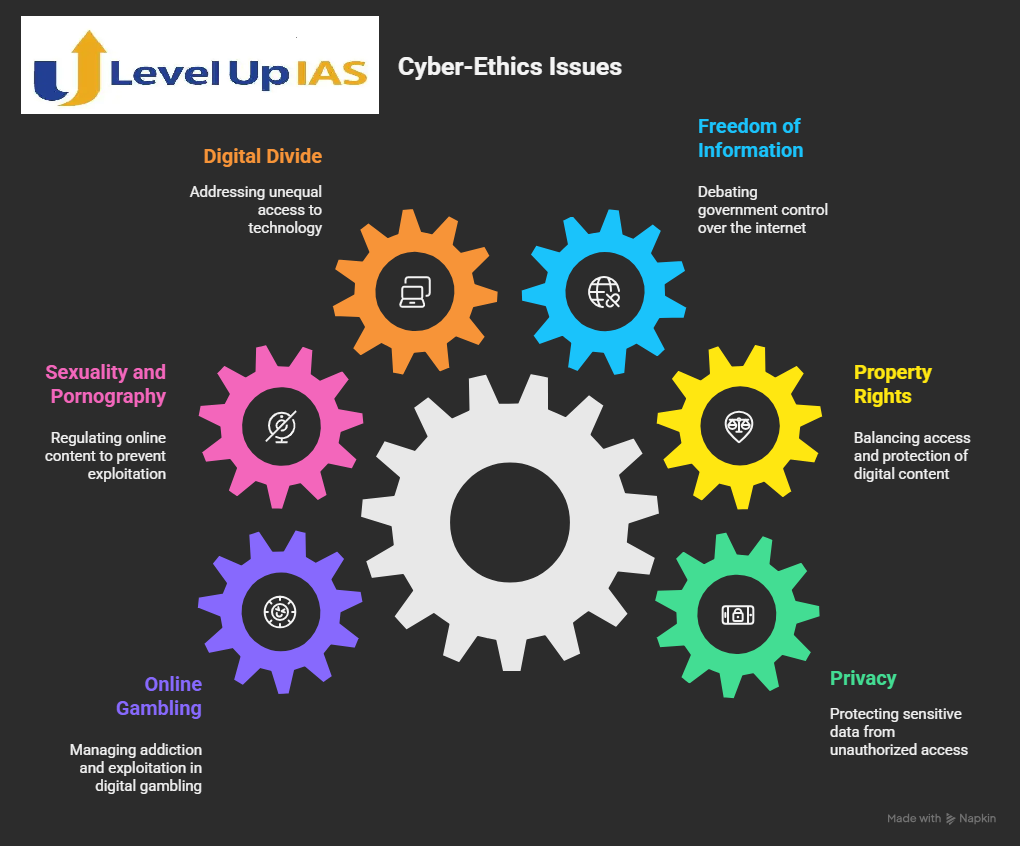
Cyber‑ethics is a branch of applied ethics that addresses moral, legal, and social issues arising from digital technologies, including computers, communication systems, and the internet.
Key Issues
1. Privacy
Privacy safeguards dignity, individuality, and autonomy.
Online sharing of sensitive data (credit card details, addresses, phone numbers, etc.) can lead to privacy violations.
Risks include identity theft, fraud, and impersonation.
2. Property and Intellectual Rights
Information ownership: Disputes arise over whether digital information should be freely accessible or protected.
File sharing: Peer‑to‑peer networks allow anonymous sharing of music, videos, and other media.
Supporters: Promotes access, reduces costs, and increases exposure for artists.
Opponents: Undermines creators’ income and intellectual property rights.
Software ownership:
Closed source software: Protected by licenses, ensuring revenue for developers.
Open source software: Advocates argue programs should be freely available for study and innovation.
3. Freedom of Information
Raises questions of jurisdiction in cyberspace.
- Three perspectives:
- The Internet should be regulated by national governments.
- The Internet is beyond government control and should remain free.
- The Internet requires international regulation since laws vary across countries.
4. Digital Divide
Refers to unequal access to digital technologies between individuals, regions, and nations.
Creates socio‑economic gaps, known as the global digital divide.
5. Sexuality and Pornography
Online pornography raises ethical and legal concerns, especially regarding child exploitation, violence, or bestiality.
Regulation varies across countries, but child pornography is universally illegal.
6. Online Gambling
Internet gambling, both legal and illegal, has grown rapidly.
Cross‑border operations make regulation difficult and raise ethical concerns about addiction and exploitation.
Ten Commandments of Computer Ethics (1992, Computer Ethics Institute)
1.Do not use computers to harm others.
2.Do not interfere with another’s computer work.
3.Do not access others’ files without permission.
4.Do not use computers to steal.
5.Do not spread false information using computers.
6.Do not copy or use software without paying for it.
7.Do not exploit others’ computer resources without authorization.
8.Do not claim others’ intellectual work as your own.
9.Consider the social impact of the systems or programs you design.
10.Always use computers with respect and consideration for fellow humans.
FAQs
Q1. What is applied ethics?
Applied ethics is the practical application of moral principles to real‑world issues such as medicine, business, politics, environment, and technology. It helps resolve dilemmas by balancing rights, duties, and consequences.
Q2. What are the major issues in bioethics?
Key issues include abortion, animal rights, biological patents, bio‑piracy, cloning, and euthanasia. Each raises questions about life, dignity, justice, and human responsibility.
Q3. Why is business ethics important in India?
It ensures transparency, prevents corruption, and builds trust among stakeholders, which is vital for sustainable economic growth.
Q4. What is military ethics?
Military ethics deals with the moral use of force, laws of war, treatment of prisoners, and ethical conduct of soldiers.
Q5. What is political ethics?
Political ethics examines the moral responsibilities of politicians and institutions in governance, focusing on accountability, fairness, and public trust.
Q6. What is cyber‑ethics?
Cyber‑ethics studies moral and legal issues in digital spaces, including privacy, intellectual property, freedom of information, and online safety.
Q7. What are the Ten Commandments of Computer Ethics?
They include principles like not harming others with computers, respecting privacy, avoiding theft, and using technology responsibly.
Q8. Why is applied ethics important for UPSC preparation?
Applied ethics is crucial because it connects philosophy with governance, law, and public policy. UPSC aspirants often encounter case studies in GS Paper IV (Ethics, Integrity, and Aptitude) where applied ethics concepts are directly tested.