
Current Affairs
Golden Triangle
Content
- Why in News?
- Introduction
- What is the Golden Triangle?
- Historical Evolution
- Why a Global Drug Hub?
- Drug Trafficking Routes
- Impact of the Golden Triangle on India
- Connection between Drug Trafficking and Insurgency
- Government Initiatives
- Challenges
- Way Forward
Why in News?
The Golden Triangle has once again attracted attention following the continued rise in synthetic drug production and cross-border narcotics trafficking from Myanmar. Political instability after the 2021 military coup, expanding control of armed ethnic groups over border regions, and increasing seizures of heroin and methamphetamine along the India–Myanmar border have raised serious concerns for India's internal security. Recent reports by the United Nations Office on Drugs and Crime (UNODC) indicate that the region remains one of the world's largest centres for illicit drug production despite decades of counter-narcotics operations.
Introduction
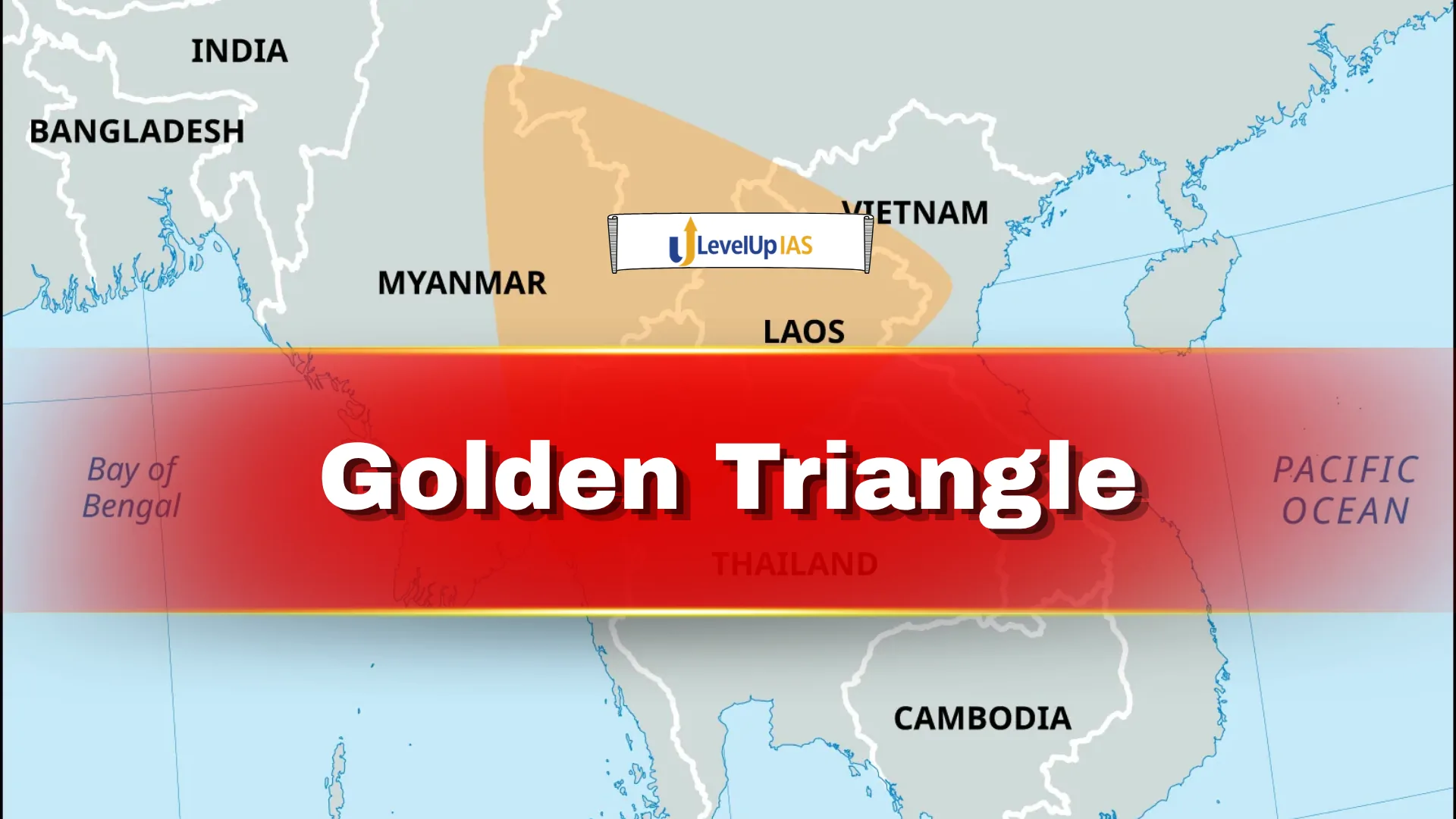
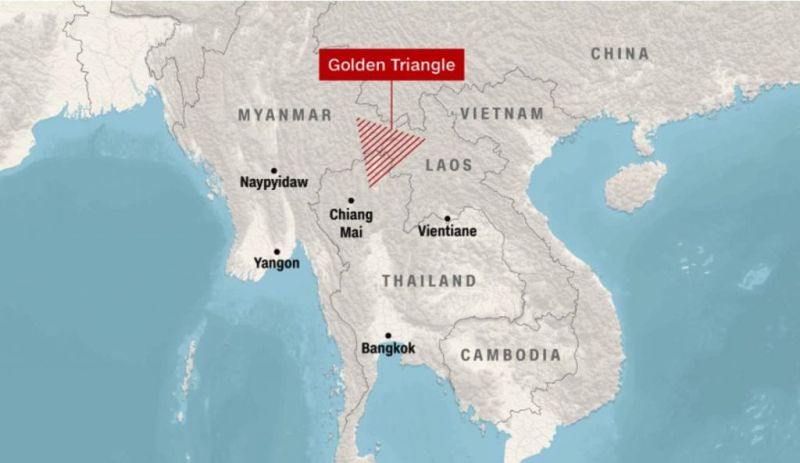
The Golden Triangle refers to the mountainous border region where Myanmar, Thailand and Laos meet near the confluence of the Ruak and Mekong Rivers. For several decades, it remained the world's largest producer of illicit opium before Afghanistan's Golden Crescent emerged as the dominant supplier.
Today, the Golden Triangle has evolved from an opium-producing region into a major global hub for synthetic drugs, especially methamphetamine tablets ("Yaba") and crystal meth, making it one of the most complex transnational security threats in Asia.
What is the Golden Triangle?
The Golden Triangle is a transboundary region located at the intersection of Myanmar, Laos and Thailand. The area consists of rugged mountains, dense forests and poorly connected borderlands, making effective governance extremely difficult.
Historically, the region became famous for large-scale cultivation of opium poppy, which supplied international heroin markets for several decades. Over time, criminal syndicates diversified into manufacturing synthetic narcotics, transforming the region into one of the world's biggest illegal drug production centres.
Unlike conventional agricultural economies, the narcotics economy in the Golden Triangle is closely linked with armed militias, ethnic insurgent groups, cross-border criminal organisations and international trafficking syndicates.
Historical Evolution of the Golden Triangle
The emergence of the Golden Triangle is closely connected with political developments in East Asia during the twentieth century.
Before the establishment of Communist rule in China, southwestern China was one of the world's largest opium-producing regions. Following the victory of the Communist Party in 1949, the Chinese government launched an aggressive anti-opium campaign involving destruction of poppy fields, rehabilitation of addicts, and strict punishment of traffickers.
As a result, drug producers shifted their operations southward into the remote border regions of Myanmar, Thailand and Laos, where weak state institutions and difficult terrain provided ideal conditions for illicit cultivation.
Another important development was the retreat of the Kuomintang (KMT) forces into northern Myanmar after the Chinese Civil War. These armed groups financed their military activities by encouraging opium cultivation and taxing local farmers.
Throughout the Cold War, political instability, ethnic insurgencies, weak governance and international rivalries allowed narcotics production to expand rapidly across the region.
Although Thailand later succeeded in drastically reducing poppy cultivation through alternative development programmes, Myanmar continues to remain one of the world's leading producers of illicit opium and synthetic drugs.
Why did the Golden Triangle become a Global Drug Hub?
The rise of the Golden Triangle cannot be explained by geography alone. It resulted from the interaction of physical, political, economic and strategic factors.
The region's rugged mountainous terrain and dense forests make surveillance and policing extremely difficult. Border areas remain sparsely populated and poorly connected by transport infrastructure, allowing traffickers to move narcotics across international boundaries with relative ease.
The long history of ethnic conflicts in Myanmar has created several areas where the authority of the central government remains weak. Armed ethnic organisations often exercise de facto control over these territories and finance their activities through drug production and trafficking.
Extreme poverty and limited livelihood opportunities encourage local communities to cultivate opium poppy because it offers significantly higher returns than conventional agriculture.
Weak institutions, corruption, porous borders and limited law-enforcement capacity further facilitate the operation of organised criminal networks.
In recent years, the emergence of sophisticated synthetic drug laboratories has made production even more profitable because synthetic drugs require smaller cultivation areas and can be manufactured throughout the year.
Major Drugs Produced in the Golden Triangle
Historically, the region was associated primarily with opium and heroin.
However, over the past two decades, criminal organisations have increasingly shifted towards synthetic narcotics.
Today, the Golden Triangle is one of the world's largest producers of:
- Opium
- Heroin
- Methamphetamine (Crystal Meth)
- Yaba tablets
- Ketamine
- Other synthetic psychoactive substances
This shift has significantly increased profits because synthetic drugs require fewer natural resources and can be manufactured on an industrial scale.
Drug Trafficking Routes
Drug trafficking from the Golden Triangle follows multiple international routes.
One network moves narcotics through Thailand and maritime routes towards East Asia and Oceania.
Another route passes through Laos into Vietnam and southern China.
The route most relevant for India enters through Myanmar, crosses into Manipur, Mizoram, Nagaland, and sometimes Arunachal Pradesh, before moving towards Assam and the rest of India.
From Indian cities, narcotics are transported to international markets through airports, ports and land borders.
These trafficking routes often overlap with networks involved in illegal arms trade, human trafficking and money laundering.
Impact of the Golden Triangle on India
India's geographical proximity to Myanmar makes it particularly vulnerable to the activities originating in the Golden Triangle.
Internal Security Challenge
Drug trafficking has emerged as one of the most significant non-traditional security threats for India. Revenue generated through narcotics often finances insurgent organisations operating in the North-East.
Several armed groups involved in separatist movements have reportedly used drug trafficking for procuring sophisticated weapons and sustaining their underground activities. Consequently, narcotics trafficking and insurgency reinforce each other, creating a vicious cycle of violence and organised crime.
Border Management Challenges
India shares a long international border with Myanmar, much of which passes through remote mountains and forests.
Large stretches remain difficult to monitor because of poor infrastructure, traditional tribal movement across borders and limited surveillance capacity.
These conditions allow traffickers to exploit informal crossing points for smuggling drugs, weapons and counterfeit currency.
Public Health Crisis
The availability of heroin and synthetic drugs has led to increasing substance abuse, particularly among young people in several North-Eastern states.
Drug addiction contributes to unemployment, crime, family breakdown and mental health disorders.
Injection drug use has also contributed to the spread of HIV/AIDS and Hepatitis among vulnerable populations.
Organised Crime
Drug trafficking has strengthened criminal syndicates operating across national boundaries.
These organisations engage simultaneously in money laundering, arms smuggling, fake currency circulation, cybercrime and human trafficking.
The convergence of these criminal activities complicates law-enforcement efforts.
Economic Impact
The illegal narcotics economy generates enormous unaccounted wealth that fuels corruption and weakens legitimate economic institutions.
Resources that should contribute to productive development are instead diverted towards criminal enterprises.
Diplomatic Challenges
India must balance counter-narcotics cooperation with Myanmar while simultaneously addressing issues related to border security, refugee movements, ethnic conflicts and humanitarian concerns.
Political instability inside Myanmar has made bilateral cooperation increasingly complicated.
Connection between Drug Trafficking and Insurgency
One of the most important dimensions of the Golden Triangle from a security perspective is its close relationship with insurgency.
Several insurgent organisations operating in the India-Myanmar border region exploit drug trafficking to finance recruitment, procure weapons and sustain armed activities.
This phenomenon is commonly described as Narco-Terrorism, where illegal narcotics become a major source of funding for violent organisations.
Narco-terrorism creates a multidimensional threat by combining organised crime, terrorism, insurgency and corruption into a single security challenge.
Government Initiatives
India has adopted a multi-layered strategy to combat narcotics trafficking.
The Narcotic Drugs and Psychotropic Substances (NDPS) Act, 1985 provides the principal legal framework for controlling production, possession and trafficking of narcotic substances.
The Narcotics Control Bureau (NCB) serves as the apex agency for intelligence coordination and enforcement against drug trafficking.
The National Investigation Agency (NIA) investigates narco-terrorism cases where drug trafficking is linked to terrorism and organised crime.
The Nasha Mukt Bharat Abhiyaan focuses on reducing drug demand through awareness generation, prevention and rehabilitation.
India has strengthened surveillance along the India–Myanmar border through improved infrastructure, border fencing in selected stretches, technological surveillance and enhanced deployment of the Assam Rifles.
International cooperation with organisations such as the United Nations Office on Drugs and Crime (UNODC), along with regional mechanisms including BIMSTEC, ASEAN, and the Mekong-Ganga Cooperation, has further strengthened intelligence sharing and capacity building.
Challenges in Countering Drug Trafficking
Despite various initiatives, several structural challenges persist.
Political instability in Myanmar has weakened border management and reduced bilateral enforcement cooperation.
The difficult terrain and long international border increase surveillance costs.
The growing shift towards synthetic drugs has made detection more difficult because production requires smaller facilities and can be relocated rapidly.
Corruption, weak financial investigations and sophisticated international criminal networks continue to undermine enforcement efforts.
The misuse of digital platforms, cryptocurrencies and encrypted communication has further complicated narcotics investigations.
Way Forward
An effective response requires a comprehensive security strategy rather than isolated policing measures.
India should strengthen integrated border management through modern surveillance technologies such as drones, artificial intelligence-enabled monitoring systems and smart fencing wherever feasible. Better road connectivity and logistical infrastructure in border districts would significantly improve operational response.
Counter-narcotics cooperation with Myanmar, Thailand and Laos should be enhanced through intelligence sharing, joint operations, extradition arrangements and coordinated financial investigations targeting organised crime syndicates.
The financial foundations of drug trafficking must be weakened by stricter enforcement against money laundering, shell companies and illegal financial networks.
Simultaneously, greater investment is needed in rehabilitation programmes, de-addiction centres, skill development and employment opportunities for vulnerable youth in border regions to reduce local participation in the narcotics economy.
India should also continue leveraging regional platforms such as BIMSTEC, ASEAN, and the Mekong-Ganga Cooperation to develop coordinated anti-narcotics strategies while supporting stability and development in Myanmar.
Related reads.

EU’s Carbon Border Adjustment Mechanism (CBAM)
22 Sep 2026 4 min
ASEAN: Association of Southeast Asian Nations
16 Sep 2026 6 min

National Food Security Act (NFSA), 2013
16 Sep 2026 6 min

Borophene
15 Sep 2026 3 min

WTO Agreement on Fisheries Subsidies
14 Sep 2026 3 min

Eärendil-1 Satellite
12 Sep 2026 2 min
Put it into practice
Reading is step one.
Turn what you've just read into exam-ready answers with mentor-led practice and our structured test series.