
Nishat Sir's innovative methodology
- Flash writing sessions
- LIVE MCQ quiz - for revision of chapters
- High quality study material - based on original research PYQ handouts
- Reference materials and class notes

Open Admissions
Sociology Optional Foundation 2027 (Batch 3) (Offline)
₹48,000 + 18% GST
Sociology Optional Foundation 2027 (Batch 3) (Online)
₹43,000 + 18% GST
GS Foundation 2028 + Optional Foundation Combo (Offline)
₹2,40,000 + 18% GST
GS Foundation 2028 + Optional Foundation Combo (Online)
₹1,90,000 + 18% GST
Note: Each lecture can be watched 3 times (2 in Recorded mode + 1 Live) within 72 hours of upload.
Note: No Hybrid access mode available.
Prepare for UPSC CSE 2027 with the Sociology Optional Foundation Course by Nishat Sir, one of the best Sociology faculty for UPSC.
The programme is designed for conceptual clarity, sociological thinking, and answer-oriented preparation from the beginning.
A major focus area is answer writing skill development: learning how to structure answers, build sociological analysis, and write effectively for UPSC Mains.
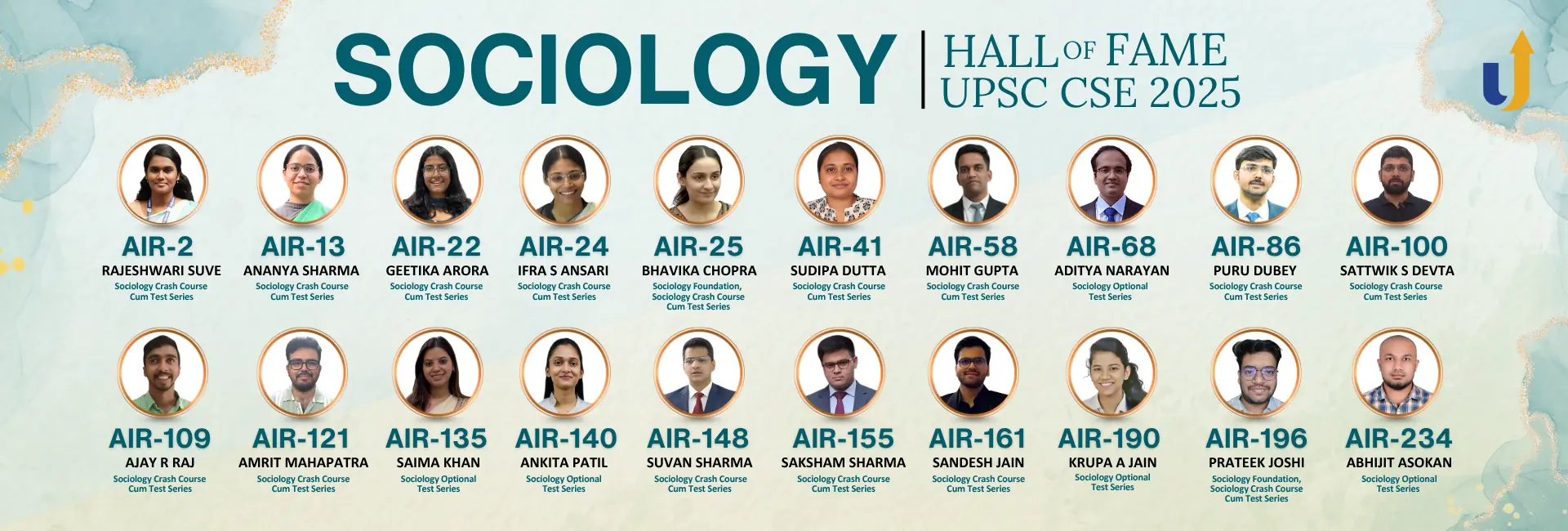
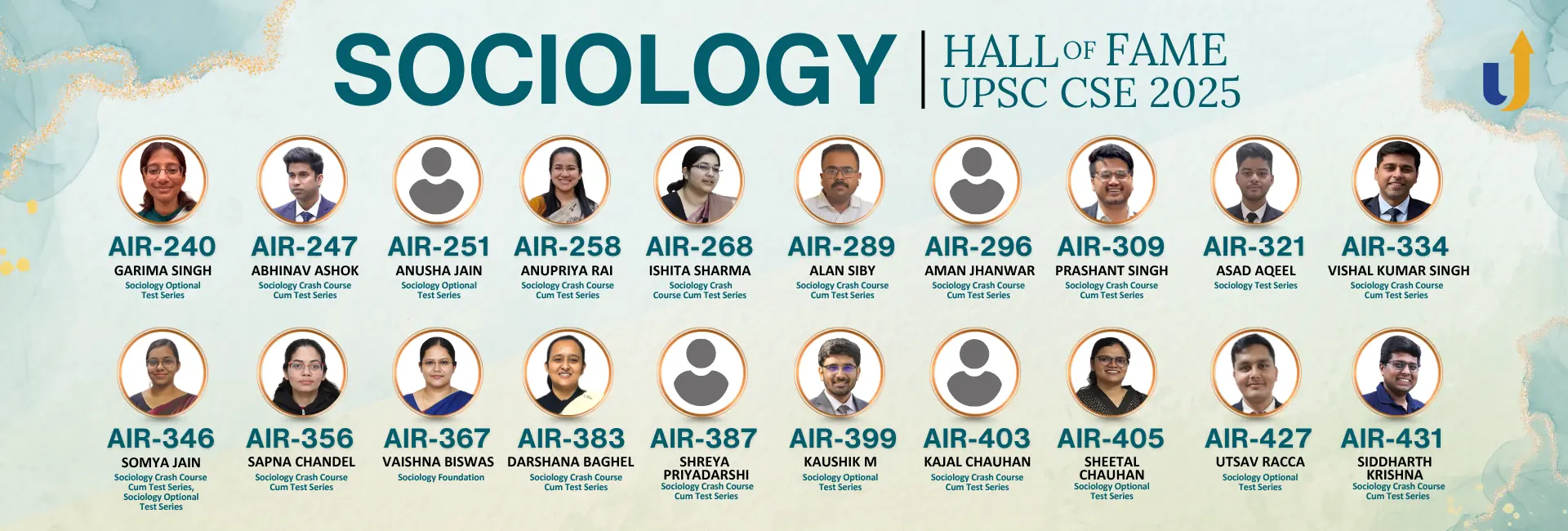
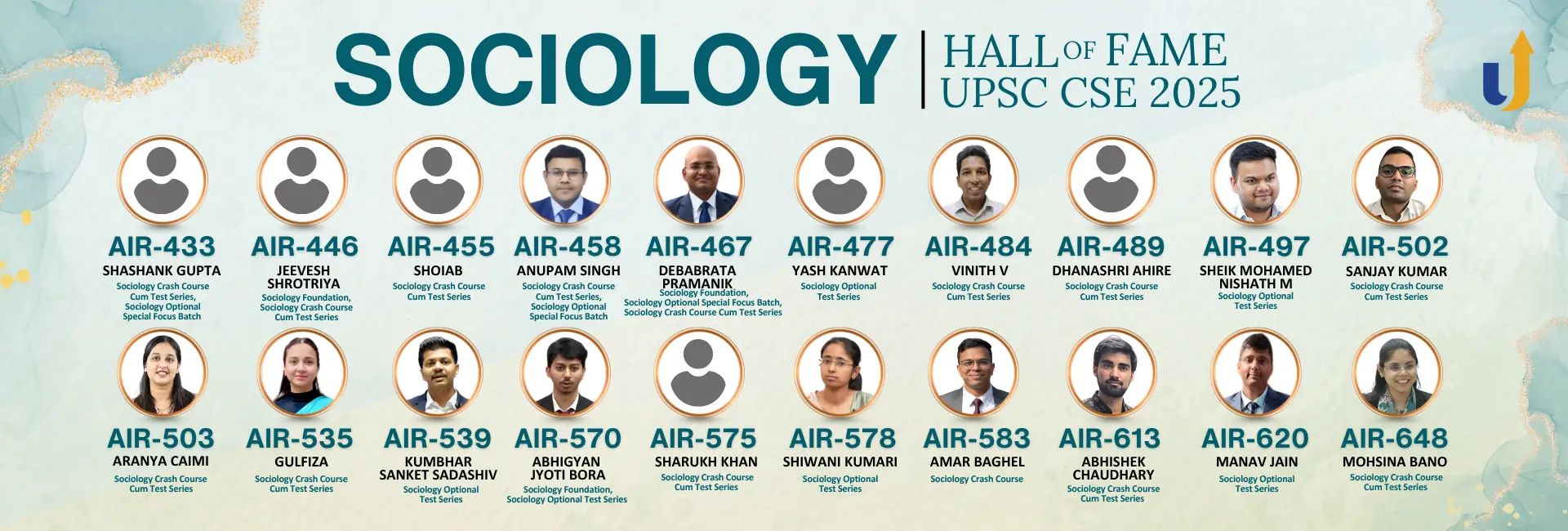
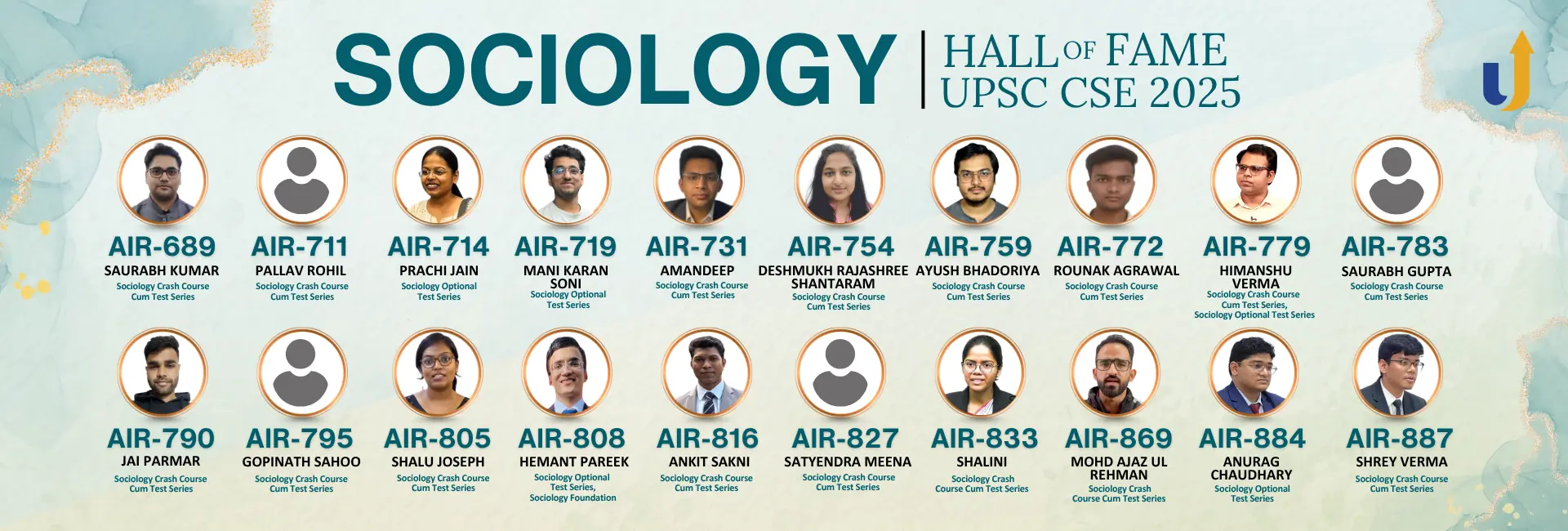
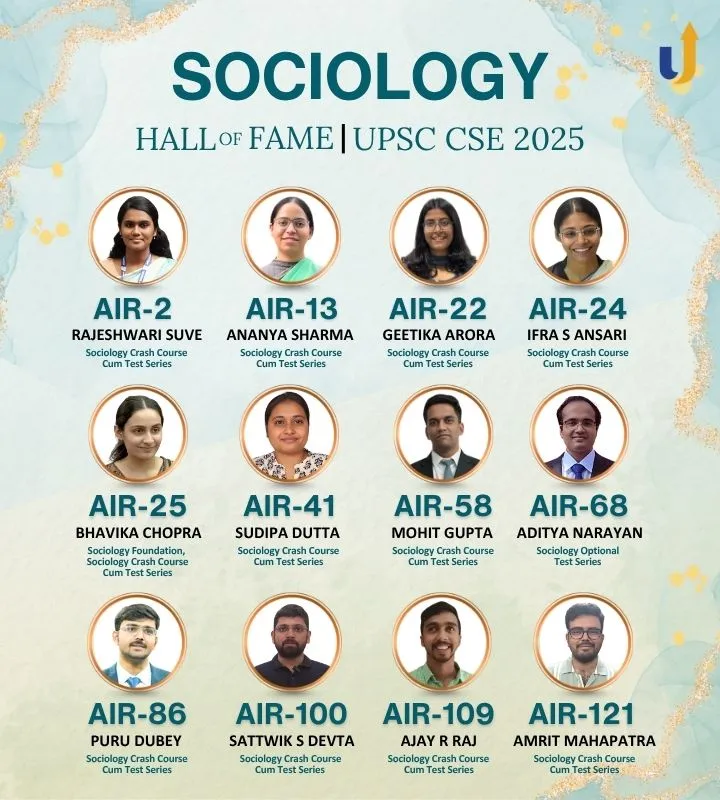
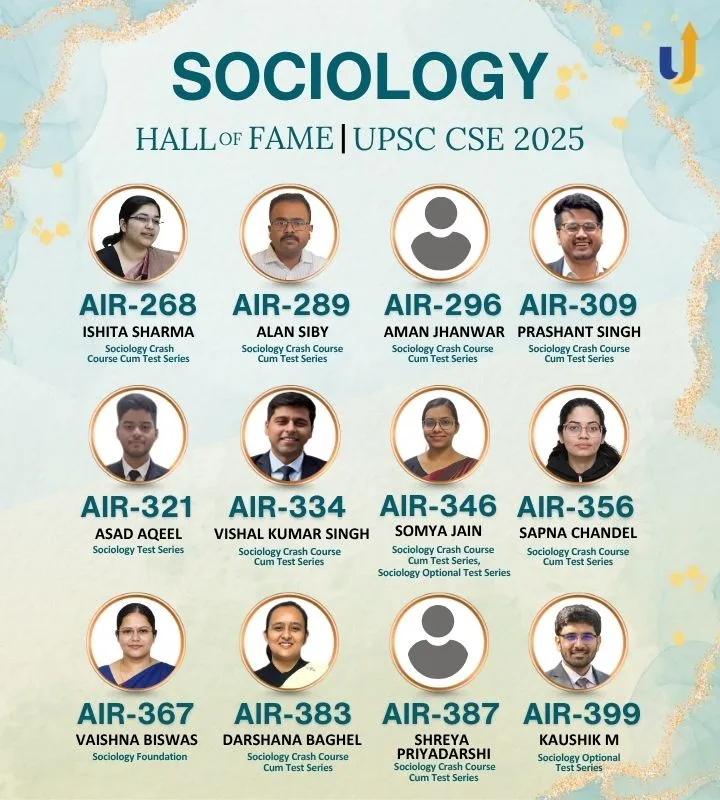
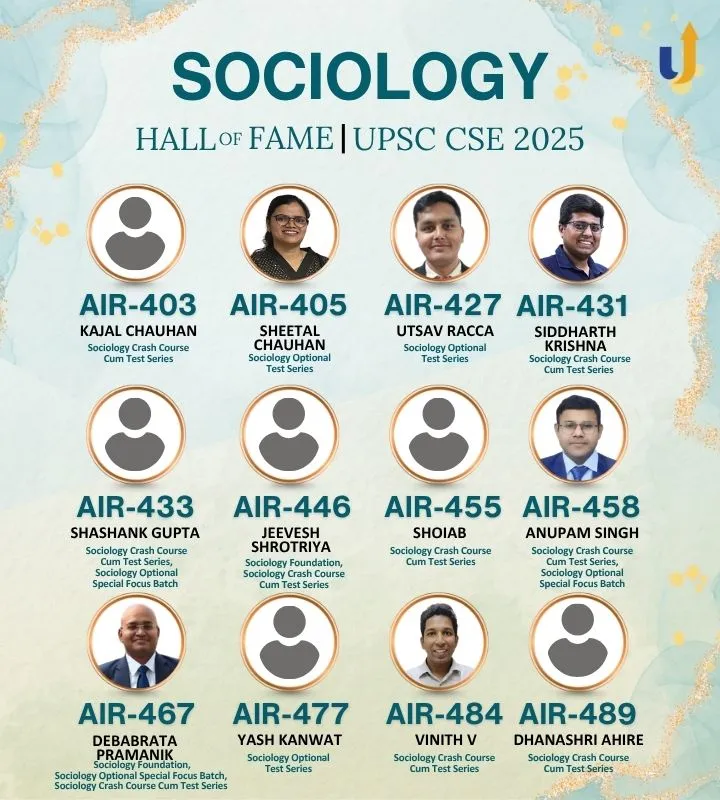
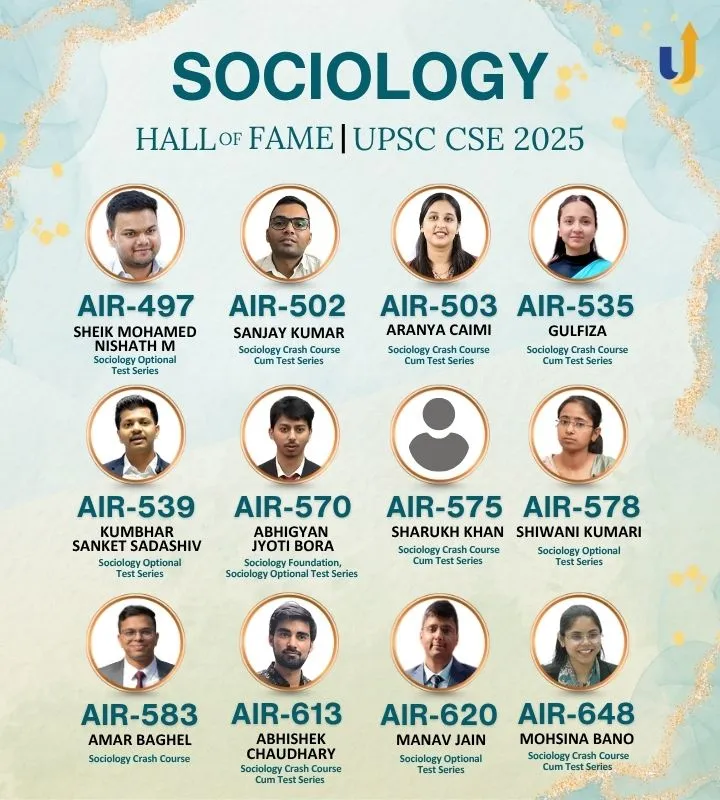
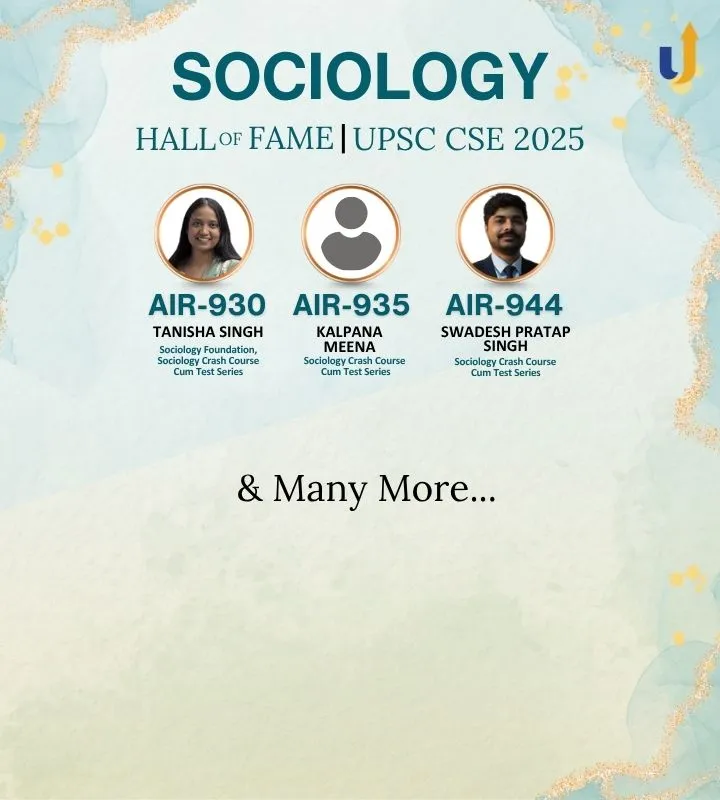
Nishat Sir has mentored 240+ UPSC rankers, including 87+ selections in UPSC CSE 2025 from Sociology classroom and mains programmes, with ranks including AIR 2, AIR 13, AIR 22, AIR 24, AIR 25, AIR 41, AIR 58, AIR 68, AIR 86, and AIR 100.
Why Sociology with Nishat Sir



Sample Sociology Handouts
Note: Each lecture can be watched 3 times (2 in Recorded mode + 1 Live) within 72 hours of upload.
Note: No Hybrid access mode available.
Online Mode: ₹ 43,000 + GST
Offline Mode: ₹ 48,000 + GST
Offline Mode: ₹ 1,90,000 + GST
Online Mode: ₹ 1,50,000 + GST
Fill out the form & connect 1-1 with us
Time-bound and complete coverage of Paper 1 and Paper 2, including PYQs.
You will learn to write high scoring answers in UPSC Sociology papers.
The course is structured around conceptual clarity, presentation, and answer-writing depth.
The programme supports complete optional preparation alongside your CSE 2027 journey.
Beginners with no prior background in Sociology.
Aspirants who scored less than 230 in Sociology in the last attempt.
Aspirants planning to appear for UPSC CSE in 2027.
Support throughout programme completion.
A system to highlight your critical gaps and find ways to fill them.
Learning loops are closed multiple times through the duration of the programme.
Mentorship keeps your preparation consistent, accountable, and course-corrected.

An IIT BHU, DSE, and JNU alumnus, Nishat Sir has mentored over 240 UPSC rankers, including 87+ Toppers in UPSC 2025 & 52+ Toppers in UPSC 2024. Known for his innovative teaching methods and personalised mentorship, Nishat Sir has helped numerous aspirants achieve exceptional scores in Sociology.
Nishat Sir's teaching philosophy is grounded in practical wisdom and a deep understanding of the UPSC examination process. Some of his key maxims that guide his methodology and approach:
Watch the method
A: For Offline/Online Courses (Validity More Than 100 Days)
| Time Frame | Deduction Percentage | Processing Time | Request Method | Refund Mode |
|---|---|---|---|---|
| Day 0 to Day 7 | 10% deduction | Processed within 30 working days | Only via email to support@levelupias.com | Same bank account used for payment |
| Day 8 to Day 30 | 50% deduction | Processed within 30 working days | Only via email to support@levelupias.com | Same bank account used for payment |
| After Day 30 | No refund applicable | Not applicable | Not applicable | Not applicable |
B: For Recorded Modules / Courses, Crash Courses, Test Series, and Short-Duration Courses (Validity Less Than 100 Days)
| Time Frame | Deduction Percentage | Processing Time | Request Method | Refund Mode |
|---|---|---|---|---|
| Day 0 to Day 7 | 20% deduction | Processed within 30 working days | Only via email to support@levelupias.com | Same bank account used for payment |
| On or After Day 8 | No refund applicable | Not applicable | Not applicable | Not applicable |
NOTE: The deduction is based on the course fee, not the amount paid.
NOTE: If a student transfers from one course to another, they will not be eligible for a refund.
Procedure to Request a Refund
All refund requests must be submitted via email to support@levelupias.com with the following details:
NOTE 1: Refund requests made verbally, over the phone, on any social media or in person will NOT be valid or accepted.
NOTE 2: The refund request date will be considered as the date when all required documents are received by the Institute. Approved refunds will be processed within 30 working days after that.
NOTE 3: Only bonafide refund requests will be accepted. If any course material (videos, handouts, etc.) is accessed or downloaded with malafide intent, the refund request will be strictly denied.
Prepared Sociology entirely through LevelUp IAS guidance.
I had very limited exposure to Sociology initially. I joined the Sociology Crash Course of Nishat Sir at LevelUp IAS and relied on it for notes, test series, and feedback. This was the only structured guidance I followed for Sociology.

Consistency and mentorship across multiple attempts.
Nishat Sir supported me not just academically but also emotionally during my preparation. His guidance helped me stay consistent and improve my Sociology preparation over time.

Improved through Foundation + Crash Course approach.
I joined the Sociology Foundation Course (2024) and later the Crash Course before Mains. Nishat Sir's detailed evaluation of my answer copies helped me understand what was working and what needed improvement. His guidance played a fundamental role in my result.

Scored 270+ in Sociology Optional.
The Sociology Crash Course helped me complete the syllabus in a short time. The test series and detailed feedback were extremely useful and played a major role in improving my marks.

Bridged gaps in Paper 1 and Paper 2 through test practice.
Writing tests at LevelUp IAS helped me identify gaps, improve answer structure, and stay consistent through the final preparation phase.

Our top rankers
FAQs
Just like a Biologist studies organs inside human body and their behavior , a Sociologist studies organs of society, their functions, the individuals, & groups. Simple !
If lungs, liver, kidney, brain etc make human organs, the religion, family, education & government system are the organs of society. Fine ?
Okay! To put it short, we study origin, evolution, and function of family, religion, education system etc. Origin and evolution is well understood, but in order to understand what is function, let us give you an example. Let’s take the case of Religion.
The functions of religion in society:
Let us correct you a bit here. Sociology is the only subject where your own personal life experiences make the background. Believe it or not, you already have a brief idea about family, religion, government, education system in your mind. The only difference is that we study them in depth with a ‘critical thinking’. Please don’t ask us about critical thinking at this stage.
This question doesn’t sound any different from ‘’how to get biggest muscles” or “how to get rank 1”. Unfortunately, there is no magic wand to get the highest marks. However, there are 3 important ingredients that definitely makes it a lot easier.
Top three ingredients would be-
Most important of all of them is ‘faith’ in each one of these ingredients.
Current affairs and multiple thinkers. Each one of them sells in the market & neither one of them in isolation or in combination with the other can fetch you selection. Neither the overemphasis on current issues nor sprinkling thinkers names and their books in the intro is going to help.
There is no definite answer to this question because there is no correlation between number of thinkers and marks. It’s not about ‘Quantity of thinkers’, rather it’s the ‘quality of argument’ given by the thinker that matters to the examiner. The examiners are very senior and they are not going to get impressed by number of thinkers or unique thinkers, rather they are mainly interested to see whether you fulfilled the demand in given word and time limit or not. This line of thinking will force you to shift to the “Quality of the argument” instead of sticking to the ‘quantity of thinkers’.
We call an argument a good quality one if & only if it addresses the exact demand & establishes the basic background to the given demand of the question. On the other hand, an argument is a bad quality one if it only reproduces heavy jargons & random quotation what you have learnt from varied sources without bothering enough of their relevance to the ‘demand’ of the question.
Current affairs is only a “cherry” on the cake and the static portion remains the “base” of the cake. Keep the rule of 80:20 in your mind.
An ideal answer should have 80% content from static area, while 20% should be reserved either for current application or the critique of the concept (whatever question demands). This rule doesn’t apply to the question where demand is ‘specifically’ on critical analysis or latest developments only.
The examiners are not there to check your grammar, sentence construction or vocabulary. They are interested to see only two things .
I guess most of the students are writing demand only, then why to overemphasise on demand ?
Because most of the students are not writing “demand”, rather they are writing their “notes”. There is a huge difference between notes and demand/answer. This is the most essential learning that we must acquire, but by the time students get to know about it, they are either exhausted with their attempts or enthusiasm or their monetary resources.
LevelupIAS is a one-stop solution for Sociology programme. Nishat Sir’s pedagogy and personalised guidance makes the subject not just student-friendly but marks-friendly too.
Our deliverables :
Yes. PYQ booklets are given in the class & we practice PYQs at the end of each unit that we complete.
Our PYQ booklet is designed to keep every aspect of sociology’s preparation well structured. We organise questions not just year wise or chapter wise but also sub-heading wise from each chapter. This enables you to understand what sub-topics are important from each chapter.
After completion of an area or a unit, Nishat sir would solve 1-2 questions on board under timed conditions. A live countdown timer is run on the smartboard & answers are written Live in the class. Faculty will brief you on instructions that will help you develop the writing skills gradually. After few such sessions, students are given questions, timed and supervised by the Faculty.
Both have different target audience, structure and objectives.
Crash course is only for those who have covered their foundation (either by self study or coaching) already & cleared prelims or anticipating to clear prelims. Since these students have less time in their hand, the crash course helps them to cover the sizeable syllabus, with PYQs, in a matter of 1.5 months (around 25 classes).
On the other hand, Sociology Foundation is for complete beginners who are starting from the scratch. This runs for 5 months minimum, is highly interactive, and fulfills all the demands of this examination for complete beginners.
Your background does not matter as long as you are passionate about cracking this exam. For your information, most of the toppers from sociology, statistically, have been from NON-sociology background.
The time period from June to November is the most preferrable one to cover optional subject. In case you miss this timeline due to any reason, you may still continue your preparation till March. However, January onwards, students start feeling the mounting pressure of Prelims examination which is usually held around May/June. This is why it is always advisable to finish Optional preparation by the ends of December or January. This helps you to give maximum time to prelims January onwards.
Every individual is endowed with different degree of cognitive skills, and therefore there cannot be one size-fit all approach. What is required is the proper handcrafted notes (consisting of exam-oriented keywords, diagrams, & flowcharts systematically organized at one place) which will not only develop interest among the students to learn the subject, but will also help them ace the exam with flying colors.
Our handouts are in-sync with the classroom. It means that unlike other institutions where class notes and handouts do not match with each other, our sociology foundation handouts and class notes are in sync with each other. Students are given handouts immediately after completion of a sub-topic/topic, which help them revise the classes in no time.