
GS-I (History, Geography, Society)
Ocean Waves
Introduction
Ocean waves are rhythmic movements of seawater that transfer energy across the ocean surface. They are among the most visible forms of oceanic movement and play an important role in coastal erosion, transportation, marine navigation and the formation of coastal landforms.
Most ocean surface waves are generated by wind blowing over the water. However, waves can also be produced by earthquakes, underwater landslides, volcanic eruptions and changes in atmospheric pressure. Although waves may cause water particles to move, they primarily transfer energy rather than transporting water over long distances.
Formation of Ocean Waves
Wind is the principal source of energy for ordinary ocean surface waves. As wind blows over the sea, friction between the air and water transfers energy to the water surface. Small ripples develop first, allowing the wind to exert a stronger influence and gradually build larger waves.
The size of wind-generated waves depends mainly on three factors:
Wind speed: Stronger winds generally transfer more energy to the water and generate larger waves.
Wind duration: Winds blowing continuously for a longer period allow waves to grow in height and length.
Fetch: Fetch is the uninterrupted distance over which wind blows across the water in a relatively consistent direction. A longer fetch allows waves to accumulate more energy.
When these factors combine, waves may grow considerably and eventually develop whitecaps and breaking crests.
Characteristics of Ocean Waves
Ocean waves are described using several important geographical terms.
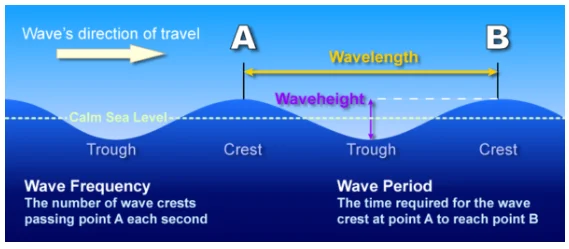
Characteristic | Description |
| Crest | The highest point of a wave. |
| Trough | The lowest point of a wave. |
| Wave height | The vertical distance between the crest and trough. |
| Amplitude | Half of the wave height, measured from the still-water level to the crest or trough in a regular wave. |
| Wavelength | The horizontal distance between two successive crests or two successive troughs. |
| Wave period | The time taken for two successive crests or troughs to pass a fixed point. |
| Wave frequency | The number of waves passing a fixed point per unit of time. |
| Wave speed | The rate at which a wave travels through the water. |
These characteristics help explain the energy, movement and potential effects of waves on coastlines and marine activities.
Movement of Water Particles in Waves
An important feature of ocean waves is that the movement of the wave does not mean that the same volume of water travels forward with it.
In deep water, water particles generally move in approximately circular orbits as a wave passes. Particles near the surface show the greatest movement, while the orbital motion becomes progressively smaller with increasing depth. Wave energy, meanwhile, continues to move forward through the water.
As a wave approaches a shallow coast, its interaction with the seabed changes this movement. The lower part of the wave experiences friction, causing the wave to slow down. Its wavelength decreases, while its height and steepness increase. Eventually, the wave becomes unstable and breaks, releasing energy along the shore.
Types of Ocean Waves
Ocean waves can be classified according to their source of energy and the processes responsible for their formation.
1. Wind Waves
Wind waves are the most common type of ocean surface wave. They form when wind transfers energy to the water surface. Their size depends on wind speed, duration and fetch.
Waves generated by nearby winds are often irregular and relatively steep. They are common in stormy seas and may become hazardous to ships and other marine activities.
2. Swell Waves
Swell waves are generated by winds and storms but travel beyond the region where they originally formed. As they move away from a storm, waves tend to become more organised and regular, with longer wavelengths and lower frequencies than many locally generated wind waves.
Swell waves can travel thousands of kilometres across the ocean before reaching distant coastlines. For example, large Pacific storms generate swells that reach the Hawaiian Islands and support their well-known big-wave surfing conditions.
3. Tsunami Waves
Tsunamis are long-wavelength waves caused by the sudden displacement of a large volume of water. Major triggers include undersea earthquakes, submarine landslides and volcanic activity.
In deep water, a tsunami may have a relatively small height and travel at very high speed. As it approaches shallow coastal waters, its speed decreases and its height may increase significantly, producing destructive flooding and powerful currents.
Unlike ordinary wind waves, tsunamis involve movement through a much greater depth of the water column. They can cross entire ocean basins and cause damage far from their source.
4. Storm Surges and Storm-Generated Waves
Strong winds and low atmospheric pressure associated with severe storms can raise sea levels along coastlines. This rise, known as a storm surge, is distinct from an ordinary wind-generated surface wave, although both can occur together.
Storm surges become particularly dangerous when they coincide with high tides, allowing seawater to penetrate further inland. The combined effects of elevated sea level, large waves and coastal flooding can damage settlements, ports and infrastructure.
5. Rogue Waves
Rogue waves are unusually large waves that occur within a surrounding sea of smaller waves. They are generally defined as waves whose height exceeds twice the significant wave height of the surrounding sea state.
They may develop when waves travelling in different directions or at different speeds reinforce one another, concentrating energy into an exceptionally large wave. Interactions between waves and ocean currents can also contribute to their formation.
Rogue waves pose a serious risk to ships and offshore structures because of their exceptional height and potentially unpredictable occurrence.
Breaking Waves and Coastal Processes
When waves enter shallow water, friction with the seabed reduces their speed. As the wavelength shortens, the wave becomes steeper and eventually breaks. The resulting movement of water and release of energy are important agents of coastal change.
Erosion: Breaking waves exert pressure on cliffs and rocky shores, dislodging material and contributing to the formation of sea caves, arches and other coastal landforms.
Transportation: Waves move sand, pebbles and other sediments along the coast. When waves approach the shoreline at an angle, they can generate longshore drift, transporting sediment parallel to the coast.
Deposition: Where wave energy decreases, transported sediments may accumulate to form beaches, spits and bars.
Coastal hazards: Powerful waves can damage coastal infrastructure, erode beaches and contribute to flooding, especially during storms and high tides.
Thus, ocean waves continually reshape coastlines through the interaction of erosion, transportation and deposition.
Significance of Ocean Waves
Ocean waves have both economic and environmental importance. Their energy influences coastal ecosystems and sediment movement, while swell patterns affect surfing, shipping and marine operations. Wave observations also contribute to weather forecasting, coastal planning and maritime safety.
However, high waves, rogue waves, tsunamis and storm-related coastal flooding can threaten human life and property. Understanding wave formation and behaviour is therefore essential for disaster preparedness and sustainable coastal management.
Wave energy can also be harnessed to generate renewable electricity. Although wave-energy technology has potential, its wider adoption depends on cost, technical reliability, environmental effects and the ability of equipment to withstand harsh marine conditions.
Conclusion
Ocean waves are a fundamental component of oceanic movement, primarily generated by wind but also produced by major geological and atmospheric disturbances. Their characteristics, including height, wavelength, period and speed, determine how they behave in the open ocean and near coastlines.
From transporting energy across ocean basins to shaping beaches and creating coastal hazards, waves have a significant influence on the physical geography of the world's oceans. Understanding their formation and dynamics is essential for oceanography, coastal management and maritime safety.
FAQs
1. What are Ocean Waves?
Ocean waves are disturbances that transfer energy through seawater, commonly appearing as alternating crests and troughs. In ordinary waves, water particles move mainly in orbital paths rather than travelling forward with the wave.
2. What causes Ocean Waves?
The most common cause is wind blowing over the ocean surface. Other causes include earthquakes, underwater landslides, volcanic eruptions and gravitational forces associated with tides.
3. What are the main characteristics of Ocean Waves?
The main characteristics are:
- Crest: Highest point of a wave.
- Trough: Lowest point between successive crests.
- Wavelength: Distance between two successive crests or troughs.
- Wave height: Vertical distance between crest and trough.
- Wave period: Time taken for successive crests to pass a fixed point.
4. What factors determine the height of Wind-Generated Waves?
Wave development depends mainly on:
- Wind speed
- Duration of wind
- Fetch - uninterrupted distance over which the wind blows across the water
Stronger winds, longer duration and greater fetch generally produce larger waves.
5. What are Swells?
Swells are relatively regular waves that travel beyond the areas where they were generated by wind. They can travel long distances across ocean basins and often reach coastlines after the generating storm has moved away.
Related reads.
Decolonisation in Asia and Africa
18 Oct 2026 8 min
Temperature Distribution in Oceans
10 Oct 2026 9 min
Globalisation and Its Effects
09 Oct 2026 8 min
Tides in Oceanography
08 Oct 2026 7 min

Land Reforms in India
08 Oct 2026 8 min

The Mughal Art and Architecture
07 Oct 2026 9 min
Put it into practice
Reading is step one.
Turn what you've just read into exam-ready answers with mentor-led practice and our structured test series.