Attitude: Definitions and Components
General Studies Home Page
Table of Contents
- Introduction
- Definitions by Scholars
- Characteristics of Attitudes
- Types of Attitudes
- Content of Attitude: Its Components
- The Multi‑Component Model of Attitude
- Relation Between CAB Components
- Strategies and Techniques to Eliminate Prejudice in Different Settings
- Conclusion
- FAQs
Introduction
Attitudes are lasting evaluations—positive, negative, or neutral—that people form about objects, ideas, events, or individuals. They guide how we think, feel, and behave in different situations.
Definitions by Scholars
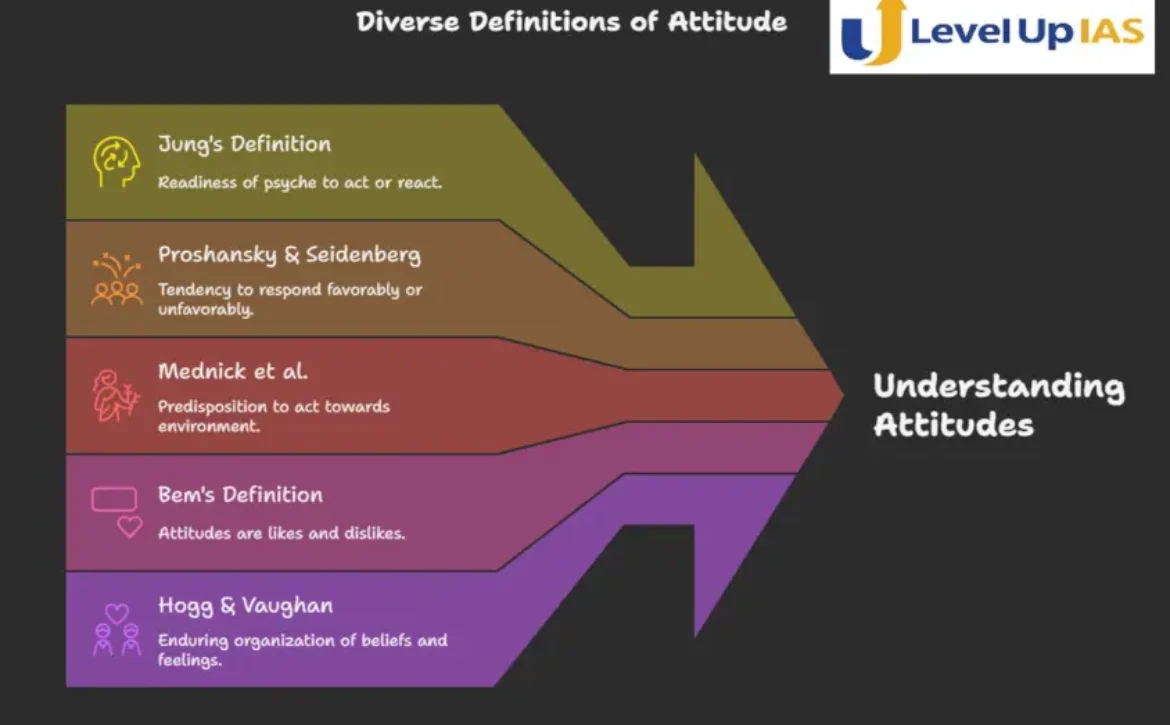
- Jung (1921): “Attitude is a readiness of the psyche to act or react in a certain way.”
- Proshansky & Seidenberg (1965): “An attitude is a complex tendency to respond consistently in a favourable or unfavourable way to social objects.”
- Mednick et al. (1975): “An attitude is a predisposition to act in a certain way towards aspects of one’s environment.”
- Bem (1979): “Attitudes are likes and dislikes.”
- Hogg & Vaughan (2005): “An attitude is a relatively enduring organization of beliefs, feelings, and behavioural tendencies towards socially significant objects, groups, events, or symbols.”
From these definitions, attitudes can be understood as predispositions to act, think, and feel in particular ways toward people, objects, or ideas.
Characteristics of Attitudes
- Attitudes involve an object (person, event, idea, or organization).
- They can be expressed through statements like:
- “I enjoy classical music.”
- “I dislike rock music.”
- They are communicated using words such as like, dislike, love, hate, good, bad.
- Attitudes are learned and acquired, unlike personality traits which are more permanent.
Types of Attitudes
1. Positive Attitudes
- “There is something good in every situation.”
- “A problem is an opportunity to grow.”
- “Change is a sign of progress.”
- “Mistakes are valuable steps toward success.”
2. Negative Attitudes
- “There is always something wrong.”
- “Other people cause problems.”
- “Mistakes equal failure.”
- “I have no control over my life.”
3. Neutral Attitudes
- “The situation is unimportant.”
- “Someone else will solve the problem.”
- “Change is unnecessary.”
- “The future will come and go regardless of me.”
Significance of Positive Attitude in the Workplace
A positive attitude benefits both employees and organizations:
1. Career Success: Encourages problem‑solving and achievement, leading to promotions and rewards.
2. Productivity: Improves quality of work and reduces errors.
3. Leadership: Builds respect and influence among peers.
4. Teamwork: Strengthens collaboration and appreciation of others’ skills.
5. Decision‑Making: Promotes logical, objective choices.
6. Motivation: Helps overcome obstacles and inspires progress.
7. Interpersonal Relations: Enhances customer loyalty and rapport.
8. Stress Management: Reduces stress through positive thinking, improving health and reducing absenteeism.
List of Common Attitudes
Attitudes can be expressed in many forms, often overlapping with personality traits:
- Positive: Confidence, Optimism, Gratitude, Cheerfulness, Cooperation, Respect, Generosity.
- Negative: Hostility, Suspicion, Sarcasm, Jealousy, Inferiority.
- Neutral/Mixed: Seriousness, Caution, Modesty, Flexibility, Realism.
Unlike personality traits, attitudes are flexible and can change with experiences.
Content of Attitude: Its Components

Attitudes are the evaluations we make about people, objects, ideas, or events. Unless someone lives in complete isolation, they naturally form opinions and reactions. For example:
- You may admire Amitabh Bachchan or dislike him.
- You may believe Arvind Kejriwal will or will not be an effective chief minister.
- You may feel concerned or indifferent about AIDS.
- You may find Kapil Sharma funny or not funny.
- You may like or dislike owning a Sports Utility Vehicle (SUV).
These reactions are called attitudes, and they usually involve three interconnected components:
1.Cognitive (beliefs and thoughts)
2.Affective (feelings and emotions)
3.Behavioural (actions or tendencies to act)
The Multi‑Component Model of Attitude
The most widely accepted model explains attitudes as summary evaluations that combine:
- Thinking (Cognitive)
- Feeling (Affective)
- Behaving (Behavioural)
Together, these components shape how we respond to people, situations, and objects.
Components of Attitude
1.Cognitive Component (Beliefs and Thoughts)
Refers to ideas, attributes, and beliefs we associate with an object.
Example:
- A person buying a car may evaluate safety records, fuel efficiency, and repair costs before forming an attitude.
- A favourable attitude toward a politician may be based on beliefs about charisma, intelligence, or economic policies.
Often linked to stereotypes: simplified beliefs about groups or individuals.
- Example: “Subsidy recipients are lazy.”
- Such faulty generalizations can lead to communalism, casteism, or regionalism.
2. Affective Component (Feelings and Emotions)
Refers to emotional responses linked to an attitude object.
Example:
- Many people feel scared when they see snakes, leading to a negative attitude toward them.
When emotions dominate, they may result in prejudice—pre‑judging without facts.
Prejudice often targets people based on gender, class, race, religion, or nationality.
- Examples: Violence against Africans, isolation of students from North‑East India.
3. Behavioural Component (Actions and Tendencies)
Refers to past behaviours or intended actions toward an object.
Example:
- Signing a petition against factory farming may indicate a negative attitude toward animal cruelty.
- A person may intend to exclude welfare recipients from their neighbourhood.
- Behavioural tendencies may differ from actual actions, but they often reflect underlying attitudes.
When based on stereotypes or prejudice, behaviour can lead to discrimination.
- Examples: Attacks on Indians in Australia, detention of celebrities like Shahrukh Khan at airports.
Relation Between CAB Components
The CAB model of attitudes—Cognitive, Affective, and Behavioural—shows how these three elements often work in synergy. When a person holds positive beliefs (cognitive) about an object, they usually also experience positive emotions (affective) and display supportive actions (behavioural).
However, this relationship is not always consistent. For instance, someone may feel happy when eating a chocolate cake (affective), yet their belief (cognitive) might remind them that cake is unhealthy. This demonstrates that the three components can sometimes conflict.
Individual Differences in CAB Orientation
People vary in how strongly their attitudes are shaped by each component:
- Thinkers (Cognitive‑oriented): They rely more on logical evaluation and beliefs.
- Feelers (Affective‑oriented): They base attitudes primarily on emotions and feelings.
Example: Advertising Persuasion
Consider a series of advertisements featuring athletes promoting a soft drink:
- One message highlights a cognitive benefit: “It is less filling and lower in calories.”
- Another emphasizes an affective appeal: “It tastes great.”
Which message is more persuasive depends on whether the audience is more influenced by beliefs (thinkers) or feelings (feelers).
Strategies and Techniques to Eliminate Prejudice in Different Settings
Prejudice is not innate—it is learned through ignorance, stereotypes, and fear of differences. Left unchecked, it can spread across generations, fueling discrimination, victimization, and hate. The good news is that prejudice can be unlearned through awareness, education, and proactive action. Below are practical strategies to build prejudice‑free environments in families, schools, workplaces, places of worship, and communities.
Building a Prejudice‑Free Family Environment
- Celebrate festivals and holidays with extended family, encouraging storytelling across generations.
- Invite friends from diverse backgrounds to share traditions and customs.
- Use inclusive language; avoid stereotypes and challenge prejudiced remarks.
- Speak out against offensive jokes or slurs—silence implies agreement.
- Plan family outings to multicultural neighborhoods, museums, and art galleries.
- Visit landmarks linked to civil and human rights struggles.
- Encourage children to read books by authors from diverse cultures.
Creating a Prejudice‑Free Zone in Schools
- Begin assemblies with a pledge against prejudice; display it prominently.
- Establish a Diversity Club to promote respect and inclusion.
- Discuss terms like racism, sexism, homophobia, and bias; post definitions in classrooms.
- Invite civil rights leaders or motivational speakers to address students.
- Organize essay contests on personal experiences or success stories against prejudice.
- Design anti‑prejudice slogans for posters, bumper stickers, or community campaigns.
- Form student‑faculty committees to draft “Rules of Respect” for classrooms.
- Host talks by local officials on civil rights and hate crime laws.
- Dedicate wall space for graffiti or art with unity messages.
- Feature ethnic cuisines in school cafeterias.
- Stage multicultural plays and ensure diverse representation in music programs.
Promoting Diversity in the Workplace
- Make respect for diversity a core company value in employee handbooks.
- Create safe spaces for exploring cultural differences.
- Encourage employees to share personal backgrounds and experiences.
- Provide bulletin boards for community events and cultural activities.
- Publish calendars of ethnic and religious holidays with explanations.
- Offer opportunities to attend local cultural exhibitions and events.
Building Inclusion in Places of Worship
- Encourage leaders to condemn bigotry during sermons.
- Invite friends of other faiths to attend services and share traditions.
- Include clergy from different religions in services and discussions.
- Use bulletin boards to highlight news on religious persecution and human rights issues.
Creating a Prejudice‑Free Community
- Establish Human Rights Commissions and community watch groups.
- Form multicultural committees to organize cultural events and awareness programs.
- Petition local officials to declare the area a prejudice‑free zone.
- Organize community‑wide events like a “Walk Against Hate” to support anti‑bias initiatives.
- Study local demographics to understand diversity and promote inclusion.
- Celebrate Human Rights Day with city‑wide participation.
- Encourage newspapers to publish monthly editorials on diversity and anti‑prejudice themes.
Conclusion
Attitudes are more than simple likes or dislikes—they are enduring evaluations that shape how we think (cognitive), feel (affective), and act (behavioural) in everyday life. The CAB model of attitudes highlights the synergy between these components, showing how beliefs, emotions, and actions interact to influence human behaviour.
While positive attitudes foster career success, teamwork, motivation, and stress management, negative or prejudiced attitudes can lead to bias, stereotypes, and discrimination. Importantly, attitudes are learned, flexible, and changeable, unlike personality traits, making them central to personal growth and social harmony.
Whether one is a thinker guided by logic or a feeler driven by emotions, understanding the multi‑component nature of attitudes is essential for effective persuasion, workplace success, and building healthier interpersonal relationships.
FAQs
1. What is the definition of attitude in psychology?
Attitude in psychology refers to a lasting evaluation—positive, negative, or neutral—that people form about objects, ideas, events, or individuals. It guides how we think, feel, and behave in different situations.
2. What are the main components of attitude?
The three components of attitude are:
Behavioural (actions or tendencies to act), Cognitive (beliefs and thoughts) & Affective (feelings and emotions). Together, these form the CAB model of attitude.
3. What are the types of attitudes?
Attitudes can be classified into:
Neutral Attitudes (realism, caution, modesty)
Positive Attitudes (optimism, confidence, gratitude)
Negative Attitudes (hostility, suspicion, jealousy)
4. Why is a positive attitude important in the workplace?
A positive attitude improves productivity, teamwork, leadership, stress management, and career success. It also enhances interpersonal relations and motivates employees to overcome challenges.