Bharatiya Antariksh Station: India’s Own Space Station Plan
Content
- Introduction
- Long-Term Vision
- Bharatiya Antariksh Station (BAS)
- Significance of BAS for India
- Indian Crewed Lunar Mission (2040)
- ISS as a Reference Model
Introduction
India is pursuing a long-term, human-centric spaceflight programme. That includes building its own space station, Bharatiya Antariksh Station (BAS) by 2035. And launching an Indian crewed lunar mission by 2040, aligned with the broader vision of Viksit Bharat by 2047.
This roadmap builds on the Gaganyaan human spaceflight programme and the technological successes of missions like Chandrayaan-3.
Long-Term Vision
India is gradually shifting from purely robotic missions to sustained human presence in space. That is marking a qualitative jump in its space capabilities. The approval of a roadmap for BAS and a crewed lunar mission integrates space ambitions with wider national development goals under Viksit Bharat by 2047.
These milestones are not isolated projects but part of a phased human spaceflight architecture where Gaganyaan, BAS, and the future lunar mission reinforce one another technologically and operationally.
Bharatiya Antariksh Station (BAS)
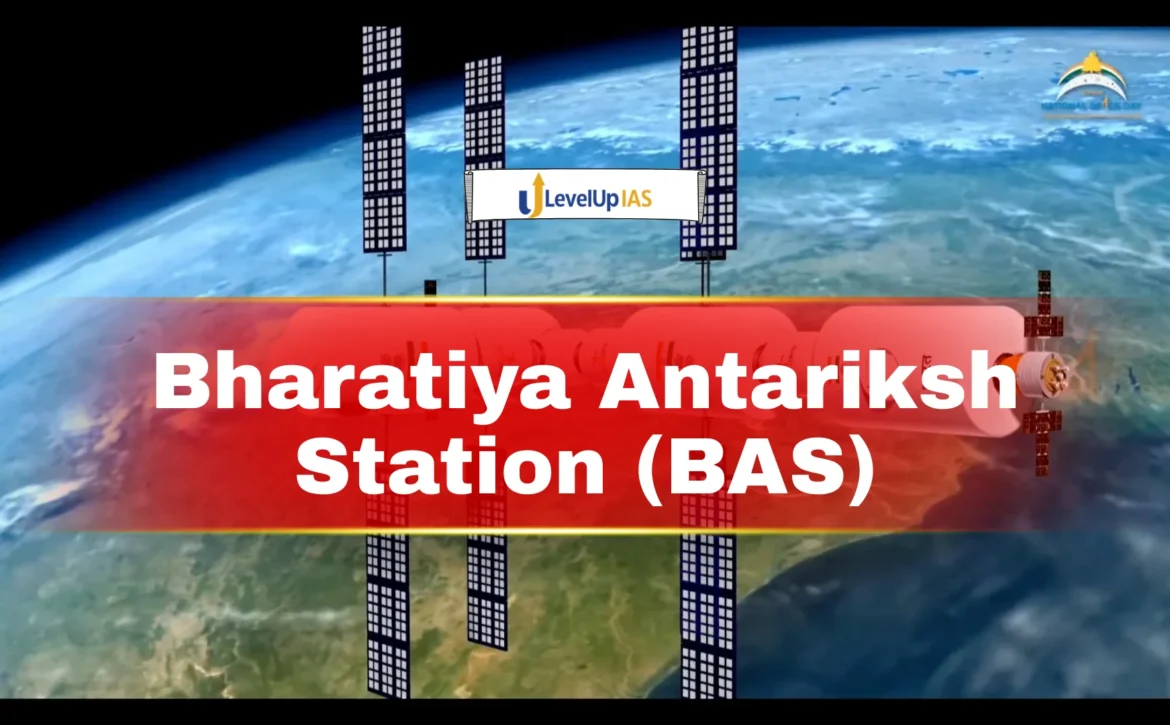
- BAS is envisaged as an indigenously developed space station to be placed in Low Earth Orbit (LEO), at an altitude of roughly 400-450 km, similar to the orbit of the International Space Station.
- Unlike short-duration missions, BAS is designed to support long-term human stay in space, allowing continuous scientific and technological experiments.
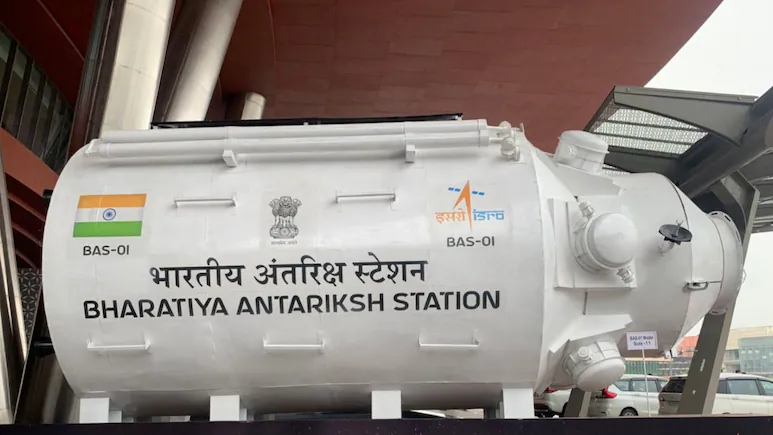
- The station will follow a modular design with about five modules, beginning with a base module targeted for launch around 2028 after successful crewed Gaganyaan flights, with full operational capability aimed for 2035.
- Launch and crew transport will likely use upgraded versions of the LVM-3, the same class of launch vehicle used for Gaganyaan.
Significance of BAS for India
BAS has strategic, scientific, technological, and socio-economic importance for India’s space programme. It is expected to become especially relevant once the ISS is decommissioned in the early 2030s, when only a small number of countries will possess their own space stations.
- Strategic relevance:
- BAS will give India an independent human spaceflight infrastructure, placing it among a select group of spacefaring nations with their own stations.
- It will enhance India’s status in global space governance and future cooperation frameworks.
- Scientific research:
- BAS will provide a permanent microgravity platform for experiments in space medicine, human physiology, advanced materials, alloys, biotechnology, and life sciences.
- Such continuous experiments are difficult in short, mission-based flights, making BAS crucial for sustained research.
- Human spaceflight capability:
- Long-duration operations on BAS will help perfect life-support systems, crew health monitoring, orbital docking, and long-term habitation technologies.
- These capabilities form the technological backbone for future lunar and deep-space missions.
- Economic and educational impact:
- BAS can stimulate private sector participation through agencies such as IN-SPACe and NSIL, supporting India’s growing space economy.
- It can inspire students towards STEM disciplines and strengthen a research-oriented culture in universities and labs.
Indian Crewed Lunar Mission (2040)
India’s roadmap includes sending Indian astronauts to the Moon by around 2040, signaling a shift from one-off exploration to sustained human presence beyond Earth orbit. This mission will draw on:
- Operational experience from Gaganyaan in human-rating launch vehicles and crew modules.
- Long-duration training and technology validation on BAS, including life support and docking operations.
- The lunar science and technology base developed through Chandrayaan missions, especially the soft landing achievements of Chandrayaan-3 near the lunar south pole.
Collectively, these elements reduce risk and create an incremental path from Low Earth Orbit to cislunar space and eventually to the lunar surface.
ISS as a Reference Model
The International Space Station serves as a key reference point for understanding BAS and India’s human spaceflight ambitions. Operational since 1998, it is the largest functional space laboratory in LEO, orbiting at about 400 km altitude.
The ISS is a collaborative project involving NASA (USA), Roscosmos (Russia), ESA (Europe), JAXA (Japan), and the Canadian Space Agency, with participation from 15 countries, illustrating how space stations can become platforms for international cooperation and advanced microgravity research.