BRICS: Evolution, Significance and Contemporary Challenges
Content
- Introduction
- Evolution and Background
- Membership and Expansion
- Objectives and Core Functions
- Recent Summits
- Significance
- Challenges and Criticisms
- Way Forward
- FAQs
Introduction
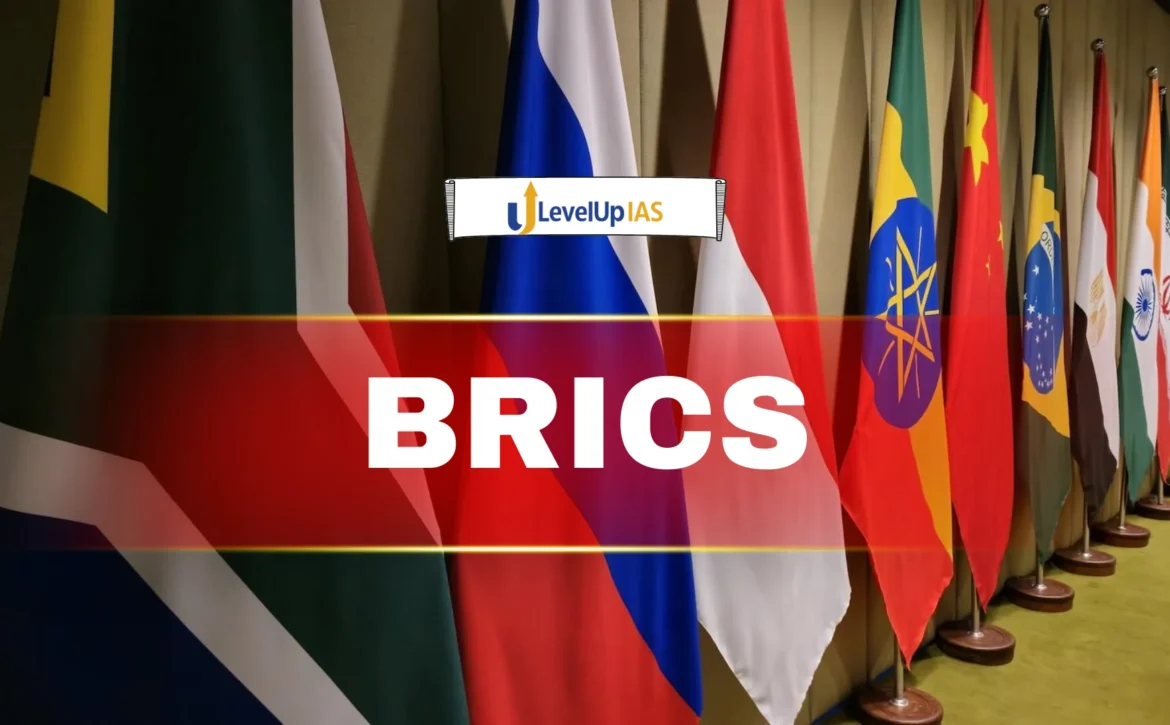
The BRICS grouping comprising Brazil, Russia, India, China and South Africa has emerged as a significant platform of emerging economies seeking to reshape global governance. The acronym BRIC was coined in 2001 by Jim O’Neill of Goldman Sachs to highlight the growth potential of Brazil, Russia, India and China. South Africa joined in 2010, transforming BRIC into BRICS.
Collectively, BRICS represents about 25% of the global economy and nearly 40% of the world’s population, positioning itself as a counterweight to Western-dominated institutions such as the G7, IMF and World Bank. Its relevance has further increased amid global geopolitical shifts, especially following the Ukraine conflict.
1. Evolution and Background
Origin:
- BRIC was first used in 2001, representing Brazil, Russia, India and China.
- South Africa joined in 2010, making it BRICS. The first official BRIC summit was held in Yekaterinburg, Russia (2009).
Nature of the Group:
- BRICS is not a treaty-based organisation with a charter or secretariat.
- It operates as a consultative forum for political dialogue, economic cooperation, policy coordination, and collective engagement in multilateral platforms.
2. Membership and Expansion (2024-2025)
Original Members:
Brazil, Russia, India, China, South Africa.
New Full Members:
- Egypt, Ethiopia, Iran and United Arab Emirates were formally inducted as full members effective January 1, 2024.
- Indonesia joined as a full member in January 2025.
Partner Countries:
In addition to full members, several countries hold partner status (a tier below full membership), including Belarus, Bolivia, Kazakhstan, Cuba, Malaysia, Thailand, Uganda, Uzbekistan and Nigeria.
BRICS+/External Interest:
- Over 40 countries have expressed interest or applied to join the grouping. Some emerging requests (e.g., Palestine) have surfaced, reflecting BRICS’ magnetic pull on the Global South.
Significance of Expansion:
From the original five, BRICS has grown into an 11-member bloc, expanding its geographic footprint and strategic reach across Africa, the Middle East, and Southeast Asia.
3. Objectives and Core Functions
A. Economic Cooperation:
- Enhance trade, investment and economic linkages among member states.
- Promote development and sustainable growth.
- Strengthen the New Development Bank (NDB) and Contingent Reserve Arrangement (CRA) as alternatives to traditional Bretton Woods institutions.
B. Reform of Global Governance:
- Advocate for representation of emerging economies and reforms in IMF, World Bank, and UN Security Council.
- Push for a more equitable global economic architecture.
C. Multipolar World Order:
- Promote a multipolar international system, reducing dominance by Western powers.
- Support strategic autonomy of member states.
D. De-dollarisation and Financial Autonomy:
- Explore trade in local currencies and mechanisms to reduce dependence on the US dollar.
- Discuss cross-border payment systems.
E. Political and Security Cooperation:
- Dialogue on counter-terrorism, cybersecurity, and regional stability.
- Shared perspectives on international conflicts and peace processes.
4. Outcomes from Recent Summits
16th BRICS Summit (October 2024, Kazan):
- Theme: “Strengthening Multilateralism for Just Global Development and Security”.
- Focus on economic cooperation, reduced reliance on Western systems, and enhanced NDB role.
- Introduced the concept of partner countries.
17th BRICS Summit (July 2025, Rio de Janeiro):
- Wide representation of BRICS members and partner nations.
- Efforts to underline South-South cooperation and alignment on multilateral reform.
- Internal differences and diverse priorities made consensus difficult on some issues.
IMF Reform Proposal (2025):
- Finance ministers from BRICS called for IMF quota reform to reflect economic realities of developing countries and challenge old post-World War II structures.
5. Strategic and Geopolitical Significance
A. Global South Representation:
BRICS serves as a platform for emerging economies to collectively voice concerns and priorities on global financial, political, and security issues.
B. Counterbalance to Western Institutions:
It challenges traditional Western-dominated order (G7, IMF, World Bank) and promotes inclusive decision-making.
C. Regional and Energy Influence:
Inclusion of Middle Eastern and African economies enhances BRICS’ strategic relevance in energy markets and geopolitical affairs.
D. India’s Role:
India emphasizes strategic autonomy, economic cooperation, and global governance reform while avoiding alignment in great power confrontations.
6. Challenges and Criticisms
A. Internal Divergences:
- Diverse political systems (democracies vs autocracies) and foreign policy goals complicate consensus.
- Bilateral tensions (e.g., India–China) strain group cohesion.
B. Economic Imbalances:
- China’s economy remains significantly larger, leading to power asymmetry within the bloc.
- Varied development trajectories among members complicate unified economic policy.
C. Institutional Weakness:
- Unlike the G7 or EU, BRICS lacks a strong institutional framework, reducing its ability to implement joint policies effectively.
D. Strategic Priorities and Cohesion:
- Geopolitical rivalries (e.g., Saudi Arabia–Iran) and differing alignments with external powers challenge unanimity.
7. Way Forward and Prospects
A. Strengthening Institutional Architecture:
Bolstering the operational capacity of NDB, CRA and creating specialised secretariats or working groups can enhance coordination.
B. Enhancing Intra-BRICS Trade:
Reducing tariff barriers and improving connectivity will deepen economic integration.
C. Strategic Cooperation on Global Issues:
Collaborative action on climate change, digital governance, artificial intelligence, and global health can augment relevance.
D. Inclusive Expansion Strategy:
Balanced and transparent criteria for expansion and partner engagement can help maintain group coherence.
Conclusion
BRICS continues to be a dynamic and evolving multilateral forum that reflects the aspirations of a diverse set of emerging economies. Its expansion, institutional initiatives and advocacy for reform carry implications for global power dynamics. However, internal divergences and the challenge of translating consensus into action remain significant. For India, BRICS is an avenue to enhance its global footprint while promoting a rules-based, multipolar, and inclusive world order.
FAQs
Q1. What is BRICS and when was it formed?
BRICS is an informal grouping of major emerging economies like Brazil, Russia, India, China, and South Africa, aimed at promoting cooperation, development, and a multipolar global order. It evolved from the BRIC forum formed in 2006, with South Africa joining in 2010.
Q2. What are the main objectives of BRICS?
The key objectives of BRICS include strengthening South–South cooperation, reforming global governance institutions, promoting economic development, enhancing political coordination, and reducing dependence on Western-dominated financial systems.
Q3. Why is BRICS significant in global politics?
BRICS represents over 40% of the world’s population and a substantial share of global GDP. It provides a collective voice to the Global South and challenges the dominance of Western-led institutions such as the IMF, World Bank, and G7.
Q4. What is the New Development Bank (NDB)?
The New Development Bank is a BRICS-led multilateral financial institution established in 2015 to finance infrastructure and sustainable development projects in developing countries without political conditionalities.
Q5. What are the major challenges faced by BRICS?
BRICS faces challenges such as internal political and economic divergences, China-centric asymmetry, India-China tensions, lack of a formal institutional structure, slow decision-making, and differing strategic priorities among members.
Click on the question to see the Answers