Buddhism: An Overview
Content
- Introduction
- About Buddhism
- Who is Gautama Buddha?
- Five Events in Buddha’s Life
- Doctrines of Buddhism
- Eight-Fold Path of Buddhism
- Core Principles of Buddhism
- Different Sects of Buddhism
- The Expansion of Buddhism
- Expansion Beyond India
- Sangha in Buddhism
- Factors for Buddhism’s Decline
- FAQs
Introduction
Buddhism originated in the 6th century BCE in the Gangetic plain during a period characterized by the second urbanization and significant social transformations in India. As the teachings of the Buddha appealed to individuals frustrated with Vedic rituals and the caste system, Buddhism rapidly gained traction throughout northern India. Additionally, during the Mauryan Empire, Buddhism extended its reach both within India and beyond.
However, Buddhism began to wane due to various socio-political factors. Its decline commenced during the Gupta dynasty, and by the 12th century CE, it had nearly vanished from India. Although, it continued to flourish in other Asian nations.
About Buddhism
- Its teachings inspire millions worldwide, offering a path to inner peace and liberation from the cycle of birth and rebirth.
- Buddhism, one of the world’s major religions, originated in India in the 6th century BCE when Siddhartha Gautama founded it, he later came to be known as the Buddha.
- Rooted in the teachings of the Buddha, it centres on the path to enlightenment through understanding the Four Noble Truths and following the Eightfold Path, which guides ethical conduct, mental discipline, and wisdom.
- Its fundamental tenet is the belief in the impermanence of all things and the cessation of suffering through the renunciation of desire and attachment.
- Its focus on compassion, meditation, and the pursuit of wisdom has profoundly shaped Asia’s spiritual and cultural landscape.
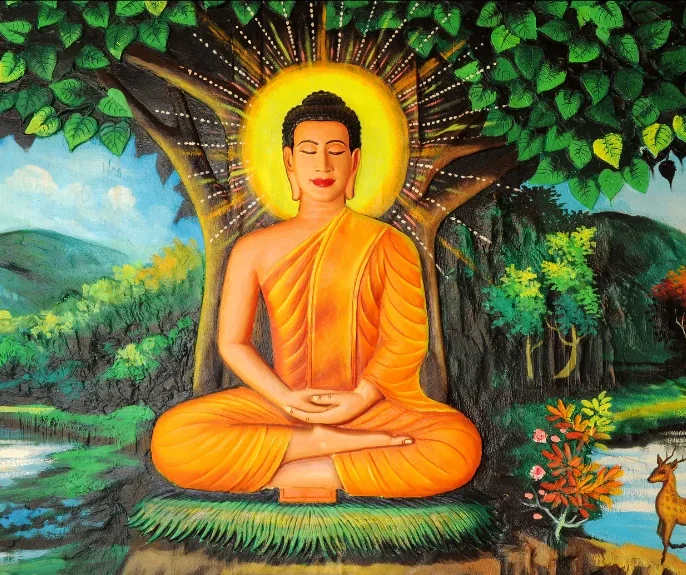
Who is Gautama Buddha?
- He was born in 563 BCE, Lumbini (Nepal), Shakya Republic.
- His parents were Suddhodana (father) and Maya Devi (mother).
- According to tradition, he was born in 563 B.C. in a Shakya Kshatriya family in Lumbini, Nepal, near Kapilavastu.
- His birthplace is identified with Piprahwa in Basti district, close to the foothills of Nepal.
- Gautama’s father served as the elected ruler of Kapilavastu and led the republican clan of the Shakyas.
- His mother was a princess from the Koshalan dynasty.
- Thus, similar to Mahavira, Gautama also belonged to a noble family.
- He observed the suffering of people and actively sought a solution to end it.
- Like Mahavira, he left home at the age of 29. He wandered for about seven years and attained knowledge at the age of 35 at Bodh Gaya under a Peepal tree.
- Here onwards, he began to be called the Buddha or the enlightened.
- He died in 483 BCE in Kusinagar (Uttar Pradesh), Malla Republic.
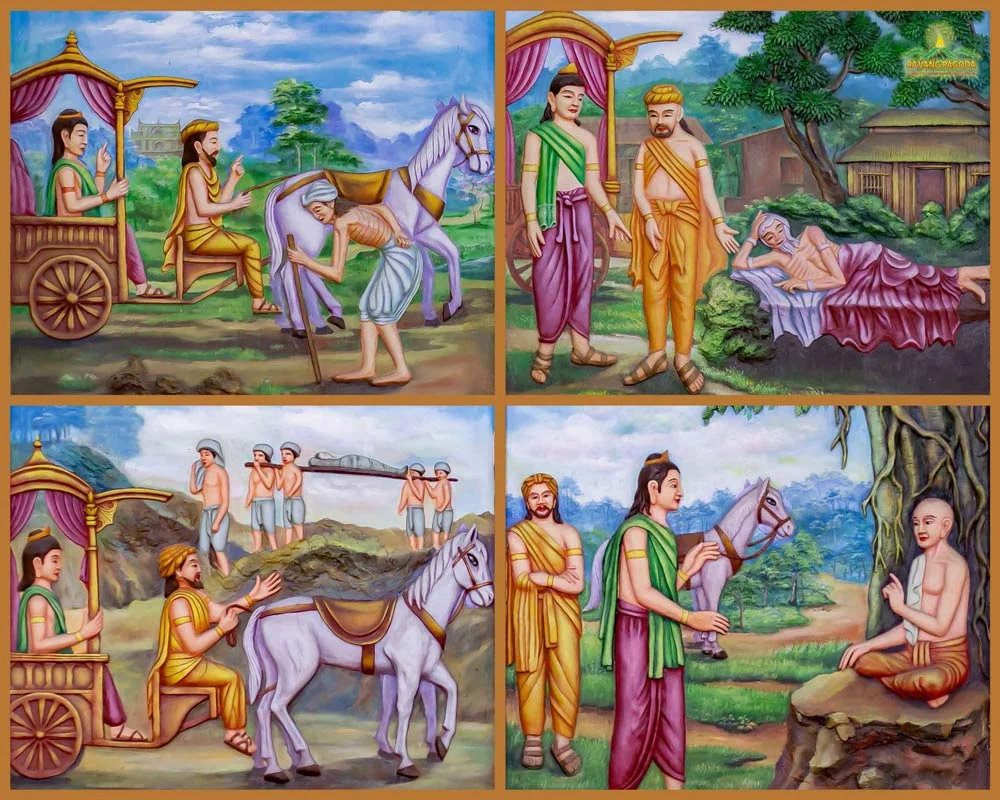
Five Events in Buddha’s Life
| Event | Place | Associated Symbol | Explanation |
| Conception / Birth | Lumbini | White Elephant, Lotus | White elephant symbolises purity and greatness; lotus symbolises divine birth. |
| Renunciation (Mahabhinishkramana) | Kapilavastu | Horse (Kanthaka) | Represents departure from royal life and worldly attachments. |
| Enlightenment (Bodhi) | Bodh Gaya | Bodhi Tree | Symbol of supreme wisdom and enlightenment. |
| First Sermon (Dharmachakra Pravartana) | Sarnath | Dharmachakra (Wheel) | Symbolises the beginning of Buddha’s teachings. |
| Mahaparinirvana | Kushinagar | Stupa | Represents final liberation (nirvana) and remembrance. |
Doctrines of Buddhism
The four great doctrines of Buddhism are:
- Life is full of sorrow (Dukha).
- There are causes of sorrow (Dukha samudaya).
- This sorrow can be stopped (Dukha Nirodha).
- There is a path leading to the cessation of sorrow, which has been called as Dukha Nirodha Gamini Pratipada.
Eight-Fold Path of Buddhism
Ashtangika marga or eight-fold path (for the elimination of human misery).
- Right View: The right knowledge of the cause of suffering, knowledge to end the cause of suffering, and the path to end the suffering.
- Right Intention: Right Intent must come from the heart.
- It involves recognising the equality of all life and compassion for all, beginning with yourself.
- Right Speech: Right speech involves recognising the truth and awareness of the impact of idle gossip and repeating rumours.
- Right Action: Right Action also encompasses the five precepts that the Buddha gave: not to kill, steal, lie, avoid sexual misconduct, and not to take drugs or other intoxicants.
- Right Livelihood: Right Livelihood also implies that a Buddhist who can undertake some work, either as part of a Buddhist community or in the workplace or do home-based or community service.
- Right Effort: Also called as “right endeavour”, it entails that one should always try to take any action on the goodwill of people.
- Right Mindfulness: One should constantly be aware of phenomena affecting the body and mind. This means one must be aware of one’s thoughts, words, and actions.
- Right Meditation: Also known as “right concentration”, Right concentration teaches people to focus and concentrate on one thing or object at a time.
Core Principles of Buddhism
Some of its core principles of are as follows:
Nirvana
- The ultimate aim of life is to attain nirvana, the eternal state of peace and bliss, which means liberation from the cycle of birth and death. It is also known as moksha or salvation.
Karma
- It refers to the spiritual principle of cause and effect, where the intent and actions of an individual (cause) influence the future of that individual (effect).
- It is the concept of reincarnation or the cycle of rebirths (samsara).
Ahimsa
- Ahimsa is based on the premise that all living beings have the spark of the divine spiritual energy. Thus, hurting another being is akin to hurting oneself. Buddha laid down a code of conduct for his followers as done by Jaina:
- Do not covet the property of the others.
- Do not commit violence.
- Do not use intoxicants.
- Do not speak a lie.
- Do not indulge in a corrupt practice.
Sangha
- Gautama Buddha also organised the Sangha, or religious order, which was open to everybody, irrespective of caste and sex.
- Women were also admitted to the Sangha.
- The sole requirement for the monks was to diligently adhere to the rules and regulations of the Sangha.
- They organised preaching under the auspices of the Sangha.
- The rules made for the monks in Buddhist Sangha were written down in a book called Vinaya-Pitaka.
- Separate branches existed for different genders.
- All male could join the Sangha. Children had to seek permission from their parents, wives of their husbands, slaves of their masters, debtors of their creditors, and people who worked for the king from the king himself.
- People who joined the sangha led simple lives, meditated most of the time, and begged for food during fixed hours. Hence, they were called Bhikkhus and Bhikkhunis.
Dhamma
- As the Buddha taught, Dhamma is about ourselves and freeing ourselves from personal suffering.
- As suffering beings, we are deluded about the truths of our bodies and minds.
However, if we practice the Dhamma, we focus on our body and mind and unveil their true characteristics. Our suffering lessens as we gradually understand the Dhamma more and more.
Different Sects of Buddhism
Following the Buddha’s passing, his disciples interpreted his teachings in diverse manners, leading to doctrinal splits and the creation of separate Buddhist sects.
- The first significant division occurred during the 2nd Buddhist Council at Vaishali around 383 BCE, when the monastic community split into:
- The Sthaviravadins who strictly followed the Vinaya code governing monastic discipline and
- The Mahasanghikas who championed more lenient norms.
- Around the 1st century CE, after the Fourth Buddhist Council under Kanishka, Mahayana Buddhism arose as a divergence from Hinayana Buddhism.
- Mahayana adherents developed a distinct sect, venerating Buddha images as divine entities, unlike the non-theistic Hinayana.
- In the 7th century, Vajrayana Buddhism emerged as a tantric branch of Mahayana. As Buddhism expanded through trade routes, localized adaptations led to variations such as Tibetan, Chinese, and Zen Buddhism.
- Nonetheless, fundamental teachings such as the Four Noble Truths, the Eightfold Path, and the concept of Non-Self remained consistent across the sects. And the divisions were primarily based on different practices and interpretations rather than core principles.
- The fundamental aspects of the various sects and subsects are outlined in the table below
Different Sects
| Sect | Tenets / Key Features |
| Hinayana (Lesser Vehicle) / Theravada | • Theravada means “Teaching of the Elders”; most conservative and orthodox school. • Emphasises individual liberation through self-effort and meditation based on the Pali Canon. • Belief in one historical Buddha, Gautama Shakyamuni. • Emperor Ashoka helped spread Theravada in India. • Originated from the Vibhajjavada school. • Core focus: Monastic discipline, Four Noble Truths, Noble Eightfold Path, Three Marks of Existence, karma, rebirth, jhana and vipassana meditation. • Does not accept Mahayana sutras. • Dominant in Sri Lanka and Southeast Asia since 3rd century BCE. • Strong monastic sangha–laity relationship. • Ideals the Arhat, who attains nirvana through rigorous spiritual effort. |
| Sub-sects of Hinayana / Early Buddhism | Sarvastivada – All dharmas exist in past, present, and future; influential in NW India and Central Asia. Vaibhasika – Offshoot of Sarvastivada; focused on Abhidhamma philosophy; texts: Abhidharma-kosa (Vasubandhu), Milinda Panho. Sautrantika – Based on Sukta Pitaka; opposed Vaibhasika realism; teachers: Kumaralata, Yasomitra, Harivarman. Sthaviravada – Original Theravada lineage; Pali Canon emerged from it; dominant in South India and Sri Lanka. Vibhajjavada – Compiled the Pali Canon; basis of modern Theravada. Sammitiya – Differentiated definitive and interpretative teachings; extinct in medieval period. |
| Mahayana (Greater Vehicle) | • Emerged around 1st century BCE during the Fourth Buddhist Council. • Central concept of Bodhisattva – enlightened beings who delay nirvana to help others. • Patronised by Harshavardhana; texts translated into Sanskrit. • More inclusive, emphasising lay participation. • Key ideas: Bodhisattva ideal and Buddha-nature. • Important texts: Lotus Sutra, Heart Sutra. • Spread from Kashmir to Central Asia, China, Korea, Japan, and Vietnam via the Silk Route. • Development of Buddha images and Bodhisattvas like Avalokitesvara. |
| Sub-sects of Mahayana | Madhyamaka (Sunyavada) – Based on Buddha’s middle path (Madhyama Pratipad); systematised by Nagarjuna; text: Mulamadhyamika Karika. Yogacara (Vijnanavada) – Idealistic and absolutist school; focuses on mind and consciousness; counters extreme nihilism of Madhyamaka. |
| Zen | • Sub-school of Mahayana. • Emphasises meditation as the path to enlightenment. • Known as Chan in China and Son in Korea. • Strongly associated with Japan, with multiple sub-schools. |
| Vajrayana (Diamond Vehicle) | • Emphasises rituals, mantras, and tantra for attaining enlightenment in a single lifetime. • Practised mainly in Tibet, Bhutan, Nepal, and Mongolia. |
| Navayana | • Modern Buddhist movement that emerged in India in the late 20th century. • Reformist reinterpretation of Buddhism with emphasis on social justice, equality, and annihilation of caste. |
The Expansion of Buddhism
During the Buddha’s lifetime, a significant portion of the population embraced Buddhism.
For instance, the inhabitants of Magadha, Kosala, and Kaushambi adopted the teachings of Buddhism. The republics of Sakyas, Vajjis, and Mallas also joined in the movement. Several factors explain the widespread appeal of Buddhism:
Social and Economic Transformations:
Numerous individuals were dissatisfied with the caste system and the inflexible social stratification, seeking a more inclusive and egalitarian spiritual journey.
Impact of the Buddha’s Teachings:
The Buddha’s messages were powerful and resonated deeply; his focus on compassion, non-violence, and personal responsibility attracted many followers.
Influence of Rulers and Elites:
The acceptance of Buddhism by rulers and influential figures significantly contributed to its growth.
For instance, according to tradition, Ashoka dispatched his son Mahendra and daughter Sanghamitra to Sri Lanka to promote Buddhism. He also established numerous monasteries and generously supported the community of monks.
Monastic Infrastructure:
The creation of a network of monasteries and the dissemination of the monastic tradition facilitated the spread of Buddhism.
Accessibility of the Buddha’s Teachings:
The teachings of the Buddha were available to individuals from all social backgrounds, irrespective of caste or status.
Utilization of Common Language:
The explanation of doctrines in Pali enhanced the religion’s spread, unlike Brahmanical traditions, which predominantly used Sanskrit.
Expansion of Buddhism Beyond India
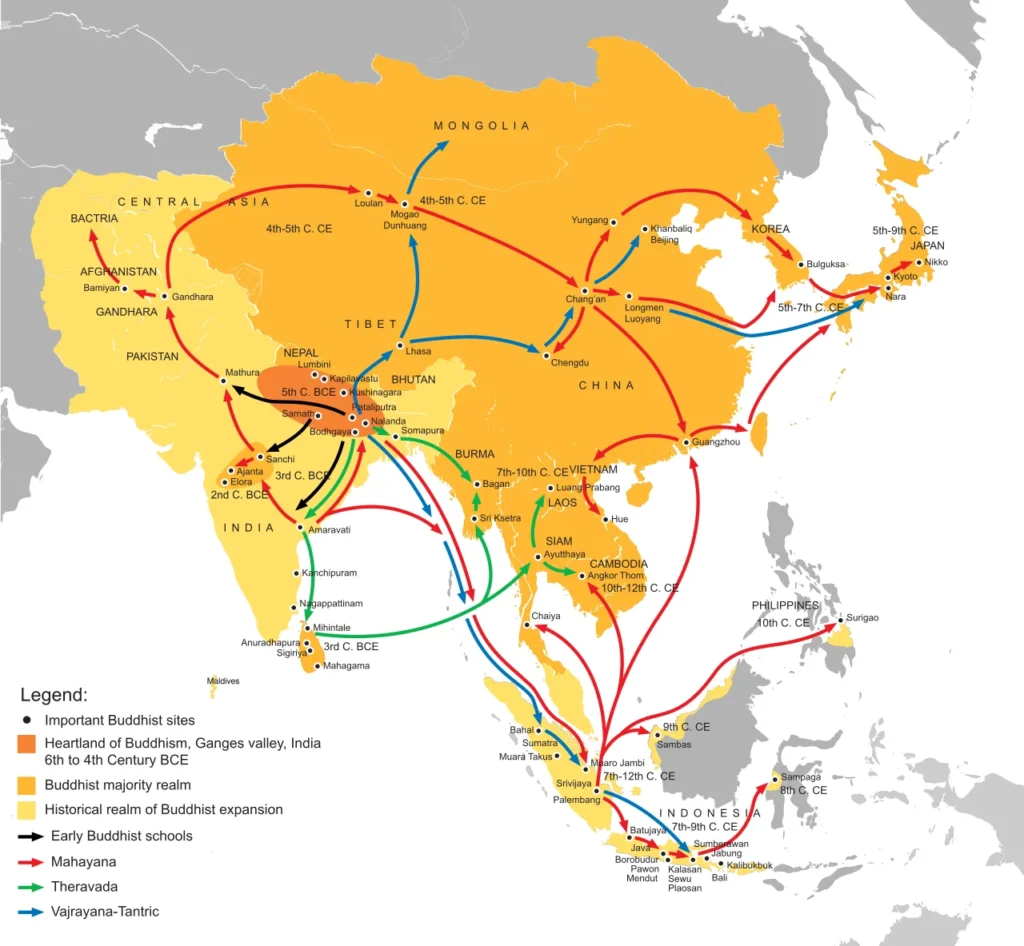
Propagation of Hinayana Buddhism
- During his reign, Ashoka dispatched missions to various regions such as Sri Lanka, Myanmar, and Thailand, which laid the groundwork for Theravada Buddhism in Sri Lanka and Southeast Asia.
Spread of Mahayana Buddhism
- Kanishka, the Kushan Emperor, supported Mahayana Buddhism and endorsed the Fourth Buddhist Council in Kashmir, aiding in the diffusion of Buddhism into Central Asia.
Buddhism made its way to Central Asia and China through merchants and monks navigating the Silk Route from India.
- Significant Buddhist centers emerged along the Silk Route, including Kashgar, Khotan, and Bamiyan.
- Chinese monks like Fa-Hien and Hiuen Tsang journeyed to India, bringing back texts and concepts of Mahayana Buddhism, which were then disseminated throughout China.
- In China, Buddhism interacted with the indigenous Confucian and Daoist philosophies.
- In the 6th century CE, Buddhism reached Japan from China and Korea, where various schools like Zen and Pure Land evolved, incorporating local elements.
Spread of Vajrayana Buddhism
- Vajrayana Buddhism emerged in India around the 8th century.
- In Tibet, Vajrayana engaged with the Bon religion.
- Monks such as Atisha Dipankara and Padmasambhava played a vital role in propagating this sect mainly in Tibet and Southeast Asia.
- Tibetan Buddhism integrates Indian Buddhist beliefs and local Tibetan customs.
- A key aspect of Tibetan Vajrayana is the existence of a spiritual leader in the form of reincarnated lamas, perceived as the Bodhisattva of compassion, known as Avalokitesvara (or Chenrezig).
Although Buddhism eventually diminished in India, its place of origin, it managed to thrive across much of Asia as Hinayana (in Southeast Asia), Mahayana (in most of the remaining Asia), and Vajrayana (in Tibet).
The Institution of Sangha in Buddhism
The Buddhist Sangha or religious order was established by the Buddha, playing a crucial role in spreading his teachings. Many of his discourses were given at Shravasti, a significant center.
Support and Patronage:
Affluent merchants like Anathapindika became fervent backers, generously contributing to the Sangha. This enabled the expansion of Buddhism as monks traveled and shared their teachings.
Membership Criteria:
The Sangha had a policy of open membership, welcoming anyone over the age of fifteen, regardless of caste or gender, except for criminals and those with diseases. Initially hesitant, the Buddha eventually permitted women to join after appeals from Ananda and Mahapajapati Gotami. New monks and nuns were required to shave their heads and don yellow robes.
Daily Practices and Routines:
Monks were expected to go on daily alms rounds to collect food while spreading Buddhism. During the four-month monsoon season, they would meditate in a designated location.
Educational Efforts:
The Sangha also emphasized the importance of education for the general public, extending opportunities to non-Brahmins who had been marginalized under Brahmanism.
Principles of Governance:
The Sangha functioned democratically, adhering to a code of conduct for monks and nuns. It retained the authority to enforce discipline and sanction misbehaving members. In this way, the structured Sangha, with its inclusive membership rules, practices, educational efforts, and governance, contributed to the rise of Buddhism in India.
Factors Contributing to Buddhism’s Decline:
The decline of Buddhism can be linked to a complex interaction of several historical, social, and cultural factors that differed across various regions and eras. Below are some significant elements identified as contributing to the decline of Buddhism in specific areas:
Ideological Challenges:
- Buddhism originated from egalitarian ideals that were in opposition to Brahmanical dominance and Vedic rituals.
- However, similar issues of hierarchy, corruption, and complicated rituals surfaced within institutional Buddhism over time.
- For example, the concentration of wealth and influence in monasteries undermined the core principles of Buddhism. The entanglement of monks in worldly affairs stood in opposition to Buddhist ideals.
- The fragmentation into multiple sects and subsects contributed to a dilution of Buddhism’s original philosophical essence.
- These structural and ideological challenges mirrored issues within Hinduism, weakening Buddhism’s distinct religious identity.
Hinduism’s Reformation and Integration:
- Conversely, Hinduism underwent reforms by integrating Buddhist practices such as vegetarianism and rejecting animal sacrifice.
- Influential Hindu figures like Adi Shankaracharya established monasteries (mathas) modeled after Buddhist institutions to revitalize Hinduism while critiquing Buddhist thought.
- Deep-rooted philosophical similarities between Buddhism and Hinduism regarding concepts like karma, dharma, and moksha facilitated Buddhism’s gradual absorption into Hinduism beginning around 500 CE.
- The portrayal of Buddha as an incarnation of Vishnu in Hindu texts further aided this integration. Additionally, the appeal of Buddhist egalitarianism attracted lower castes, accelerating the process of assimilation.
Decline of Royal Support:
- The downfall of major Buddhist-supporting dynasties such as the Kushanas and the shift of royal favor towards Brahmanical Hinduism under the Guptas hastened Buddhism’s decline.
- The absence of state backing led to the deterioration of Buddhist sanghas and monasteries.
Absence of Vernacular Literature:
- In contrast to early Buddhist texts written in Pali, later scriptures were composed in Sanskrit, limiting their reach among the vernacular-speaking populations of inland India.
- This hampered Buddhism’s growth beyond urban elite circles.
Impact of Foreign Invasions:
- Invasions from the northwest by non-Buddhist groups like the Huns and Turks (Khilji) resulted in the vandalism and persecution of Buddhist monks and followers.
- These attacks disrupted Buddhist monasteries, pilgrimage sites, and institutions such as Nalanda.
The destruction of Mahayana Buddhist locations in northern India by Islamic invaders from 1100 CE marked the end of Buddhism in its homeland. Despite this decline, Buddhism’s influence remains reflected in the rich cultural and spiritual heritage of Asia.
FAQs
1. Who founded Buddhism?
Buddhism was founded by Gautama Buddha (Siddhartha Gautama) in the 6th century BCE in the eastern Gangetic plains of India.
2. What are the Four Noble Truths of Buddhism?
The Four Noble Truths explain that life involves suffering (Dukkha), suffering arises from desire (Trishna), it can be ended, and the Eightfold Path leads to its cessation.
3. What is the Eightfold Path?
The Eightfold Path is the Middle Path consisting of right view, intention, speech, action, livelihood, effort, mindfulness, and concentration.
4. How many Buddhist Councils were held?
Four major Buddhist Councils were held to preserve and interpret Buddha’s teachings, beginning with the First Council at Rajgir after Buddha’s Mahaparinirvana.
5. What is the difference between Hinayana and Mahayana Buddhism?
Hinayana emphasizes individual salvation (Arhat) and strict monastic discipline, while Mahayana focuses on universal salvation (Bodhisattva ideal) and devotional practices.
Click on the question to see the Answers