Continental Drift Theory, Evolution, Evidence

Content
- Introduction
- About Continental Drift Theory
- Evolution into Plate Tectonic Theory
- Alfred Wegener
- Concept of Continental Drift
- Forces for Drifting
- Continental Drift Theory Evidence
- Significance of the Continental Drift Theory
- FAQs
Introduction
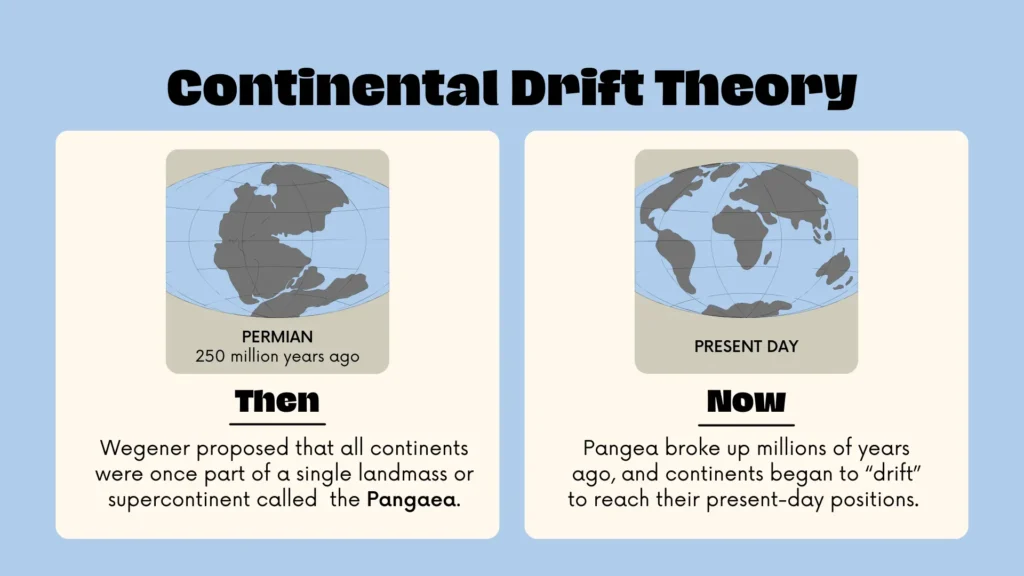
The Continental Drift Theory, introduced by Alfred Wegener in 1912, marked a turning point in the study of Earth’s geological evolution. The theory suggests that all continents were once joined together in a single massive landmass known as Pangaea, which gradually fragmented and drifted to their present positions over vast geological time scales.
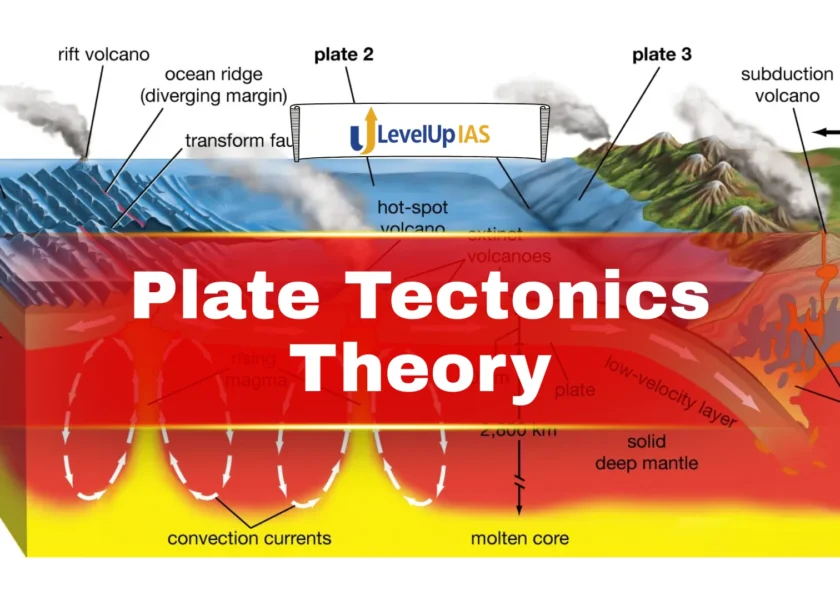
Although Wegener’s idea initially faced strong opposition, it eventually became the groundwork for the modern Plate Tectonic Theory, which attributes the movement of continents to mechanisms such as mantle convection, ridge push, and slab pull.
About Continental Drift Theory
The concept of continental drift was first introduced by Abraham Ortelius in 1596, though it gained real prominence only in 1912, when German meteorologist Alfred Wegener presented a detailed framework. Wegener proposed that a massive supercontinent called Pangaea began fragmenting around 200 million years ago, gradually giving rise to the continents in their present configuration.
Evolution into Plate Tectonic Theory
- Although Wegener’s evidence was persuasive, his theory failed to explain the mechanism behind continental movement.
- This limitation was overcome in the mid-20th century with the emergence of the plate tectonic theory, which clarified that Earth’s lithosphere is segmented into tectonic plates floating atop the semi-fluid asthenosphere.
- The identification of key driving forces, mantle convection, ridge push, and slab pull provided the long-sought explanation for the dynamic behavior of Earth’s crust.
Alfred Wegener
The Continental Drift Theory, formulated by Alfred Wegener, is widely recognized as Wegener’s hypothesis, first introduced in 1912. He proposed that all continents were once united in a vast supercontinent known as Pangaea, which began disintegrating around 200 million years ago, eventually forming the continents as they exist today.
Concept of Continental Drift
Wegener suggested that the continents slowly drifted across the oceanic crust, resulting in their modern arrangement.
Evidence Supporting the Hypothesis
To substantiate his theory, Wegener drew upon diverse lines of evidence, including the complementary fit of continental coastlines, the similarity of rock formations and fossil records found across different landmasses, and paleoclimatic indicators showing consistent patterns across distant regions.
Reasons for Initial Rejection
Although his arguments were compelling, the scientific community at the time dismissed Wegener’s idea due to the absence of a convincing mechanism explaining how such massive landmasses could move through Earth’s crust.
Continental Drift Theory Forces for Drifting
- Alfred Wegener originally proposed that the continents drifted across Earth’s surface due to centrifugal force generated by Earth’s rotation.
- The tidal pull arising from gravitational interactions with the Moon and the Sun. However, these forces were later found to be insufficient to move vast continental masses.
- The true explanation for continental motion emerged with the advent of the Plate Tectonic Theory, which provided a detailed mechanism describing how tectonic plates shift and interact.
Modern Mechanisms of Plate Movement
The plate tectonic framework identifies several dynamic forces responsible for the movement of continents:
- Mantle Convection: Heat from Earth’s interior induces convection currents within the asthenosphere, which exert drag forces on the overlying tectonic plates.
- Ridge Push: At mid-ocean ridges, newly formed crust from upwelling magma cools and becomes denser, creating a gravitational push that drives plates apart.
- Slab Pull: In subduction zones, the sinking of dense oceanic plates beneath lighter continental or oceanic plates exerts a pulling force on the trailing plate, enhancing motion.
- Gravity: Gravitational forces assist the descent of the denser lithospheric material into the mantle, particularly at convergent boundaries.

Continental Drift Theory Evidence
Alfred Wegener and subsequent researchers presented a range of compelling evidence to substantiate the Continental Drift Theory. These included the jigsaw-like alignment of continental margins, matching rock formations, tillite deposits from ancient glaciations, similar placer mineral deposits, and the distribution of identical fossils across continents, all collectively pointing to the existence of a prehistoric supercontinent, Pangaea.
1. Jigsaw Fit of Continents
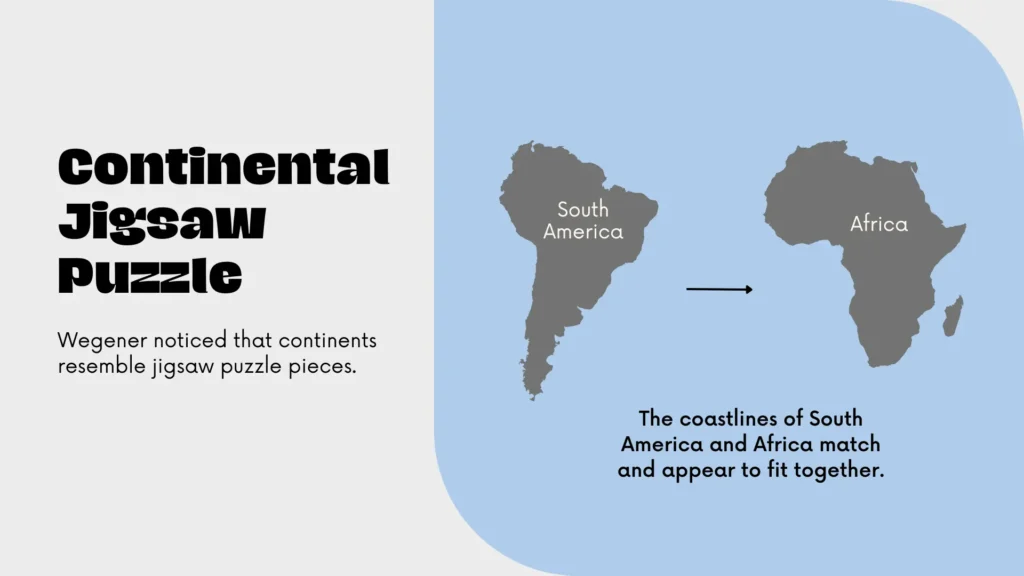
One of the most visually persuasive indicators is the complementary fit of continental coastlines. The eastern coast of South America fits remarkably well with the western coast of Africa. Comparable alignments are observed between the coastlines of North America and Europe, and between Antarctica and Australia, suggesting that these landmasses were once contiguous.
2. Geological Evidence
- Rock Formations: Matching rock types, ages, and structural features are found on continents now separated by oceans. For example, the Appalachian Mountains of North America align geologically with the Caledonian Mountains of Scotland and Scandinavia. Similarly, ancient rock belts in Brazil and Western Africa show identical composition and age, reinforcing the idea that these continents were once joined.
- Tillite Deposits: Sedimentary rocks derived from glacial till, known as tillite, occur across South Africa, India, Australia, and South America. Their presence indicates a shared glacial epoch when these regions were near the South Pole. The Gondwana sedimentary system found in India is also present across other Gondwanaland continents, providing strong evidence of past continental unity.
3. Fossil Evidence
The distribution of identical fossils across widely separated continents offers biological proof of continental drift:
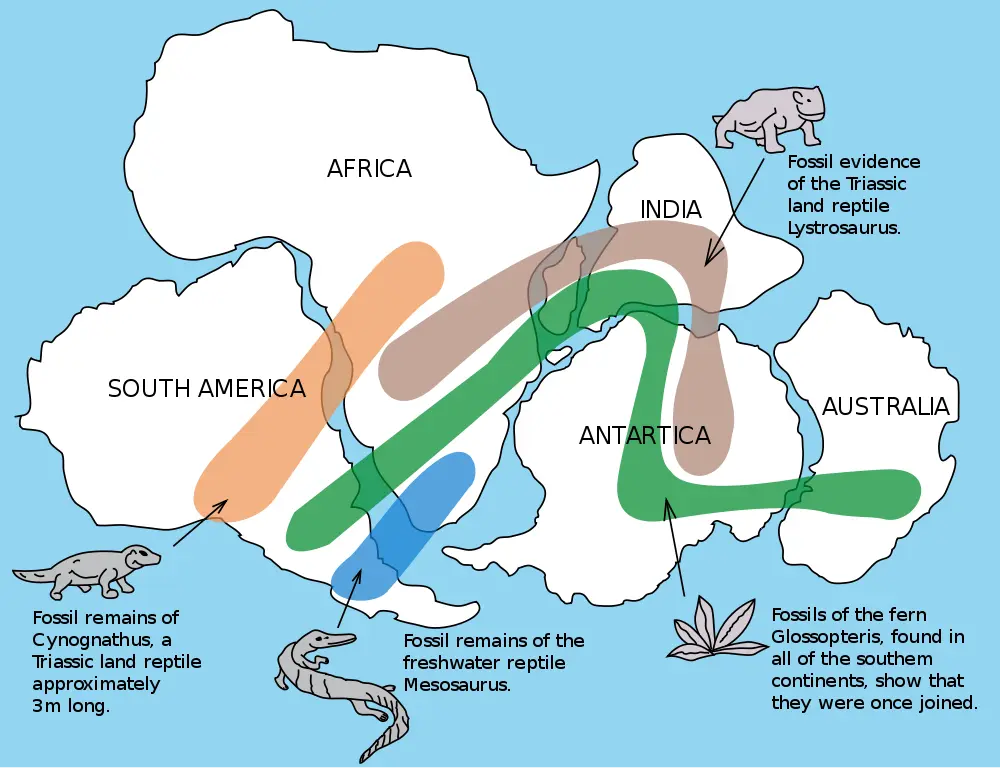
- Mesosaurus: Fossils of this freshwater reptile have been discovered in both South America and Africa, implying a former land connection.
- Glossopteris: This seed fern’s fossils are distributed across South America, Africa, India, Antarctica, and Australia, supporting the concept of the southern supercontinent Gondwanaland.
- Lystrosaurus: Fossils of this terrestrial reptile appear in Africa, India, and Antarctica, reinforcing the evidence of continental linkage.
4. Paleoclimatic Evidence
- Glacial Deposits in Tropical Regions: Tillite found in today’s tropical zones suggests that these areas were once situated closer to the poles, corroborating large-scale continental movement.
- Placer Deposits: Geological studies imply that gold deposits in Ghana may have originated from the Brazilian Plateau, consistent with the notion that South America and Africa were once a single landmass.
Significance of the Continental Drift Theory
The Continental Drift Theory profoundly reshaped the understanding of Earth’s geology by offering explanations for key geological processes such as earthquakes, volcanic activity, and the formation of mountain ranges. It also laid the groundwork for interpreting the past distribution of plant and animal species, paleoclimatic variations, and the dynamic nature of Earth’s crust.
Although initially dismissed due to the absence of a convincing mechanism for continental movement, the theory gained substantial recognition with the progress of geophysical research and seafloor mapping during the mid-20th century. Contemporary evidence derived from satellite measurements, magnetic anomalies, and seafloor spreading studies has provided strong empirical support for Wegener’s pioneering concept of continental drift, validating its central role in the evolution of modern plate tectonic theory.
FAQs
1. What is the Continental Drift Theory?
The Continental Drift Theory, proposed by Alfred Wegener (1912), states that all present continents were once part of a single supercontinent called Pangaea, which later drifted apart.
Q2. What evidence did Wegener give for continental drift?
Wegener supported his theory with:
- Geological evidence (matching rock formations across continents)
- Fossil evidence (similar fossils found on distant continents)
- Paleoclimatic evidence (glacial deposits in tropical regions)
- Biological evidence (similar plant and animal species across continents)
Q3. What are the limitations of the Continental Drift Theory?
Wegener could not explain the force or mechanism that caused continents to drift. This lack of a scientific driving force led to the theory being initially rejected.
Q4. How did the theory evolve over time?
New discoveries like seafloor spreading, mid-ocean ridges, and plate tectonics provided the mechanism missing in Wegener’s theory and helped validate continental movement.
Q5. How is Continental Drift Theory linked to Plate Tectonics?
Continental drift is an early idea that later became part of the broader Plate Tectonics Theory, which explains that continents move because they sit on large mobile tectonic plates.
Click on the question to see the Answers