CBD-Convention on Biological Diversity
Content
- Why in News?
- Introduction
- About CBD
- Membership
- Key Protocols under CBD
- Key Highlights of India’s Report
- Significance of CBD
- Challenges
- Way Forward
- Conclusion
Why in News?
India has submitted its latest national report under the Convention on Biological Diversity (CBD), prepared by the Ministry of Environment, Forest and Climate Change. The report assesses India’s progress in achieving biodiversity targets under the Kunming-Montreal Global Biodiversity Framework (KMGBF).
Introduction
The Convention on Biological Diversity (CBD) is a legally binding international treaty aimed at conserving biodiversity, promoting sustainable use of its components, and ensuring equitable sharing of benefits arising from genetic resources.
It represents a global commitment to address biodiversity loss, which is increasingly recognised as a major environmental challenge alongside climate change.
About CBD
The CBD was adopted during the Earth Summit held in Rio de Janeiro, Brazil, and came into force in 1993. It operates under the United Nations Environment Programme.
The Secretariat of the CBD is located in Montreal, and its apex decision-making body is the Conference of the Parties (COP), which meets periodically to review progress and set global targets.
Objectives of CBD:
- Conservation of biological diversity
- Sustainable use of biodiversity components
- Fair and equitable sharing of benefits arising from genetic resources
Membership of Convention on Biological Diversity (CBD)
The Convention on Biological Diversity (CBD) has near-universal membership, making it one of the most widely accepted environmental treaties globally.
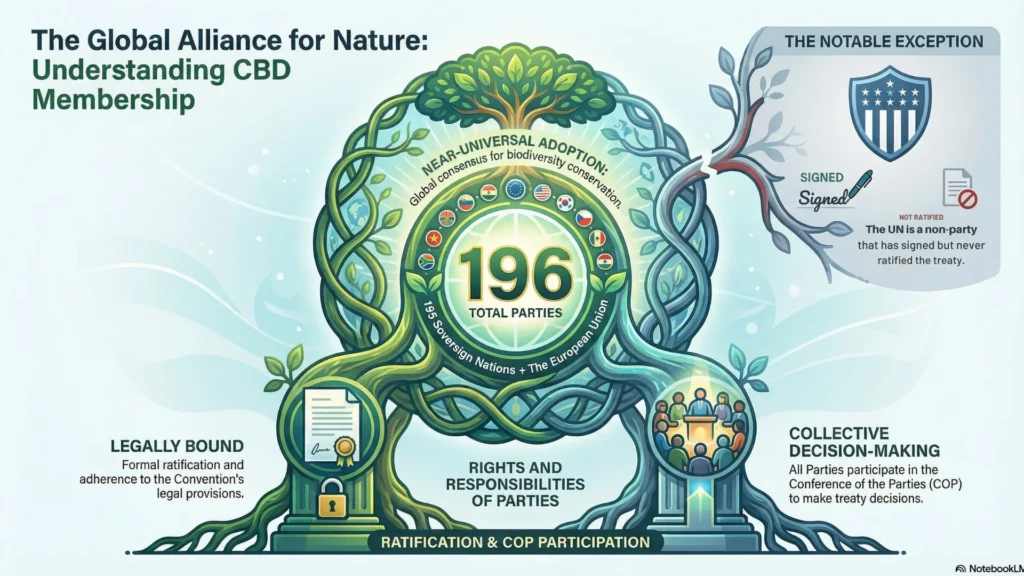
- As of now, the CBD has 196 Parties, which include 195 countries and the European Union.
- It is important to note that United States is not a Party to the CBD, as it has signed but not ratified the Convention.
- Membership is almost universal, reflecting global consensus on biodiversity conservation.
- Being a “Party” means the country has ratified and is legally bound by the provisions of the Convention.
- All Parties participate in the Conference of the Parties (COP), which is the decision-making body of the CBD.
Key Protocols under CBD
The CBD framework is strengthened by two important protocols:
- Cartagena Protocol on Biosafety (2000): Focuses on safe handling, transport, and use of living modified organisms (LMOs).
- Nagoya Protocol (2010): Deals with access to genetic resources and fair sharing of benefits arising from their utilisation.
Key Highlights of India’s Report
- India’s report is significant as it presents the first full assessment of progress toward the 23 targets under the Kunming-Montreal Global Biodiversity Framework (KMGBF).
- A major achievement is the alignment of India’s National Biodiversity Strategy and Action Plan (NBSAP) with global targets, resulting in the formulation of 23 National Biodiversity Targets (NBTs) supported by 142 indicators.
- The report indicates that all NBTs are currently on track, reflecting consistent policy implementation and monitoring mechanisms.
- From an ecological perspective, India has improved its global standing, moving to the 9th position in terms of total forest area, with forest and tree cover reaching 25.17% of its geographical area.
- In terms of restoration efforts, India has achieved 24.1 million hectares of land restoration, progressing towards its target of restoring 26 million hectares of degraded land by 2030.
- India has also emerged as a significant global carbon sink, ranking 5th globally, with forests absorbing approximately 150 million tonnes of CO₂ annually (2021-2025).
- Further, India has surpassed its climate commitments, with 51.93% of its installed electricity capacity coming from non-fossil fuel sources, exceeding its Nationally Determined Contribution (NDC) target of 50%.
Significance of CBD
- The CBD plays a crucial role in addressing the global biodiversity crisis by providing a comprehensive framework for conservation and sustainable development.
- It promotes international cooperation, enabling countries to share knowledge, technology, and financial resources for biodiversity protection.
- For India, the CBD supports policy integration between biodiversity conservation and climate action, aligning with sustainable development goals.
- The framework also emphasises equity and justice, particularly through benefit-sharing mechanisms for local communities dependent on biological resources.
Challenges
Despite progress, several challenges remain in achieving CBD objectives. These include habitat loss, climate change, invasive species, and overexploitation of natural resources, which continue to threaten biodiversity.
There are also issues related to implementation gaps, funding constraints, and coordination between different levels of governance.
Balancing development needs with conservation priorities remains a persistent policy challenge, particularly for developing countries like India.
Way Forward
- Going forward, there is a need to strengthen institutional capacity and community participation in biodiversity conservation, ensuring that local communities are actively involved in decision-making processes.
- Enhancing data collection, monitoring systems, and use of technology such as remote sensing and GIS can improve tracking of biodiversity targets.
- India should continue to integrate biodiversity conservation with broader policies related to climate change, agriculture, and urban development, ensuring a holistic approach.
- Greater emphasis on international collaboration, funding mechanisms, and technology transfer will be essential to achieve global biodiversity targets under the KMGBF.
Conclusion
The Convention on Biological Diversity remains a cornerstone of global environmental governance. India’s latest report highlights significant progress while also underscoring the need for sustained efforts.
Achieving biodiversity targets will require coordinated action, policy innovation, and global cooperation, ensuring that ecological sustainability is maintained alongside economic development.
Visit LevelUp IAS- Click Here