Dimensions of Ethics: A Comprehensive View
< General Studies Home Page
Content
Introduction
Ethics as a field of study is not confined to philosophy alone. It intersects with political science, public administration, military studies, environmental sciences, organizational behavior, and more. Broadly, ethics today can be understood through four major dimensions:
Meta Ethics
The prefix “meta” means beyond or above, and metaethics takes a step back to examine the very foundation of moral thought. It asks: What do moral terms mean? Where do ethical principles originate? Are they universal truths or human inventions?
Two central concerns dominate metaethics:
Metaphysical Issues
- Metaphysics studies what kinds of things exist. In ethics, this translates into asking whether moral values are timeless truths existing in some higher realm, or whether they are simply social conventions.
- Other-worldly view: Moral values are seen as objective, eternal, and universal, applying to all rational beings across time and space.
- This-worldly view: Skeptical traditions, such as those of Sextus Empiricus, argue that moral values are human constructs rather than divine commands—an approach often linked to moral relativism.
Psychological Issues
- This aspect explores why people choose to act morally. Knowing moral rules (e.g., “don’t kill,” “don’t steal”) does not guarantee compliance.
- Motivations may include avoiding punishment, gaining social approval, achieving happiness, maintaining dignity, or fitting into society.
Descriptive Ethics
Also called comparative ethics, this branch studies how people actually think about morality and behave in practice. Unlike normative ethics (which prescribes how people should act) or metaethics (which questions the meaning of moral concepts), descriptive ethics is more empirical.
- It gathers data about moral beliefs and practices across cultures.
- It is value-neutral, treating ethics as a social science rather than a purely philosophical inquiry.
- Questions like “Is moral knowledge possible?” are not central here; instead, the focus is on observed patterns of moral behavior.
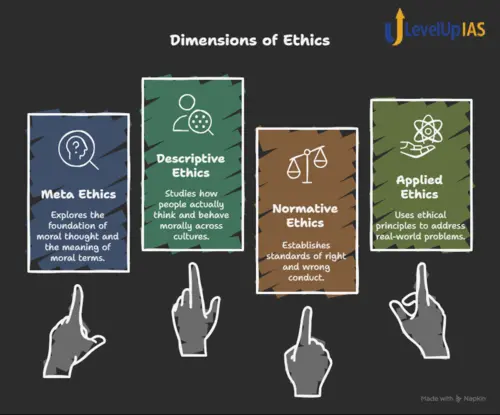
Normative Ethics
Normative ethics is concerned with establishing standards of right and wrong conduct. It seeks guiding principles or tests for moral behavior.
The Golden Rule is a classic example: Treat others as you would want to be treated. This principle can be applied to judge actions such as lying, stealing, or harming others.
Three major approaches fall under normative ethics:
Virtue Theories
- Rooted in ancient Greek philosophy, virtue ethics emphasizes cultivating good character traits rather than merely following rules.
- Plato highlighted four cardinal virtues: wisdom, courage, temperance, and justice. Aristotle argued that virtues are habits that regulate emotions (e.g., courage moderates fear).
- Moral education is central—virtues must be instilled in youth to shape lifelong character.
Duty Theories (Deontological Ethics)
- These theories stress obligations and duties, regardless of consequences.For example, caring for one’s children is a duty, even if neglecting them might bring personal gain.
- Morality is grounded in foundational principles of obligation.
Consequentialist Theories (Teleological Ethics)
- Here, morality is judged by outcomes. An action is right if its positive consequences outweigh the negative ones.
- This involves a cost-benefit analysis: tallying good and bad results, and choosing the action with the most favorable balance.
Applied Ethics
Applied ethics bridges theory and practice. It uses ethical principles to address real-world problems. Examples include environmental ethics, which examines responsibilities of governments and corporations in tackling pollution.
- Unlike simple dichotomies of “right vs. wrong,” applied ethics recognizes that moral dilemmas are complex and multifaceted.
- Ethical decisions often require balancing multiple interests to improve overall conditions rather than favoring one side exclusively.
Note: Applied ethics is a broader concept to cover for UPSC MAINS EXAMINATION. Read it here:
FAQs
1. What are the four major dimensions of ethics?
The four major dimensions of ethics are Meta Ethics, Descriptive Ethics, Normative Ethics, and Applied Ethics. Each explores morality from different angles—foundations, cultural practices, guiding principles, and real-world applications.
2. What is Meta Ethics and why is it important?
Meta Ethics examines the meaning and origin of moral concepts. It asks whether values are universal truths or human inventions and explores psychological motivations behind moral actions. This helps us understand the foundation of ethical thought.
3. What is the difference between “other-worldly” and “this-worldly” views in Meta Ethics?
Other-worldly view: Moral values are objective, eternal, and universal.
This-worldly view: Moral values are human constructs, often linked to moral relativism.
This distinction highlights whether morality is absolute or culturally dependent.
4. Why is ethics important for UPSC aspirants?
Ethics forms a crucial part of the UPSC syllabus, especially in General Studies Paper IV. Understanding dimensions of ethics helps aspirants develop analytical skills, moral reasoning, and decision-making abilities essential for public administration.