Early Muslim Invasions
Content
- Introduction
- Arab Invasion in India
- Turkish Invasion in India
- Muhammad Ghori (1149–1206 AD)
- Rajput Uprisings
- Conclusion
- FAQs
Introduction
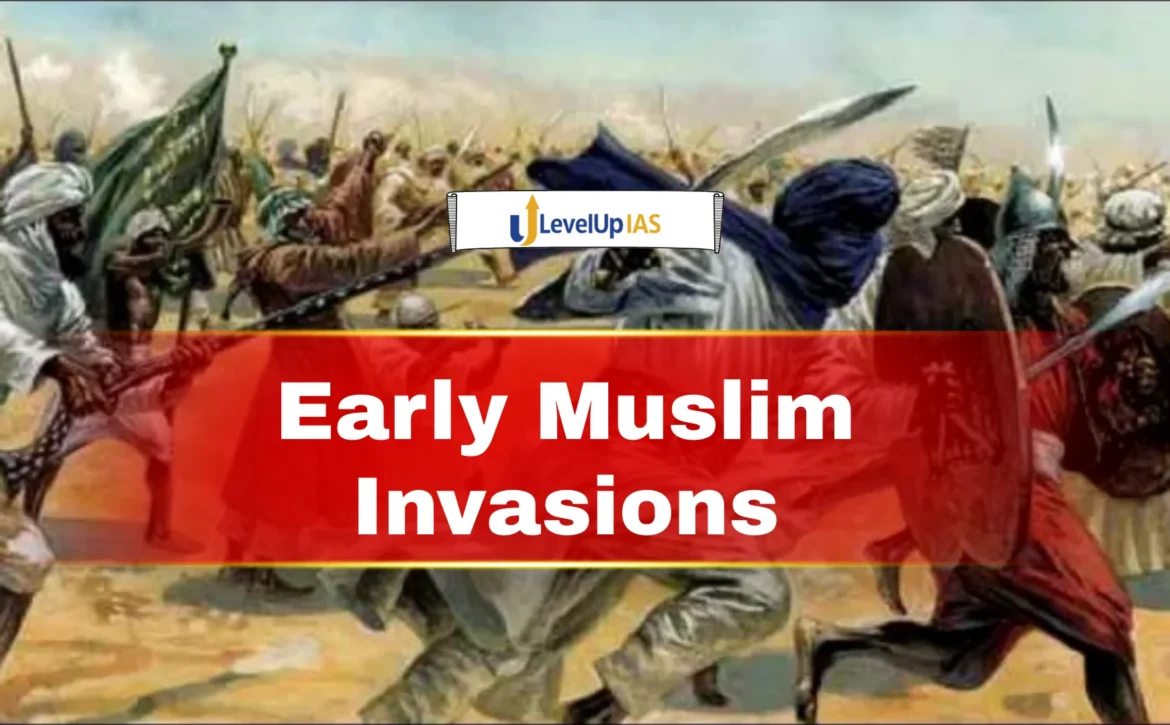
The initial Muslim incursion into India was executed by the Arabs under the leadership of Muhammad Bin Qasim. This event took place in 711 AD and led to the annexation of Sind. Mohammed Ghazni carried out the first Turkish invasion of India, primarily to acquire wealth. Between 1000 and 1027 AD, he invaded India seventeen times while claiming to wage Jihad.
His inaugural attack on India occurred in 1001 AD. This article will explore the Early Muslim Invasions in India, which will be beneficial for UPSC exam preparation.
Arab Invasion in India
Muhammad bin Qasim
- Muhammad ibn Qasim (31 December 695-18 July 715) was an Arab military commander serving under the Umayyad Caliphate. He led the Muslim conquest of Sindh as part of the Umayyad expansion into India. His campaigns resulted in the establishment of Arab rule in Sindh after defeating the Sindhi Brahmin ruler Raja Dahir, whose death marked the end of Brahmin authority in the region. The Arab forces sent Dahir’s severed head to the Umayyad governor, al-Hajjaj ibn Yusuf, in Basra.
- With the capture of Aror, the then-capital of Sindh, Muhammad bin Qasim became the first Muslim general to successfully conquer Hindu-ruled territory in India, paving the way for Muslim rule in the subcontinent. Remarkably, he led this campaign at the young age of seventeen, introducing a new religious and cultural influence to the Indus Valley, similar to how Alexander the Great had earlier reshaped the region.
- According to the Chachnama, between 709 and 711 CE, al-Hajjaj appointed Qasim to lead the Sindh expedition. As Hajjaj’s nephew and a skilled military commander, Qasim had already taken charge of governing the frontier region of Makran. He carefully planned and executed the invasion of Sindh.
Battle of Rewar
Muhammad bin Qasim fought Raja Dahir, the Brahmin ruler of Sindh, and defeated him in the Battle of Rewar. As a result, Sindh and Multan came under Arab control. Qasim famously referred to Multan as the ‘City of Gold’ because of its wealth and prosperity.
Administrative System
After the conquest, Arab officials administered Sindh by following a system similar to that used in other Arab-ruled territories. Historians believe this early Islamic administration was relatively liberal compared to later Muslim regimes. This was mainly because Islamic law during the early centuries was less rigid than in later periods. Over time, Muslim governments across different regions became more austere, a trend visible during Turkish and Mughal rule in India between the 12th and 18th centuries.
Turkish Invasion in India
Mahmud of Ghazni (971–1030 AD)
- After the Arab conquest of Sindh, it was the Turks who expanded Muslim rule into India during the 11th century. Mahmud of Ghazni was the first Turkish ruler to invade India, beginning his campaigns in 1001 AD.
- He defeated several Indian rulers, including Jaipala of the Hindu Shahi dynasty, Fateh Daud of Multan, Anandpala of Nagarkot, and the Chandela rulers of Mathura, Kanauj, and Gwalior. These victories enabled him to return to Ghazni with immense wealth.
- In 1025 AD, Mahmud launched a major attack on the Somnath Temple in Kathiawar. Raja Bhima Dev, the ruler of the region, fled along with his supporters.
Assessment of Mahmud of Ghazni
Mahmud of Ghazni is often regarded as one of Asia’s most powerful Muslim rulers. He was a patron of art, literature, and scholars such as Firdausi and Alberuni. While some view him as a heroic defender of Islam, others remember him for the destruction of Hindu, Jain, and Buddhist religious sites. His conquests significantly transformed the political, religious, and cultural landscape of the Indian subcontinent.
Muhammad Ghori (1149–1206 AD)
Mu’izz ad-Din Muhammad, popularly known as Muhammad of Ghori, ruled the Ghurid Empire from 1173 to 1206. His empire extended across present-day Afghanistan, Iran, Pakistan, northern India, Bangladesh, Tajikistan, and Turkmenistan.
Although the Ghurid Empire was short-lived, Muhammad Ghori’s military campaigns laid the foundation for long-lasting Muslim rule in India. After his death in 1206, his former slave and general, Qutbuddin Aibak, became the first Sultan of Delhi, marking the beginning of the Delhi Sultanate.
First Battle of Tarain (1191 AD)
In 1189 AD, Muhammad Ghori attacked the fort of Bhatinda and advanced into the kingdom of Prithviraj Chauhan. However, in 1191 AD, Prithviraj defeated him in the First Battle of Tarain, and the Rajputs recaptured Bhatinda.
Second Battle of Tarain (1192 AD)
In the Second Battle of Tarain, Muhammad Ghori defeated the combined Rajput forces led by Prithviraj Chauhan. With the assistance of Qutb-ud-din Aibak, Muhammad Ghori captured Prithviraj and later executed him. This victory marked the beginning of Turkish rule in India.
Muhammad Ghori appointed Qutb-ud-din Aibak as his military commander in India.
Rajput Uprisings
Between 1193 and 1198 AD, several Rajput rebellions broke out. Qutb-ud-din Aibak suppressed these uprisings and consolidated Turkish control over northern India. Delhi was declared the capital.
Battle of Chandawar (1194 AD)
In 1194 AD, Muhammad Ghori fought Jaichand of Kannauj, the Gahadavala ruler, at Chandawar near the Yamuna River, close to modern-day Firozabad. Jaichand, who was also Prithviraj Chauhan’s father-in-law, was defeated and killed. This victory gave Muhammad Ghori control over much of northern India.
Conquest of Bengal and Bihar
Muhammad-bin-Bakhtiyar Khilji, one of Ghori’s generals, destroyed the Buddhist university of Vikramasila in 1202 AD and Nalanda University in 1203 AD, leading to the decline of major centers of Buddhist learning in eastern India.
Conclusion
The Arab invasion resulted in the formation of two Muslim-ruled regions, Sindh and Multan. In contrast, the Turkish invasions led to the establishment of Muslim dominance over a much larger part of northern India, shaping the political and cultural history of the subcontinent for centuries.
FAQs
1. What are referred to as the early Muslim invasions in India?
Early Muslim invasions refer to the initial Arab military and commercial contacts with India, especially the conquest of Sindh in 712 AD by Muhammad bin Qasim.
2. Who led the first major Muslim invasion of India?
Muhammad bin Qasim, an Umayyad general, led the first successful military campaign into Sindh.
3. Why was Sindh invaded?
The invasion was triggered by attacks on Arab traders and the political ambitions of the Umayyad Caliphate to expand its influence.
4. Were these invasions mainly religious?
No. They were driven by political, economic, and strategic motives, not purely religious expansion.
5. What was the outcome of Muhammad bin Qasim’s campaign?
Arab rule was established in Sindh, marking the beginning of Islamic political presence in the Indian subcontinent.
Click on the question to see the Answers