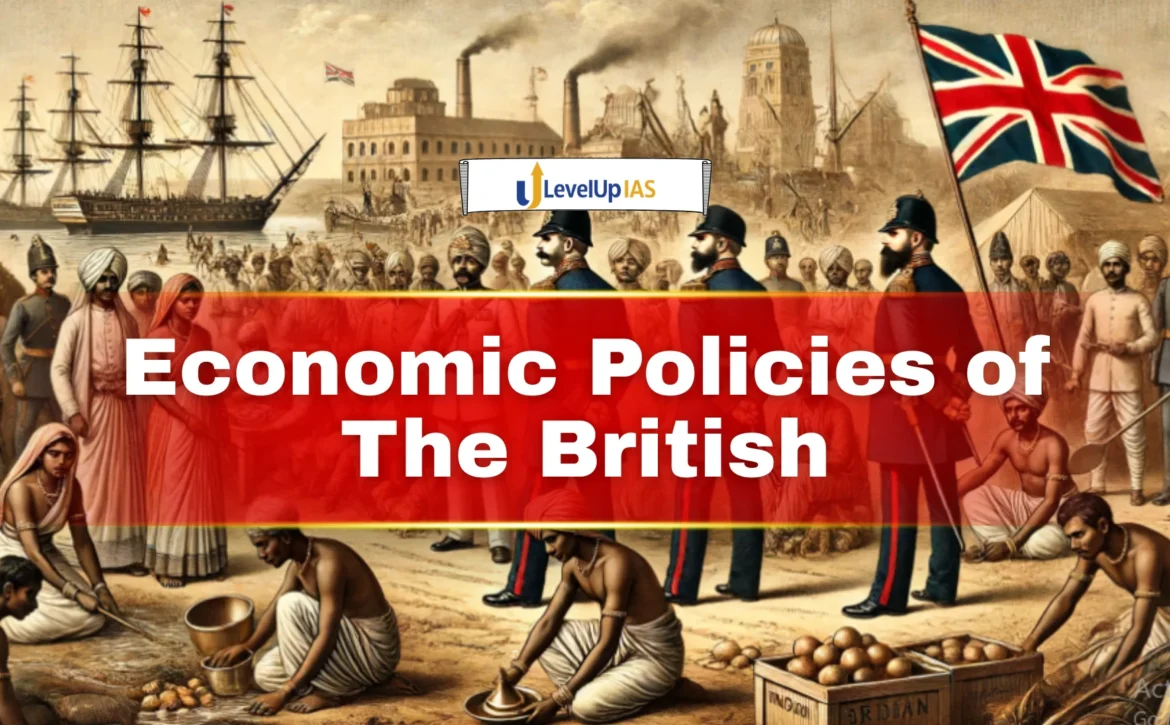
Economic Policies of The British
Content
- Introduction
- Nature of British Economic Policy
- Land Revenue Policies
- Commercialization of Agriculture
- Deindustrialisation and Commercial Policy
- Railways, Transport and Finance Capitalism
- Drain of Wealth Theory
- Impact on Indian Society and Economy
- Positive and Negative Dimensions
- FAQs
Introduction
The Economic policies of the British in India transformed a self-sufficient traditional economy into a colonial appendage serving the interests of British capital, leading to deindustrialisation, agrarian crisis, and the famous “drain of wealth”.
These policies were never designed for Indian welfare; they aimed at maximizing revenue, securing markets, and extracting resources, though they also incidentally introduced railways, modern education, and new infrastructure.
Nature of British Economic Policy
British rule gradually reoriented India’s economy to suit the needs of the metropolitan (British) economy. India was turned into a supplier of raw materials, a market for British manufactured goods, and a field for investment of British capital.
Key features:
- Colonial exploitation and extraction of surplus from agriculture and trade.
- Subordination of indigenous industry to British industrial interests.
- Systematic transfer of wealth abroad through the “drain of wealth”.
Land Revenue Policies
British land revenue experiments reshaped agrarian relations and became a major instrument of exploitation. High and rigid revenue demands, combined with the commercialization of agriculture, led to peasant indebtedness, land alienation, and recurrent famines.
Permanent Settlement (Zamindari System)
Introduced by Lord Cornwallis in Bengal, Bihar and Orissa in 1793, Permanent Settlement fixed land revenue in perpetuity, recognizing zamindars as landlords and intermediaries. The state demand was kept very high (around 10/11th of the rental in early practice), leading many zamindars to extract ruthlessly from peasants and lose estates through auction when they failed to pay.
Main impacts:
- Creation of a class of loyal landlord intermediaries.
- Peasant oppression, rack-renting and widespread insecurity of tenure.
- Little incentive for zamindars to invest in agricultural improvement.
Ryotwari System
The Ryotwari system, introduced in parts of Madras and Bombay presidencies under Thomas Munro and others, established a direct settlement between the state and the peasant (ryot). In theory the peasant was recognized as the proprietor, but in practice the state demand remained high and was periodically revised, often exceeding the peasant’s capacity.
Consequences:
- Removal of intermediaries but persistence of heavy revenue burden.
- Growth of moneylenders due to frequent indebtedness of peasants.
Mahalwari System
The Mahalwari system, introduced in North-Western Provinces, parts of Central India and Punjab, made the village community or mahal collectively responsible for payment of land revenue. Revenue was to be revised periodically (usually every 20–30 years), again keeping the demand high.
Effects:
- Collective responsibility increased pressure on entire village communities.
- Continued insecurity and lack of capital investment in agriculture.
Commercialization of Agriculture
Under British rule, there was a sharp shift from subsistence to commercial agriculture, driven by the needs of British industry and world markets. Peasants increasingly cultivated cash crops such as cotton, indigo, jute, tea, coffee, sugarcane and opium to meet revenue demands and market pressures.
Major outcomes:
- Vulnerability to price fluctuations and global depressions, often resulting in rural distress and famine.
- Foodgrain area stagnated or shrank in some regions, aggravating food insecurity.
- A class of rich peasants and traders emerged, but the majority of cultivators suffered from debt and land loss.
Deindustrialisation and Commercial Policy
The British transformed India into a market for Lancashire textiles and other manufactured goods while suppressing indigenous industries. This process of deindustrialisation undermined traditional handicrafts and curtailed the growth of modern industry in the early phase.
Key aspects:
- In the 18th century, the East India Company initially used its political power to obtain Indian textiles and other goods on favourable terms for export to Europe.
- From the early 19th century, British commercial policy shifted decisively towards free trade, flooding India with machine-made British textiles at low tariffs while Indian goods faced high duties in Britain.
- Traditional textile centres such as Bengal and Dhaka declined, leading to large-scale artisan unemployment and ruralisation of displaced craftsmen.
Railways, Transport and Finance Capitalism
The introduction of railways, telegraphs, modern roads and ports is often cited as a positive legacy of British rule, but these developments primarily served imperial interests. Railways were designed to move raw materials from the interior to ports and to distribute British manufactured goods into the hinterland more efficiently.
Important dimensions:
- “Finance capitalism”: From the late 19th century, Britain invested heavily in railways, plantations, mining and infrastructure in India, earning guaranteed profits backed by Indian revenues.
- Freight and fare structures were biased towards export of raw materials and import of manufactures, strengthening India’s role as a classic colonial economy.
- While railways promoted internal mobility and facilitated the rise of a national market, the immediate gains accrued largely to British investors and Indian intermediaries.
Drain of Wealth Theory
Dadabhai Naoroji systematically argued that British rule caused a continuous “drain of wealth” from India to Britain without adequate economic return. This external drain, he claimed, was a central cause of Indian poverty and underdevelopment.
Naoroji identified several channels of drain:
- Remittances of salaries, pensions and profits by British officials and businessmen settled in India.
- Government expenditure on wars, administration, and empire-building outside India but financed from Indian revenues.
- Free trade policies that allowed British capitalists to appropriate a large share of India’s surplus.
He estimated that enormous sums were transferred annually, reinforcing the nationalist critique of the inherently exploitative nature of colonial rule.
Impact on Indian Society and Economy
The cumulative effect of British economic policies was structural distortion and chronic poverty. India shifted from being a relatively prosperous, diversified economy to a stagnating agrarian colony characterized by recurrent famines, low per capita income and high levels of inequality.
Key impacts:
- Agrarian crises: High revenue, commercialization and indebtedness led to peasant uprisings and agrarian revolts in several regions.
- Social change: New classes emerged like zamindars, moneylenders, rich peasants, urban professionals, while artisans and small peasants suffered.
- Intellectual response: Early nationalists used economic critique (drain theory, deindustrialisation, unequal trade) to build a powerful anti-colonial consciousness.
Positive and Negative Dimensions
From an examination angle, it is important to present a balanced but critical view. The overwhelmingly negative consequences existed alongside some unintended positive effects.
Negative aspects:
- Systematic exploitation and extraction of India’s surplus for Britain’s benefit.
- Deindustrialisation, rural impoverishment and recurring famines.
- Structural dependence on exports of raw materials and imports of manufactures.
Limited positive legacies:
Emergence of a pan-Indian market and some early modern industries towards the late 19th and early 20th centuries.
Introduction of railways, telegraph, postal services and modern administrative structures.
Spread of modern education and ideas, which contributed to the growth of nationalism.
FAQs
1. What were the economic policies of the British in India?
The British economic policies aimed to serve colonial interests by extracting revenue, securing raw materials, and creating a market for British manufactured goods, leading to economic exploitation of India.
2. What is the Drain of Wealth theory?
The Drain of Wealth theory, propounded by Dadabhai Naoroji, explains the continuous transfer of India’s surplus resources to Britain in the form of profits, salaries, pensions, and administrative expenses.
3. How did British land revenue systems affect Indian peasants?
Land revenue systems such as Permanent Settlement, Ryotwari, and Mahalwari imposed high and rigid taxes, leading to peasant indebtedness, land alienation, and frequent famines.
4. What is meant by deindustrialisation of India?
Deindustrialisation refers to the decline of traditional Indian handicrafts and industries due to discriminatory British trade policies and the influx of cheap machine-made British goods.
5. How did the commercialisation of agriculture impact India?
Commercialisation forced farmers to grow cash crops like indigo, cotton, and tea instead of food grains, increasing vulnerability to famines and rural poverty.
Click on the question to see the Answers