El Niño: Meaning, Mechanism, and Impact on Global Climate
Content
- Introduction
- What is ENSO?
- Mechanism of El Niño
- Characteristics of El Niño
- Global Climatic Impacts of El Niño
- Impact of El Niño on India
- Other Climate Phenomena
Introduction
El Niño is a climatic phenomenon associated with abnormal warming of sea surface temperatures in the central and eastern equatorial Pacific Ocean. It forms part of the larger El Niño-Southern Oscillation (ENSO) system, which represents periodic fluctuations in oceanic and atmospheric conditions across the tropical Pacific. These fluctuations significantly influence global weather patterns, including rainfall distribution, temperature anomalies, and monsoon behaviour.
El Niño events typically occur every 2-7 years and can last for about 9-12 months, sometimes longer. The phenomenon has major implications for agriculture, water resources, disaster management, and economic stability across different parts of the world.
What is ENSO?
The El Niño-Southern Oscillation (ENSO) is a coupled ocean atmosphere phenomenon in the tropical Pacific characterized by periodic changes in sea surface temperatures, atmospheric pressure, and wind patterns.
ENSO has three phases:
- El Niño (Warm Phase): Unusual warming of the central and eastern Pacific Ocean.
- La Niña (Cold Phase): Unusual cooling of the same region.
- Neutral Phase: Normal climatic conditions without major anomalies.
These phases influence global atmospheric circulation and affect climate patterns across continents.
Mechanism of El Niño Formation
1. Normal Conditions (Neutral ENSO Phase)
Under normal conditions, strong trade winds blow from east to west across the Pacific Ocean. These winds push warm surface water towards the western Pacific near Indonesia and Australia.
As warm water accumulates in the western Pacific, cold nutrient-rich water rises near the coast of South America through a process known as upwelling. This maintains a balance in ocean temperatures and atmospheric circulation known as the Walker Circulation.
2. Development of El Niño
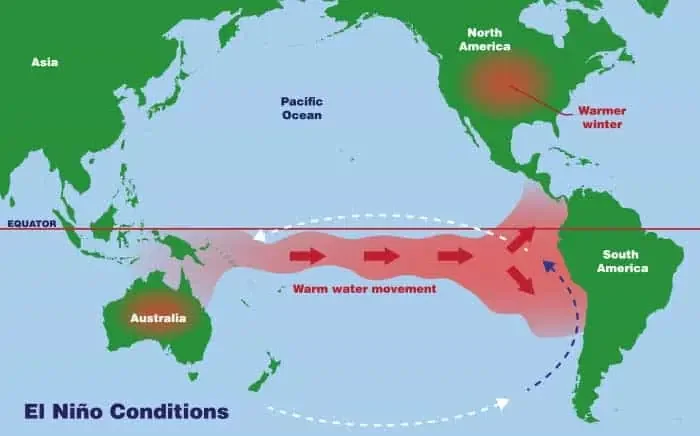
El Niño begins when the trade winds weaken or reverse direction.
Key processes include:
- Weakening of trade winds across the equatorial Pacific.
- Eastward movement of warm surface water toward the central and eastern Pacific.
- Reduction of upwelling of cold water along the South American coast.
- Weakening of Walker Circulation and shifting of rainfall patterns across the tropics.
As a result, sea surface temperatures in the eastern Pacific become significantly warmer than normal.
Characteristics of El Niño
- Occurs periodically every 2–7 years.
- Identified when sea surface temperatures rise about 0.5°C or more above average in the central and eastern Pacific.
- Associated with weakening of trade winds and disruption of normal atmospheric circulation patterns.
Global Climatic Impacts of El Niño
El Niño causes significant changes in weather patterns across the globe.
1. Changes in Rainfall Distribution
Regions such as western South America may experience heavy rainfall and flooding, while parts of Australia, Southeast Asia, and Africa may face drought conditions.
2. Increase in Extreme Weather Events
El Niño is associated with heatwaves, floods, droughts, and forest fires due to altered atmospheric circulation patterns.
3. Impact on Marine Ecosystems
Reduced upwelling near the South American coast decreases the availability of nutrients in ocean waters, affecting fisheries and marine biodiversity.
Impact of El Niño on India
1. Weakening of the Indian Monsoon: El Niño events are often associated with below-normal southwest monsoon rainfall in India, as the shift in atmospheric circulation disrupts the moisture-bearing winds that bring rainfall to the subcontinent.
2. Increased Risk of Drought: Several drought years in India, including 2002, 2009, 2014, and 2015, were associated with El Niño conditions.
3. Agricultural and Economic Impact: Reduced rainfall affects Kharif crops such as rice, pulses, maize, and oilseeds, leading to lower agricultural productivity and affecting rural livelihoods.
4. Water and Energy Stress: Weak monsoons lead to reduced reservoir levels, affecting irrigation, drinking water supply, and hydroelectric power generation.
Interaction with Other Climate Phenomena
1. Indian Ocean Dipole (IOD)
The Indian Ocean Dipole, which represents temperature differences between the eastern and western Indian Ocean, can either strengthen or offset the impact of El Niño on the Indian monsoon.
2. La Niña
La Niña represents the opposite phase of ENSO and generally leads to stronger monsoon rainfall in India due to intensified trade winds and increased moisture transport.
Conclusion
El Niño is a major climatic phenomenon that significantly influences global weather systems and regional climate patterns. Its impact on the Indian monsoon makes it particularly important for India’s agriculture, water security, and economic stability. Understanding El Niño and the broader ENSO system is therefore crucial for improving climate prediction, disaster preparedness, and sustainable resource management.
FAQs
Q1. What is El Niño?
El Niño refers to the periodic warming of sea surface temperatures in the central and eastern equatorial Pacific Ocean, which disrupts normal atmospheric circulation and global climate patterns.
Q2. How does El Niño occur?
During El Niño, weakened trade winds reduce the upwelling of cold water along the western coast of Peru and Ecuador. Warm surface water spreads eastward across the Pacific Ocean, altering ocean-atmosphere interactions.
Q3. What is the connection between El Niño and ENSO?
El Niño is part of the broader climate system called the El Niño–Southern Oscillation, which includes three phases: El Niño (warming phase), La Niña (cooling phase), and neutral conditions.
Q4. How does El Niño affect the Indian monsoon?
El Niño often weakens the southwest monsoon over India, leading to reduced rainfall and potential drought conditions in several regions.
Q5. What are the global impacts of El Niño?
It can cause droughts in some regions, heavy rainfall and floods in others, marine ecosystem disruptions, and global temperature anomalies.