Exercise Sea Dragon 2026
Content
- Why in News?
- Introduction
- About Exercise Sea Dragon
- Key Highlights
- Significance of the Exercise
- Strategic Implications for India
- Way Forward
- Conclusion
Why in News?
The Indian Navy is participating in Exercise Sea Dragon 2026, a United States Navy-led multinational anti-submarine warfare (ASW) exercise, along with several Indo-Pacific partner nations.
Introduction
It is a multilateral naval exercise focused on anti-submarine warfare (ASW), conducted annually to enhance coordination and maritime security among like-minded countries. It reflects the growing emphasis on naval cooperation and strategic partnerships in the Indo-Pacific region, particularly in response to evolving maritime security challenges.
About Exercise Sea Dragon
- Exercise Sea Dragon is an initiative led by the United States Navy to strengthen interoperability, coordination, and operational readiness among participating nations. It has been conducted annually since 2019 at Andersen Air Force Base, Guam, located in the Western Pacific region.
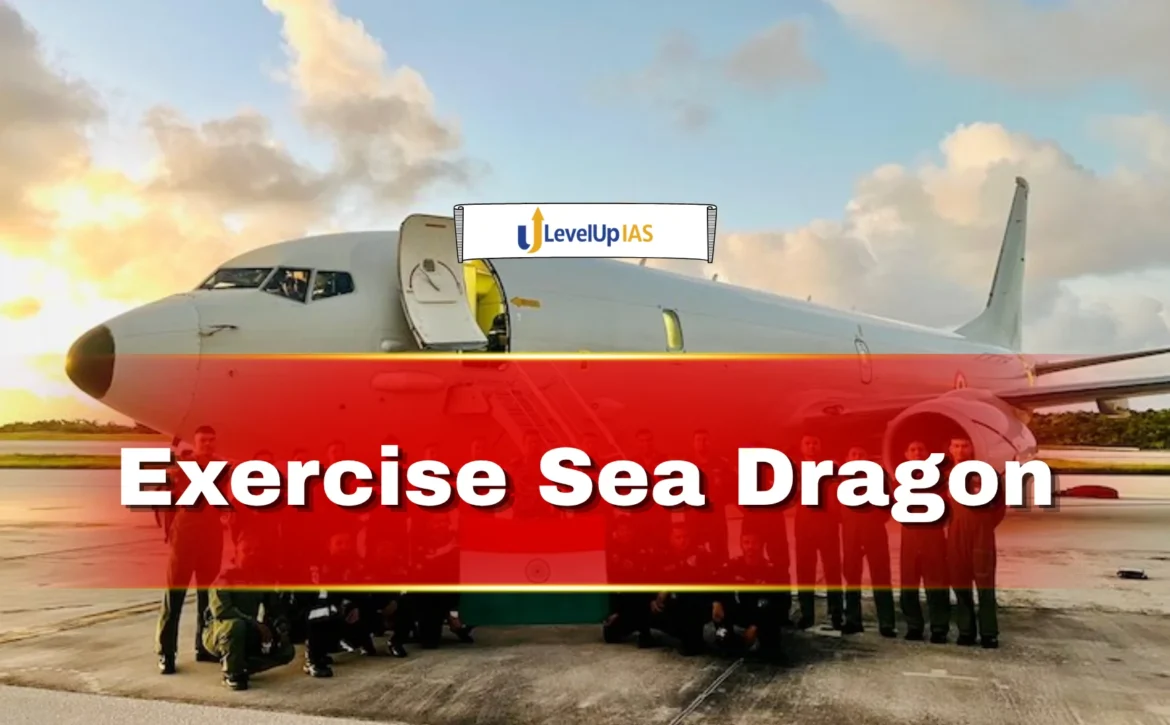
- The exercise primarily involves the deployment of long-range maritime patrol aircraft, such as the P-8 Poseidon, which are used for surveillance, reconnaissance, and submarine detection.
- A key objective of the exercise is to provide a realistic operational environment where participating forces can test and refine their anti-submarine warfare capabilities. It focuses on standardising communication protocols, data-sharing mechanisms, and tactical procedures, which are critical for joint operations during real-world contingencies.
Sea Dragon 2026: Key Highlights
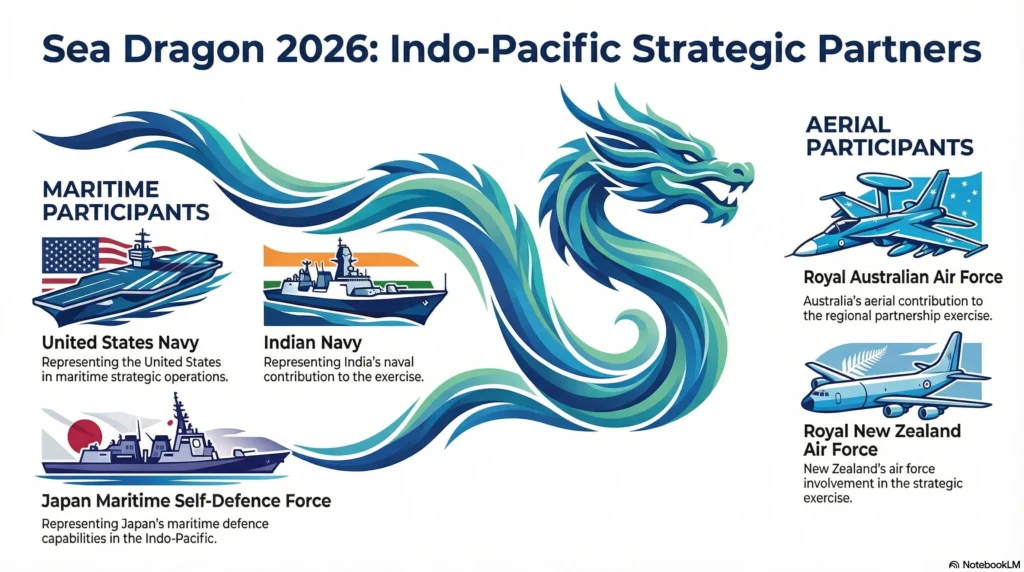
The 2026 edition of the exercise includes participation from multiple Indo-Pacific partners, including:
- United States Navy
- Indian Navy
- Royal Australian Air Force
- Japan Maritime Self-Defence Force
- Royal New Zealand Air Force
The emphasises coordinated mission execution, where participating teams are evaluated based on their speed, accuracy, and operational efficiency.
It follows a progressive training model, beginning with simulated tracking exercises and advancing to the detection and tracking of a live submarine, thereby enhancing the practical ASW skills of participating aircrews.
Each event during the exercise is graded, and the nation achieving the highest cumulative score is awarded the prestigious “Dragon Belt”, symbolising excellence in anti-submarine warfare operations.
Significance of the Exercise
- It holds strategic importance in strengthening maritime security in the Indo-Pacific region, which is a critical theatre for global trade and geopolitical competition.
- For India, participation enhances its naval capabilities, particularly in anti-submarine warfare, which is increasingly important given the rising presence of submarines in the region.
- The exercise also promotes interoperability among partner nations, ensuring that their forces can operate seamlessly in joint missions. This is particularly relevant in the context of emerging security frameworks and strategic alignments in the Indo-Pacific.
- Additionally, it contributes to capacity building and technological cooperation, as countries operate similar platforms and share best practices.
Strategic Implications for India
- India’s participation reflects its commitment to a free, open, and inclusive Indo-Pacific. It aligns with India’s broader maritime vision such as SAGAR (Security and Growth for All in the Region).
- It also strengthens India’s defence partnerships with key countries like the United States, Japan, and Australia, which are important for maintaining regional stability and deterrence.
- Furthermore, it enhances India’s preparedness to deal with non-traditional and traditional maritime threats, including submarine warfare, piracy, and strategic competition.
Way Forward
- To further strengthen the effectiveness of exercises like Sea Dragon, there is a need to expand the scope and participation by including more Indo-Pacific nations, thereby enhancing collective maritime security and regional cooperation.
- India should continue to leverage such platforms to upgrade its anti-submarine warfare (ASW) capabilities, especially through the integration of advanced technologies such as artificial intelligence, underwater sensors, and network-centric warfare systems.
- There is also a need to deepen interoperability and information-sharing mechanisms among partner nations, including real-time intelligence exchange and standardisation of operational protocols, which are crucial during joint missions.
- Regular participation in such exercises should be complemented by bilateral and multilateral naval engagements, ensuring sustained operational readiness and trust-building among countries.
- In the long term, India can utilise such platforms to reinforce its vision of a free, open, and inclusive Indo-Pacific, while balancing strategic interests and maintaining regional stability.
Conclusion
Exercise Sea Dragon 2026 represents a significant step towards enhancing multinational maritime cooperation and operational readiness in the Indo-Pacific. For India, it strengthens naval capabilities, deepens strategic partnerships, and reinforces its role as a key stakeholder in ensuring regional maritime security and stability.
Visit LevelUp IAS- Click Here