Geology and Rock System of India
Content
- Introduction
- Key Concepts in Indian Geology
- Archaean Rock System (Pre-Cambrian)
- Purana Rock System
- Dravidian Rock System
- Aryan Rock System
- FAQs
Introduction
India’s geological history spans billions of years, from the ancient Archaean rocks of the Peninsula to the young alluvium of the Indo-Gangetic plains. Understanding this helps explain landforms, minerals, soils and water resources across the country.
Key Concepts in Indian Geology
- Geological structure means the way rocks are arranged and deformed in the earth’s crust, including folds, faults and rock morphology. The geological time scale orders these rocks by their age, origin, evolution and extinction events, with T.S. Holland adapting a standard framework for India.
- India’s geology is often described in terms of Peninsular India, the ancient stable craton from Gondwanaland, and Extra-Peninsular India, mainly the younger Himalayas and plains. Key events include the Peninsula’s existence since early crust formation, Himalayan uplift in the Tertiary due to plate collision, and ongoing aggradation of the Indo-Gangetic plain from the Pleistocene.
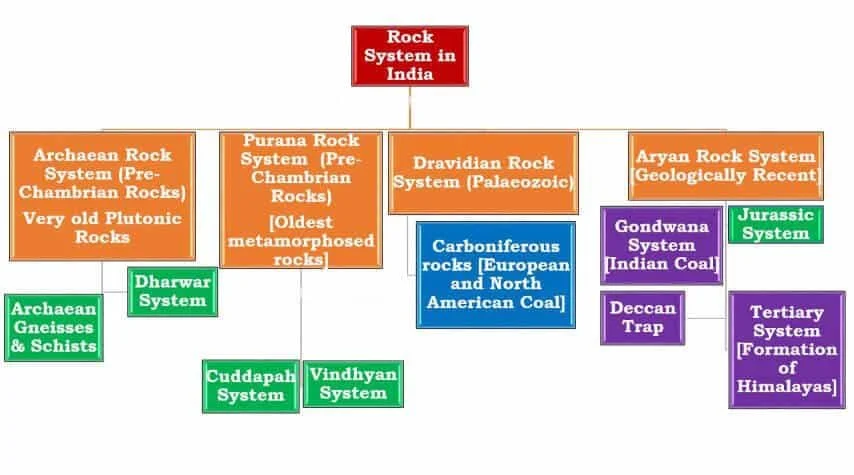
The Geological Survey of India groups the country’s rocks into four main systems: Archaean, Purana, Dravidian and Aryan.
- Archaean Rock System
- Purana Rock System
- Dravidian Rock System
- Aryan Rock System
Archaean Rock System (Pre-Cambrian)
- The Archaean marks the earliest phase of India’s tectonic evolution. With cooling and solidification of the crust over 2.5 billion years ago, some rocks dating back nearly 4 billion years. These gneisses and granites form the core of the Indian craton and act as the basement complex for all younger rocks.
- The system splits into two: the Archaean proper (granites and gneisses) and the Dharwar System (earliest metamorphosed sediments). Gneisses vary in composition from granite to gabbro, while schists are foliated crystalline rocks rich in mica, talc, hornblende and chlorite.
- These rocks are unfossiliferous (azoic), formed from molten magma under intense early heat, thoroughly crystalline with plutonic intrusions, and foliated into thin sheets.
- The Dharwar System, spanning 4 billion to 1 billion years, arose from metamorphism of sediments over Archaean rocks and is well seen in Karnataka’s Dharwar district. Economically, it stands out for high-grade iron ore, manganese, copper, lead and gold deposits.
Purana Rock System (Cuddapah and Vindhyan)
- Formed 1400–600 million years ago, the Purana rocks developed mainly from erosion and redeposition of Archaean and Dharwar materials, predominantly as sediments in basins.
- The Cuddapah System, named after Andhra Pradesh’s Cuddapah district with its prominent outcrops, consists of sandstones, limestones, shales and clays deposited in synclinal troughs. It hosts iron, manganese, copper, cobalt and nickel ores, plus cement-grade limestone.
- The Vindhyan System, named for the Vindhya mountains, features thick (about 4000 m) unfossiliferous sediments over the Archaean base, partly masked by Deccan Traps. It’s known for diamond fields like Panna and Golconda, and supplies building stones, ornamental stones, limestone and glass sand, though lacking metalliferous minerals.
Dravidian Rock System (Palaeozoic)
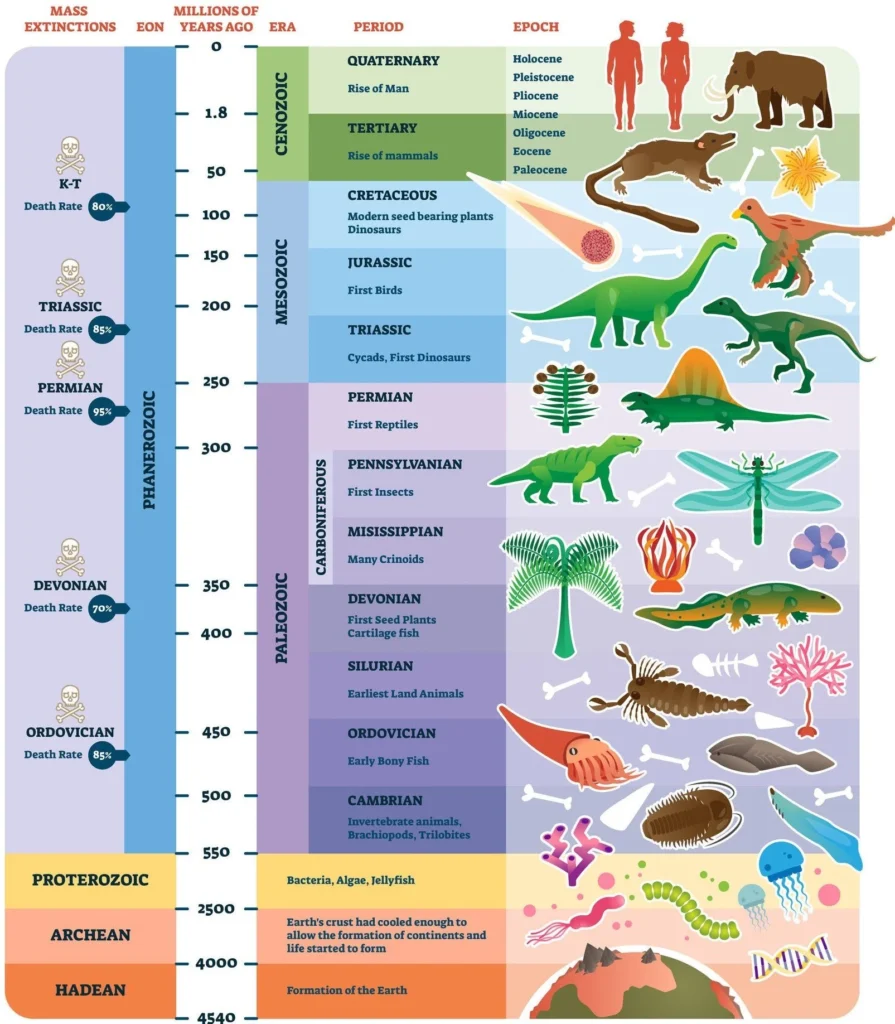
- Spanning 600–300 million years, this system aligns with the global Palaeozoic and features Carboniferous-style rocks, though coal is limited in India.
- Found mostly in extra-Peninsular areas like Kashmir’s Pir Panjal and Lidder valley, Himachal’s Spiti and Shimla, Uttarakhand’s Garhwal-Kumaon, and rarely in the Peninsula (e.g., Umaria). Rocks include shales, sandstones, quartzites, slates, dolomites and marbles, with abundant fossils signaling life’s proliferation under marine conditions.
- It covers Cambrian to Carboniferous ages, including Devonian corals. Carboniferous layers (around 350 million years) of limestone, shale and quartzite form parts of Mount Everest; this era began global coal formation, but India’s major coal is younger.
Aryan Rock System
This system runs from Upper Carboniferous to Holocene, covering Upper Palaeozoic, Mesozoic and Cenozoic eras.
Important rock groups under the Aryan system in India are:
- Gondwana System
- Jurassic System
- Deccan Trap
- Tertiary System
- Quaternary deposits
Gondwana System
Deposited in subsiding synclinal troughs on the ancient plateau since Permian times (250 million years), these freshwater sediments preserved terrestrial life. They hold 98% of India’s coal (younger and lower carbon than Carboniferous), plus iron ore, copper, uranium, antimony, and building materials like sandstone and slate.
Jurassic System
Late Jurassic marine transgressions laid shallow-water sediments in Rajasthan and Kachchh (coral limestones, sandstones, shales) and east coast (Guntur-Rajahmundry). These preserve fossils and host minerals/hydrocarbons.
Deccan Trap
Late Cretaceous to early Eocene fissure volcanism poured basaltic lavas over 10 lakh sq km, now eroded to 5 lakh sq km across Kachchh, Saurashtra, Maharashtra, Malwa and northern Karnataka. Flows form step-like topography (trap = stair), with thicknesses from 3000 m westwards to 150 m eastwards. Weathering yields black cotton soil; divided into Upper, Middle and Lower Traps with varying ash and sedimentary layers.
Tertiary System (60–7 million years)
This era saw Gondwanaland’s final breakup and Himalayan uplift from Tethys geosyncline, shaping modern India. Rocks spread over Himalayan foothills, Assam, Bengal delta, east coast and Andamans, including Kashmir’s Karewas and Gangetic Bhangar. Rich in oil, gas and fossils, it influenced drainage, climate and soils.
Quaternary Alluvium
Pleistocene-Holocene river aggradation built the vast Indo-Ganga-Brahmaputra plain, with ongoing floodplain, delta and coastal deposition.
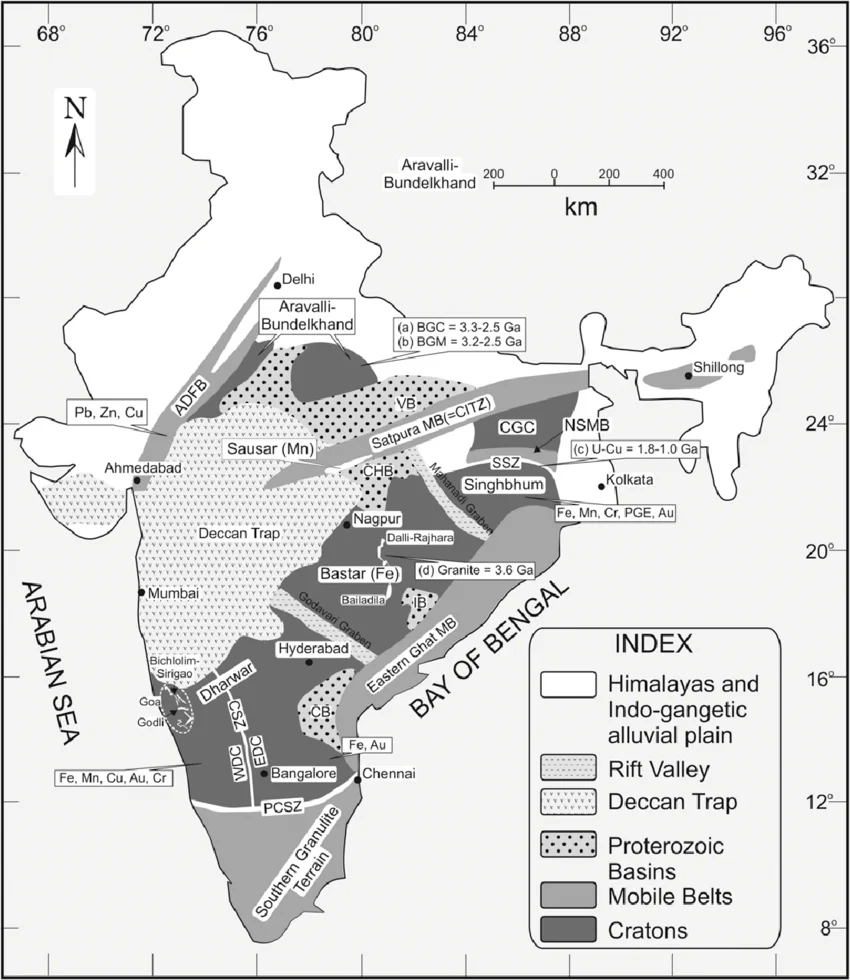
India’s Stratigraphic Diversity
Once part of Gondwanaland, India’s plate collided with Eurasia 50–65 million years ago, birthing the Himalayas. The Peninsula holds Archaean cores, plains bear sediments, and mountains feature deformed younger rocks from Archaean to recent alluvium.
FAQs
1. What is meant by the Geological Rock System of India?
The Geological Rock System of India refers to the chronological classification of rocks based on their age, origin, and structural characteristics, from the earliest Archaean rocks to the recent Quaternary deposits.
2. What is the Archaean Rock System?
The Archaean Rock System is the oldest rock system of India, forming the foundation of the Peninsular Plateau. It mainly consists of gneisses and schists and lacks fossils.
3. What is the Dharwar or Dravidian Rock System?
The Dharwar (also known as Dravidian) Rock System is composed of highly metamorphosed sedimentary and volcanic rocks and is important for mineral resources such as iron ore and gold.
4. What is the significance of the Cuddapah Rock System?
The Cuddapah Rock System consists of thick sedimentary sequences lying unconformably over Archaean rocks and is significant for limestone, shale, and quartzite deposits.
5. Which rock systems are fossiliferous in India?
Fossils are generally absent in Archaean and Dharwar rocks but are found in younger rock systems, especially Paleozoic and later formations.
Click on the question to see the Answers