Geomorphic Processes
Content
Introduction
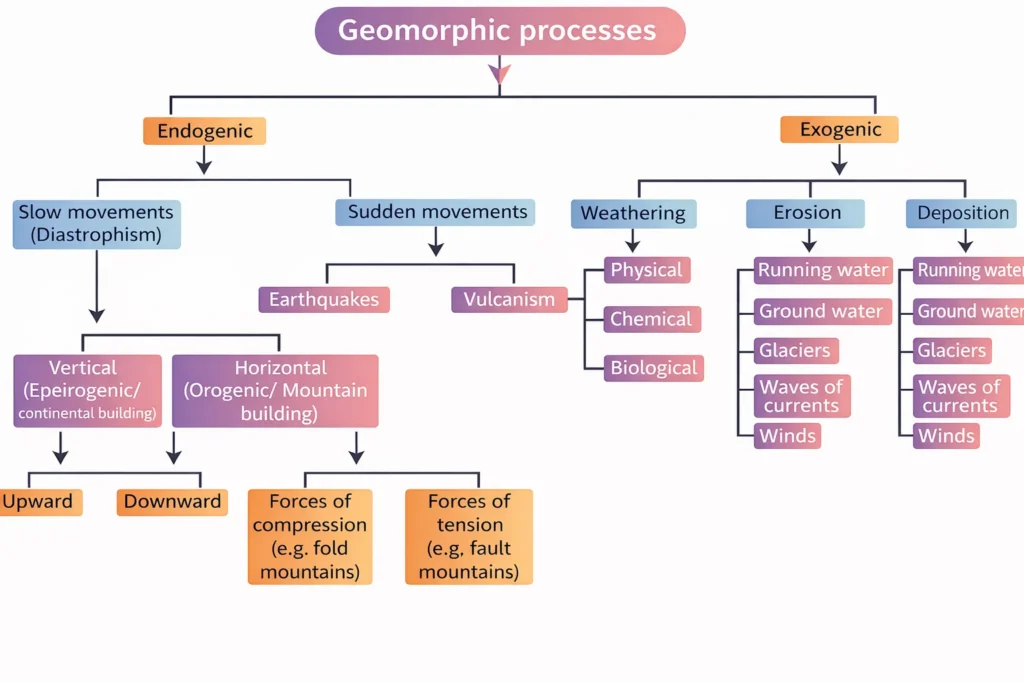
Geomorphology encompasses the examination of landforms, their features, and the various processes physical, chemical, biological, and extraterrestrial, that contribute to their development and transformation. Geomorphic processes involve both endogenic factors originating within the Earth, such as volcanic activity and seismic events, and exogenic factors driven by solar energy that operate through the climate system, including rain, wind, and ocean waves.
These two categories of geomorphic processes, endogenic and exogenic, play a crucial role in shaping various landforms on Earth and the specific landscapes of different regions.
Geomorphic Process
Geomorphic processes involve the physical pressures and chemical reactions that act on Earth materials, leading to alterations in the Earth’s surface configuration.
- Outcomes: Continuous occurrence of these internal and external changes leads to the creation of irregular terrains or landforms. These features undergo modifications in their shape, size, and configuration due to climatic influences, movements within the Earth’s crust, and variations in the intensity of geomorphic processes.
- Types of Geomorphic Processes: Endogenic Process and Exogenic Process
- The endogenic process results from the release of internal energy from the Earth’s interior. These processes lead to the formation of landforms either inside the Earth or on its surface.
- The exogenic process results from climatic influences acting upon the landforms created by endogenic processes.
- Geomorphic Agents: Earthquakes and volcanic activity serve as agents of the endogenic process, whereas running water, groundwater, ice, wind, waves, and ocean currents function as agents of the exogenic process.
Source of Energy: The primary energy sources driving both endogenic and exogenic forces include geothermal energy, gravity, heat energy, and mechanical energy from water and winds, while the ultimate energy source is the Sun.
Endogenic Process
Endogenic geomorphic processes have influenced the Earth’s topography and generated many of its most precious minerals. Energy originating from within the Earth primarily drives them.
- Endogenic forces: These are forces that contribute to land formation and play a crucial role in the development of the Earth’s crust.
- The creation of this energy results from primordial heat, radioactivity, and the friction generated by tidal and rotational movements between the Earth’s layers.
Two Major Forms:
- Slow Movements: Also referred to as diastrophism, these processes evolve gradually over thousands of years.
- Sudden Movements: These processes occur rapidly.
- Diastrophism and sudden movements are interconnected, and most of these movements typically occur in the same locations.
- Slow and sudden movements complement each other, and most of these phenomena are commonly found in the same areas.
- For instance, folding contributes to mountain formation, along with volcanism and seismic activity.
Diastrophism
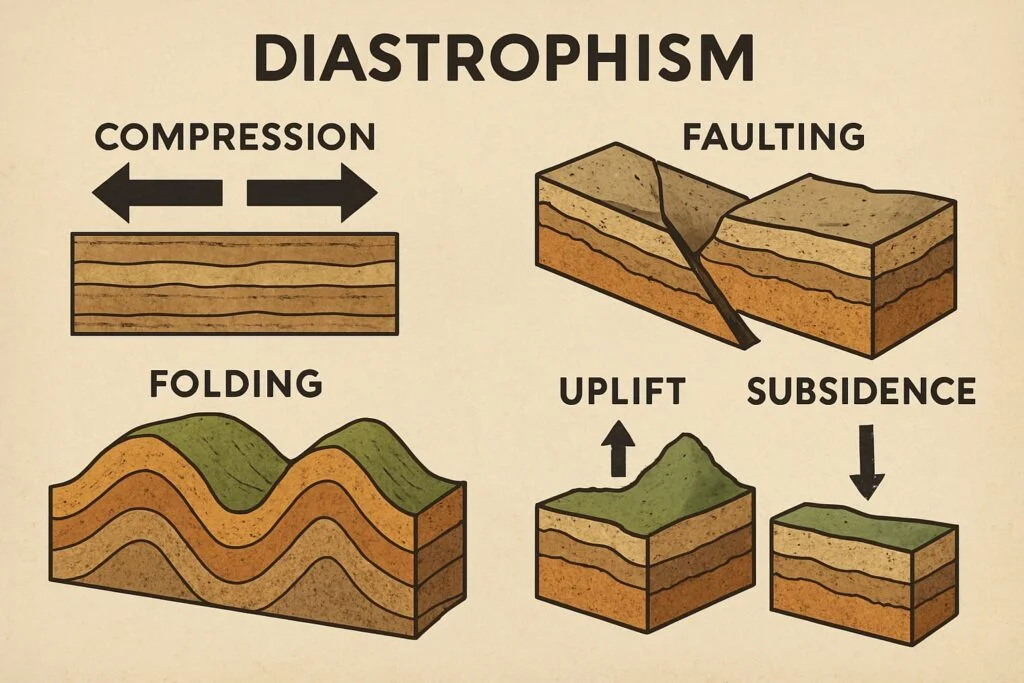
All processes that shift, elevate, or construct segments of the Earth’s crust fall under diastrophism or slow movements. There are two categories of such processes.
- Epeirogenic Process: This process pertains to the building of continents, resulting from the warping or uplift of extensive areas of the Earth’s surface. These movements lead to straightforward deformation of continents.
- Examples include: the uplift of the Deccan Plateau, the emergence of the Andaman and Nicobar Islands, etc.
- Orogenic Process: This process involves the formation of mountains related to plate tectonics. However, oceanic crusts can also emerge as a result of orogeny.
- Mountains can develop through folding or faulting due to the relative movement of the tectonic plates. Volcanism can also contribute to mountain formation.
- When two tectonic plates collide, they either push material upward to create mountain ranges or cause one plate to subduct beneath the other, leading to volcanic mountain chains.
- Examples include the Himalayas, Alps, and fold mountains alongside block mountains like the Vosges and Sierra Nevada.
Sudden Movements
Rapid endogenic forces arising from deep within the Earth trigger sudden movements. They create swift occurrences that result in substantial destruction on and below the Earth’s surface.
- Examples of sudden endogenic processes encompass earthquakes and volcanism, which take place within brief time frames.
- Despite their rapid manifestation, the buildup of energy for these events occurs slowly over extended periods.
- Volcanism: Volcanism denotes the movement of molten rock (magma) towards or onto the Earth’s surface, as well as the formation of various intrusive and extrusive volcanic structures.
- Magma is generated when a section of the upper mantle or lower crust of the Earth melts.
- Volcanic eruptions are prompted by the excessive pressure exerted by magma and heated gases on the Earth’s crust.
- Such eruptions can give rise to volcanic cones and mountains.
- Earthquakes: An earthquake represents a sudden shift within the Earth caused by the immediate release of energy that has accumulated slowly over time.
- The primary cause of earthquakes is plate tectonics, with convergent plate boundaries being the regions with the highest frequency of seismic activity. Divergent plate boundaries (where faulting occurs) also experience earthquakes.
- Examples include the Pacific Ring of Fire, the Himalayan region, and the Atlantic Mid-Oceanic Ridge, etc.
Exogenic Processes
Exogenic processes refer to those activities that take place on the Earth’s surface due to external forces and agents. These activities encompass mass wasting, weathering, erosion, and deposition. All exogenic processes are collectively known as denudation, which translates to “to peel away” or “to expose.”
- Exogenic Forces: Exogenic processes derive energy from the atmosphere, influenced by the sun’s energy and the gradients produced by tectonic activities.
- Exogenic Agents: These include wind, water, waves, gravity, and others.
- Results: The impact of exogenic forces leads to the degradation (erosion) of high landforms and aggradation (filling) of low-lying areas on the Earth’s surface.
Weathering
Weathering is characterized as the physical breakdown and chemical alteration of rocks instigated by interactions with various climatic elements.
- Types of Weathering:
- Physical Weathering: This occurs as a result of physical mechanisms, like temperature fluctuations, or when rocks are subjected to wind, rainfall, and wave action.
- Chemical Weathering: This process involves the transformation of minerals in rocks due to chemical interactions with rainwater.
- Biological Weathering: This is caused by the activities of plants and animals. For instance, a rabbit might dig into a crack within a rock, enlarging it and ultimately fracturing the rock.
Mass Movements
Mass movement, also referred to as mass wasting or slope movement, is described as the substantial relocation of fragmented rock materials downward under gravitational force.
- The movement of rock masses can occur through various means, such as flow, spread, slide, topple, and fall, or a combination of these.
- Mass movements can be categorized into two primary types:
- Slow Movements: Creep is an example of this type, which may happen on moderately steep, soil-covered inclines.
- Rapid Movements: These movements are often observed in humid climates and can occur on both gentle and steep slopes.
Erosion and Deposition
- Erosion is the process of gathering and transporting rocky debris through geomorphic agents like flowing water, wind, waves, and glaciers.
- While weathering facilitates erosion, it is not a necessary precursor.
- Following erosion, deposition occurs when erosional agents decrease in speed and energy on gradual slopes, causing the materials they carry to settle.
Resultant Landforms
The mechanism of the endogenic and exogenic operations is different from one another and hence the landforms produced by each process may be differentiated. Thus, based on dimension and scale, the relief features of the earth’s surface may be grouped into three broad categories of descending order.
| Order of Landforms | Scale & Nature | Genesis & Examples |
| First Order Landforms | These are the largest-scale landforms, covering the maximum area of the Earth’s surface. They represent global geomorphology. | They are formed primarily by endogenic processes such as plate tectonics and epeirogenic movements operating over a very long geological time period. Examples: Continents and Ocean Basins |
| Second Order Landforms | These are structural landforms developed over the first-order landforms (continents and ocean basins). | Their origin is mainly due to endogenic forces, but their final form is modified and shaped by exogenic processes. Examples: Mountains, Plateaus, Plains, Lakes, Faults, Rift Valleys |
| Third Order Landforms | These are micro-level landforms developed on second-order relief features. | They are formed by exogenic degradational and aggradational processes. They include: • Erosional: River valleys, Glacial valleys, Terraces • Depositional: Flood plains, Deltas, Sea beaches, Sand dunes • Residual: Inselbergs • Others: Minor tectonic features |
FAQs
1. What are geomorphic processes?
Geomorphic processes are physical, chemical, and biological mechanisms that operate on the Earth’s surface and lead to the formation, modification, and destruction of landforms.
2. How are geomorphic processes classified?
They are broadly classified into endogenic processes (diastrophism, volcanism) driven by internal Earth energy, and exogenic processes (weathering, erosion, mass wasting, deposition) driven by external forces.
3. What is the role of weathering in geomorphology?
Weathering breaks down rocks in situ through physical, chemical, and biological actions, providing material for erosion and soil formation.
4. How does erosion differ from weathering?
Weathering involves rock disintegration at the place of origin, whereas erosion involves removal and transportation of materials by agents like rivers, wind, glaciers, and waves.
5. What is mass wasting?
Mass wasting refers to the downslope movement of rock and soil under the influence of gravity, including landslides, soil creep, and rockfalls.
Click on the question to see the Answers