
Mains Articles
Government of India Acts (1909)
Content
- Introduction
- Background and Causes
- Key Provisions
- Significance of the Act
- Limitations of the Act
- Evaluation
- Conclusion
- FAQs
Introduction
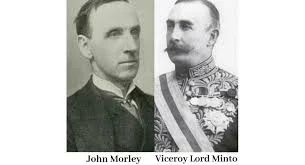
The Government of India Act, 1909, popularly known as the Morley-Minto Reforms, was an important constitutional reform introduced during British rule in India. The reforms were named after John Morley and Lord Minto.
The Act aimed to increase Indian participation in legislative administration while ensuring that real political authority remained in British hands. Though limited in scope, the reforms marked the beginning of representative politics in colonial India. However, the introduction of separate electorates for Muslims became its most controversial feature and had long-term consequences for Indian politics.
Background
- The early twentieth century witnessed the rapid growth of Indian nationalism. The rise of political consciousness, expansion of the press, and activities of the Indian National Congress intensified demands for constitutional reforms and greater Indian participation in governance.
- The immediate political atmosphere was shaped by the Partition of Bengal (1905), which generated widespread protests and gave rise to the Swadeshi and Boycott Movements. Revolutionary nationalism was also increasing in several regions. The British government realised that some concessions were necessary to calm political unrest and win over moderate nationalist leaders.
- Another major development was the Shimla Deputation (1906) led by Aga Khan III, where Muslim elites demanded separate representation and separate electorates for Muslims. The British saw this as an opportunity to pursue their policy of “Divide and Rule.”
- At the same time, moderate leaders such as Gopal Krishna Gokhale demanded constitutional reforms and greater self-governance on the model of British dominions. Under these circumstances, Morley and Minto introduced constitutional reforms through the Indian Councils Act, 1909.
Key Provisions of the Act
The Act introduced several changes in the legislative system of British India, though these reforms remained limited and carefully controlled by the colonial administration.
Expansion of Legislative Councils
The size of both the Central and Provincial Legislative Councils was considerably enlarged. The number of members in the Central Legislative Council increased from 16 to 60. Provincial councils in Bengal, Bombay, Madras, and other provinces were also expanded.
Although the councils became larger, official members continued to dominate the central legislature.
Introduction of Indirect Elections
The Act introduced the principle of election for the first time in British India. However, elections were not direct. Members were elected through an indirect and complicated electoral system involving local bodies, municipalities, universities, chambers of commerce, and provincial councils.
This marked the beginning of electoral politics in India.
Separate Electorates for Muslims
The most significant and controversial provision of the Act was the introduction of separate electorates for Muslims. Under this system, Muslim voters could elect only Muslim representatives.
This provision institutionalised communal representation in Indian politics and encouraged religious divisions. Because of this measure, Lord Minto is often called the “Father of Communal Electorate.”
The Act also provided separate representation for landlords, chambers of commerce, universities, and other special interests.
Increased Powers of Legislative Councils
The councils received limited additional powers. Members were now allowed to:
- Ask supplementary questions.
- Discuss budgets.
- Move resolutions on public matters.
However, the councils still lacked real legislative authority. They could debate issues but could not effectively control the executive.
Indian Representation in Executive Councils
For the first time, Indians were appointed to the Viceroy’s Executive Council. Satyendra Prasanna Sinha became the first Indian to join the Viceroy’s Executive Council as Law Member.
This was considered a symbolic step toward Indian inclusion in higher administration.
Significance of the Act
The Government of India Act, 1909, was significant because it introduced Indians to limited constitutional and electoral politics.
The reforms widened Indian participation in legislative institutions and created political awareness among educated Indians. They also introduced the elective principle into Indian administration, which later evolved into a parliamentary framework.
The Act provided Indian leaders with a platform to raise public grievances and criticise government policies within legislative councils. Leaders like Gopal Krishna Gokhale effectively used council debates to advocate reforms in education and administration.
The reforms also laid the constitutional foundation for later developments such as the Montagu-Chelmsford Reforms (1919) and the Government of India Act, 1935.
Limitations of the Charter Act
- Despite these reforms, Indian nationalists strongly criticised the Act because it failed to satisfy aspirations for self-government.
- The most severe criticism was directed against the system of separate electorates. Nationalist leaders believed that the British intentionally promoted communal divisions to weaken Indian unity. This policy later contributed significantly to communal politics and ultimately to Partition.
- The reforms also granted only limited powers to Indians. The executive remained fully responsible to the British government rather than to elected representatives. Real authority continued to rest with the Viceroy and colonial officials.
- Many critics argued that the reforms were merely a strategy to appease moderate nationalists while preserving imperial control. The system remained fundamentally undemocratic because franchise was highly restricted and based on property, class, and community qualifications.
Evaluation
The Morley-Minto Reforms represented a cautious and limited attempt by the British to introduce constitutional reforms in India without weakening colonial authority.
While the reforms expanded political participation and introduced representative institutions, they deliberately avoided responsible government. Most importantly, the introduction of communal electorates deepened religious divisions and institutionalised communal politics in India.
Thus, the Government of India Act, 1909, was both a milestone in the constitutional development of India and a turning point in the growth of communalism under British rule.
Conclusion
The Government of India Act, 1909, marked the beginning of electoral politics and limited constitutional reforms in British India. Although it increased Indian participation in legislative councils, it failed to establish genuine self-government. Its most lasting impact was the introduction of separate electorates, which profoundly influenced India’s political future.
The Morley-Minto Reforms therefore remain an important chapter in the constitutional and political evolution of colonial India.
FAQs
Q1. What is the Government of India Act, 1909?
The Government of India Act, 1909, also known as the Morley-Minto Reforms, was enacted by the British Parliament to introduce limited constitutional reforms in British India.
Q2. Why was the Act of 1909 introduced?
It was introduced to address growing nationalist demands, political unrest, and demands for greater Indian participation in administration.
Q3. What were the key features of the Morley-Minto Reforms?
Expansion of Central and Provincial Legislative Councils
Introduction of separate electorates for Muslims
Inclusion of Indians in executive councils
Limited increase in legislative powers
Q4. What is meant by separate electorate?
Under separate electorates, Muslims could elect their own representatives separately from other communities.
Q5. What were the criticisms of the Act?
The Act was criticised because:
Real executive power stayed with the British
It introduced communal representation
Legislative powers remained limited
Click on the question to see the Answers
Visit LevelUp IAS- Click Here
Related reads.
How to Read NCERTs for UPSC: Subject-Wise Strategy & Notes Making
22 Jun 2026 10 min
PSIR Topper's Answer Copies
22 Jun 2026 1 min
Sociology Optional PYQs (2009-2024)
22 Jun 2026 1 min
Philosophy Optional PYQs
22 Jun 2026 1 min
PSIR Optional PYQs
22 Jun 2026 1 min
History Optional PYQs (2009-2025) – Free PDF & Video
22 Jun 2026 1 min
Put it into practice
Reading is step one.
Turn what you've just read into exam-ready answers with mentor-led practice and our structured test series.