Great Nicobar Project 2026

Content
- Why in News?
- Introduction
- Overview of the Project
- Key Components
- Strategic Significance
- Environmental and Social Concerns
- Governance and Implementation
- Challenges
- Way Forward
- Conclusion
Why in News?
The National Green Tribunal (NGT) has approved the ₹81,000 crore Great Nicobar Infrastructure Project, citing its strategic importance and noting that adequate environmental safeguards have been incorporated. The decision is significant as it may set a precedent for development projects in ecologically sensitive regions.
Introduction
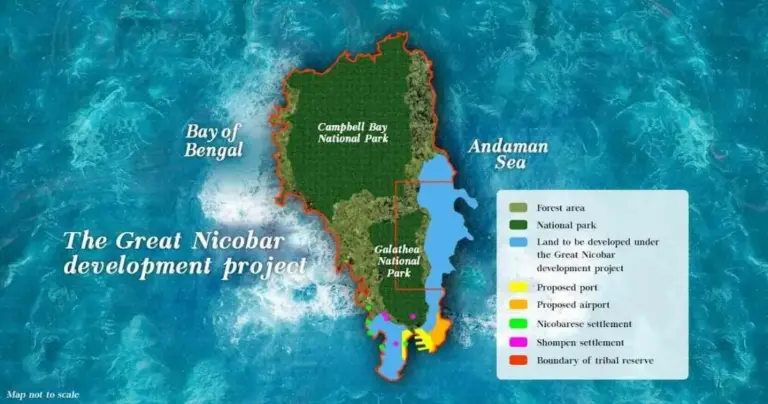
The Great Nicobar Project is a mega infrastructure initiative aimed at transforming Great Nicobar Island into a strategic, economic, and logistics hub in the Indo-Pacific region.
Spanning around 166 sq km, the project reflects India’s attempt to balance economic development, strategic interests, and environmental sustainability in a fragile island ecosystem.
Overview of the Project
Great Nicobar Island, covering about 910 sq km, hosts India’s southernmost point, Indira Point, and occupies a critical location near major global sea routes.
The project aims to convert the island into a multi-dimensional hub combining infrastructure development, maritime trade, and defence preparedness.
It was initially conceptualised by NITI Aayog and is currently being implemented by the Andaman and Nicobar Islands Integrated Development Corporation Limited.
Key Components of the Project
Integrated Township
The project includes the development of a large integrated township covering nearly 149 sq km, designed to host residential, commercial, tourism, logistics, and defence facilities. It is envisioned as a long-term urban and strategic centre supporting economic activities.
Transhipment Port
A major component is the proposed transshipment port at Galathea Bay, which aims to position India as a key maritime logistics hub. It will facilitate the transfer of cargo between large and small vessels, enhancing India’s role in global trade.
Civil and Military Airport
A dual-use international airport is planned to support both civilian and defence operations. It will complement existing facilities like INS Baaz and enhance connectivity and rapid military deployment capabilities.
Power Infrastructure
The project also includes a 450-MVA gas and solar-based power plant, ensuring reliable energy supply for the township and associated infrastructure.
Strategic Significance
- The importance of the Great Nicobar Project lies in its geopolitical, economic, and defence dimensions.
- From a geopolitical perspective, the island’s proximity to the Strait of Malacca through which nearly 30% of global trade and one-third of oil shipments pass gives India a strategic advantage in the Indo-Pacific region.
- Economically, the transshipment port is expected to reduce India’s dependence on foreign ports such as Colombo and Singapore, thereby enhancing trade efficiency and logistics competitiveness.
- From a defence standpoint, the project strengthens India’s presence in the region by integrating infrastructure with the tri-services command in the Andaman and Nicobar Islands, improving surveillance and response capabilities.
Environmental and Social Concerns
- Despite its strategic importance, the project has raised significant environmental and social concerns.
- A major issue is the large-scale diversion of around 130 sq km of forest land, involving the felling of nearly one million trees. The region is part of the Sundaland biodiversity hotspot, making it ecologically sensitive.
- The island falls under the Great Nicobar Biosphere Reserve, which hosts diverse ecosystems such as tropical forests, wetlands, and coastal habitats. The denotification of protected areas, including wildlife sanctuaries, has raised concerns about biodiversity loss.
- Particularly vulnerable is the habitat of the leatherback turtle, as Galathea Bay is one of its key nesting sites.
- The project also has implications for indigenous communities. The Shompen tribe, a particularly vulnerable tribal group, may face disruption due to habitat loss and increased external contact. Similarly, the Nicobarese community has concerns related to displacement and land rights.
- A projected rise in population from around 8,500 to 6.5 lakh by 2050 may significantly alter the island’s ecological balance and social fabric.
Governance and Implementation
The project is being implemented by ANIIDCO based on a pre-feasibility study conducted in 2021. Multiple clearances, including environmental approvals, have been obtained, with the NGT playing a key role in adjudicating environmental concerns.
The approval reflects an attempt to ensure regulatory compliance while advancing strategic development goals.
Challenges
The project faces the challenge of balancing development with ecological sustainability, particularly in a fragile island ecosystem.
Ensuring transparent governance, proper rehabilitation of affected communities, and long-term environmental monitoring will be critical.
There are also concerns regarding climate vulnerability, as island ecosystems are highly sensitive to sea-level rise and extreme weather events.
Way Forward
- Going forward, there is a need to adopt a sustainable and cautious approach to development in ecologically sensitive regions like Great Nicobar.
- Environmental safeguards must be strictly implemented and continuously monitored, with emphasis on biodiversity conservation and habitat restoration.
- Active involvement of local and indigenous communities in decision-making processes is essential to ensure inclusive development and protect their rights.
- India should also invest in climate-resilient infrastructure and scientific research, ensuring that development does not compromise long-term ecological stability.
- Balancing strategic interests with environmental sustainability will be key to the success of the project.
Conclusion
The Great Nicobar Project represents a significant step in enhancing India’s strategic and economic presence in the Indo-Pacific region. However, its success will depend on how effectively it balances developmental ambitions with environmental protection and social justice, making it a critical case study for sustainable development in sensitive regions.
Visit LevelUp IAS- Click Here