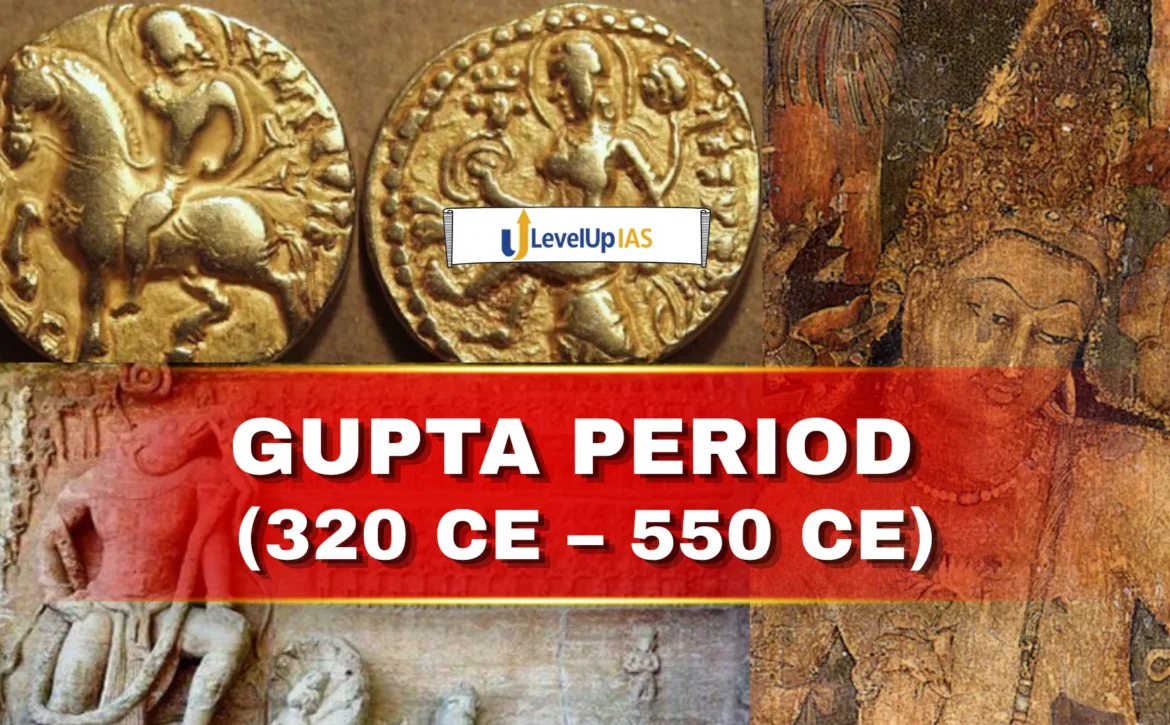
Gupta Period (320 – 550 CE)
Content
- Introduction
- Important Rulers
- Administration
- Economy
- Society
- Religion
- Art and Architecture
- Decline
- FAQs
Introduction
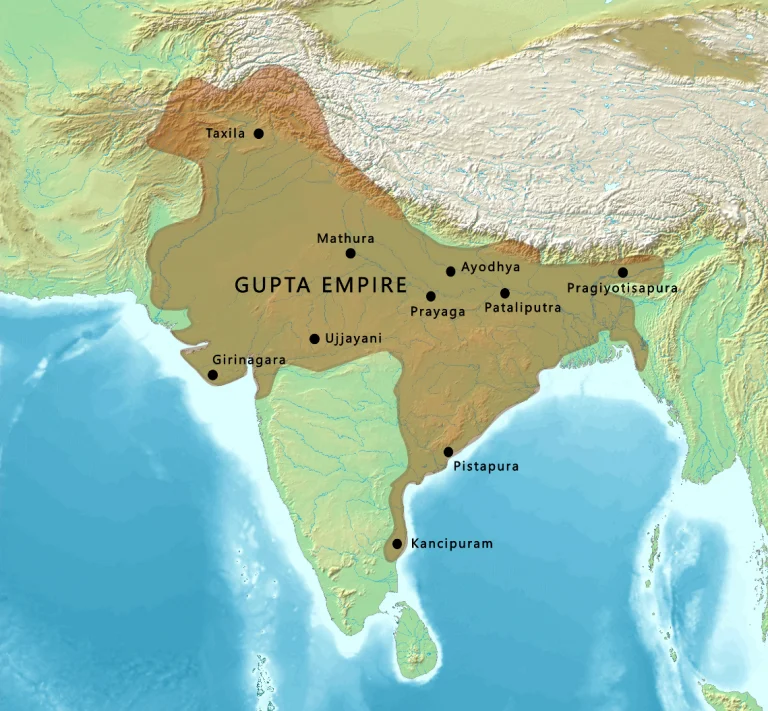
The Gupta Period marks one of the most significant phases in ancient Indian history and is often described as the “Golden Age of India.” This characterization arises from remarkable achievements in administration, economy, society, religion, science, and art. Emerging from the fertile Gangetic plains of eastern Uttar Pradesh and Bihar, the Gupta Empire established political unity in northern India after centuries of fragmentation and created conditions for cultural and intellectual advancement.
Gupta Empire – Important Rulers
| Name & Period | Key Features |
| Chandragupta I (c. 319–335 CE) | Real founder of the Gupta Empirestrengthened power through marriage alliance with Lichchhavi princess Kumaradevi assumed title Maharajadhiraja and laid foundation of expansion. |
| Samudragupta (c. 335–375 CE) | Greatest ruler; known as “Napoleon of India” achievements recorded in Allahabad Pillar Inscription followed conquest in North and suzerainty in South patron of arts. |
| Chandragupta II (c. 375–415 CE) | Also called Vikramaditya defeated Western Kshatrapasperiod of prosperity and cultural growthFa-Hien visitedassociated with Navaratnas. |
| Kumaragupta I (c. 415–455 CE) | Maintained stability adopted title Mahendradityaassociated with Nalanda Universityfaced early Huna threat. |
| Skandagupta (c. 455–467 CE) | Last strong ruler; successfully repelled Hunas wars strained economy and marked beginning of decline. |
| Later Guptas (Post-467 CE) | Weak rulers political instabilityrise of regional powersled to fragmentation and decline of empire. |
Administration under the Guptas
- The Gupta administration was marked by a balance between central authority and local autonomy, unlike the highly centralized Mauryan system. The king was the supreme authority and was often regarded as divine, assuming titles such as Maharajadhiraja and Paramabhattaraka, reflecting both political supremacy and religious legitimacy.
- At the central level, the king was assisted by a council of ministers and high officials. However, the Guptas allowed a significant degree of decentralisation, especially in provinces governed by officials or local rulers who accepted Gupta suzerainty. Administrative divisions included provinces (Bhukti), districts (Vishaya), and villages, each with its own officials and councils.
- A notable feature of the Gupta administration was the growing importance of land grants, often given to Brahmins and officials. While this strengthened local governance, it gradually reduced central control and contributed to the emergence of a proto-feudal structure.
- The judicial system was relatively mild, with emphasis on fines rather than harsh punishments. Overall, the administration ensured stability but gradually moved toward decentralisation, which later became a factor in decline.
Economy of the Gupta Period
- The Gupta economy was prosperous and well-developed, with agriculture forming its foundation. The fertile Gangetic plains supported extensive cultivation of crops such as rice, wheat, and sugarcane. Irrigation facilities were maintained and expanded by the state, contributing to agricultural productivity.
- Trade and commerce flourished during this period, both internally and externally. India maintained trade links with regions such as Southeast Asia, the Roman world, and Central Asia. Guilds (shrenis) played an important role in regulating trade and production, indicating an organized economic structure.
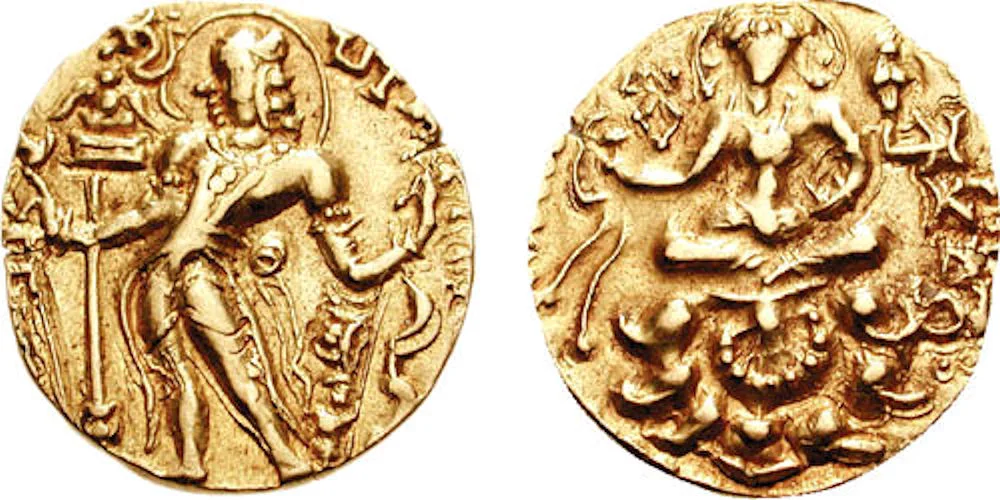
- A notable feature of the Gupta economy was the widespread circulation of gold coins (Dinaras), which reflects the high level of economic prosperity and active trade networks. These coins were issued in large numbers by rulers such as Chandragupta II and Samudragupta, and were known for their high gold purity and artistic excellence.
- The coins often depicted rulers engaged in activities such as performing rituals, hunting, or playing musical instruments, thereby providing valuable insights into the political authority and cultural life of the period.
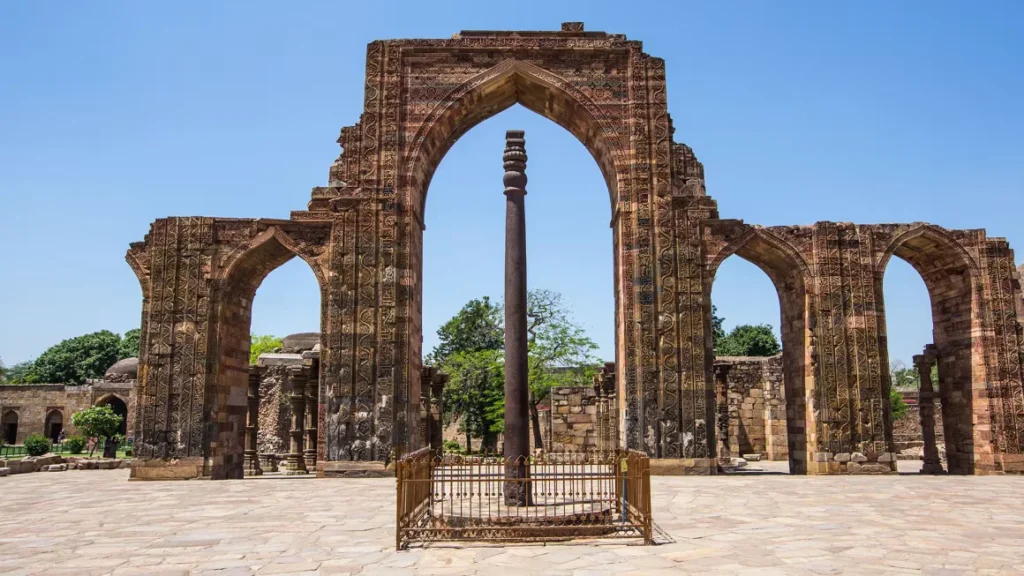
- Craft production, including textiles, metallurgy, and sculpture, reached high levels of sophistication. The famous iron pillar at Mehrauli is a testimony to advanced metallurgical skills.
- However, towards the later phase of the Gupta period, there was a gradual decline in long-distance trade and urban centres, partly due to political instability and changing economic conditions. This is also reflected in the reduced circulation of gold coins in the later period.
Thus, the Gupta economy combined agrarian strength, vibrant trade, advanced coinage, and skilled craftsmanship, forming the basis of its prosperity.
Society during the Gupta Period
- Gupta society was structured along traditional lines but showed elements of flexibility. The varna system was well established, yet occupational mobility existed in practice, with individuals sometimes engaging in professions outside their prescribed social roles.
- The period witnessed the growing importance of landed elites, such as Brahmins and local chiefs, due to the system of land grants. This contributed to the rise of a hierarchical rural society and the gradual decline of urban centres.
- The position of women showed both continuity and decline. While women in elite families participated in cultural life, practices such as child marriage and sati became more prevalent, indicating increasing patriarchal control.
- At the same time, the Gupta period saw the flourishing of education and literature. Centres of learning like Nalanda emerged, and scholars such as Kalidasa and Aryabhata contributed to literature and science.
Thus, Gupta society was hierarchical yet culturally vibrant, marked by both intellectual progress and social stratification.
Religion in the Gupta Period
- Religion during the Gupta period was characterized by revival and consolidation of Hinduism, particularly Vaishnavism and Shaivism. Gupta rulers often identified themselves as devotees of Vishnu, and temple worship became more prominent during this period.
- However, the period was marked by religious tolerance. Buddhism and Jainism continued to receive patronage, and there was peaceful coexistence of multiple religious traditions.
- The Bhakti movement gained momentum, emphasizing devotion and personal connection with the divine over ritualism. New religious practices, including the rise of the Shakti cult and early forms of Tantrism, also emerged.
- Thus, the religious landscape of the Gupta period reflects both continuity of ancient traditions and evolution of new devotional practices.
Art and Architecture
- The Gupta period represents a classical phase in Indian art and architecture, often regarded as a benchmark for aesthetic excellence. Temple architecture began to take a more defined form, marking the early development of the Nagara style in North India.
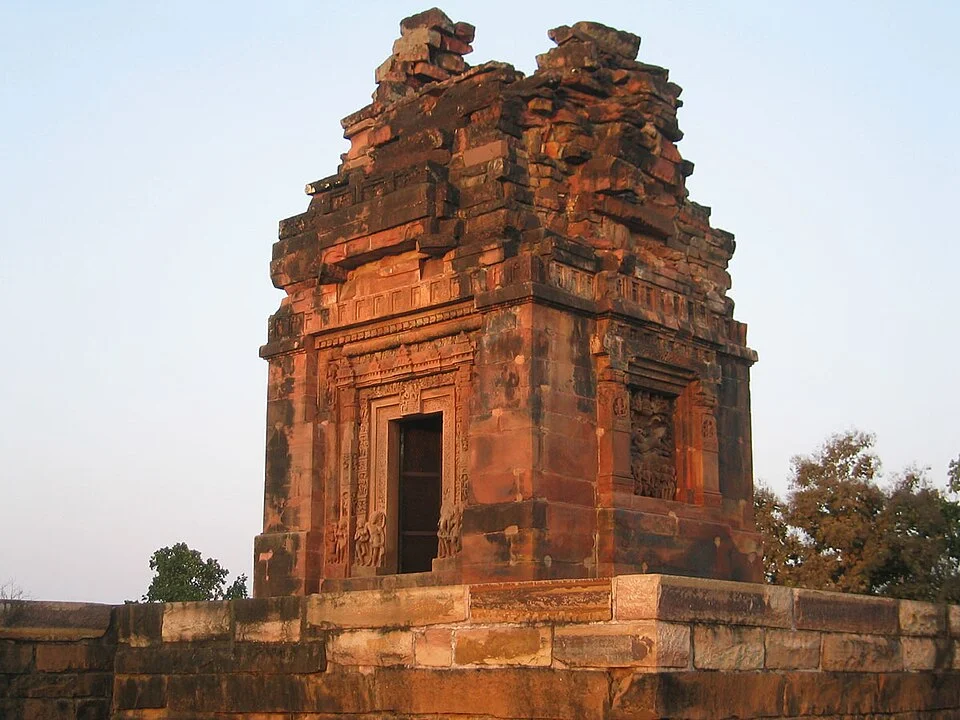
- Temples such as the Dashavatara Temple at Deogarh illustrate the emergence of structural temples with features like sanctum (garbhagriha) and shikhara. Sculpture during this period achieved a high level of refinement, characterized by elegance, balance, and spiritual expression.
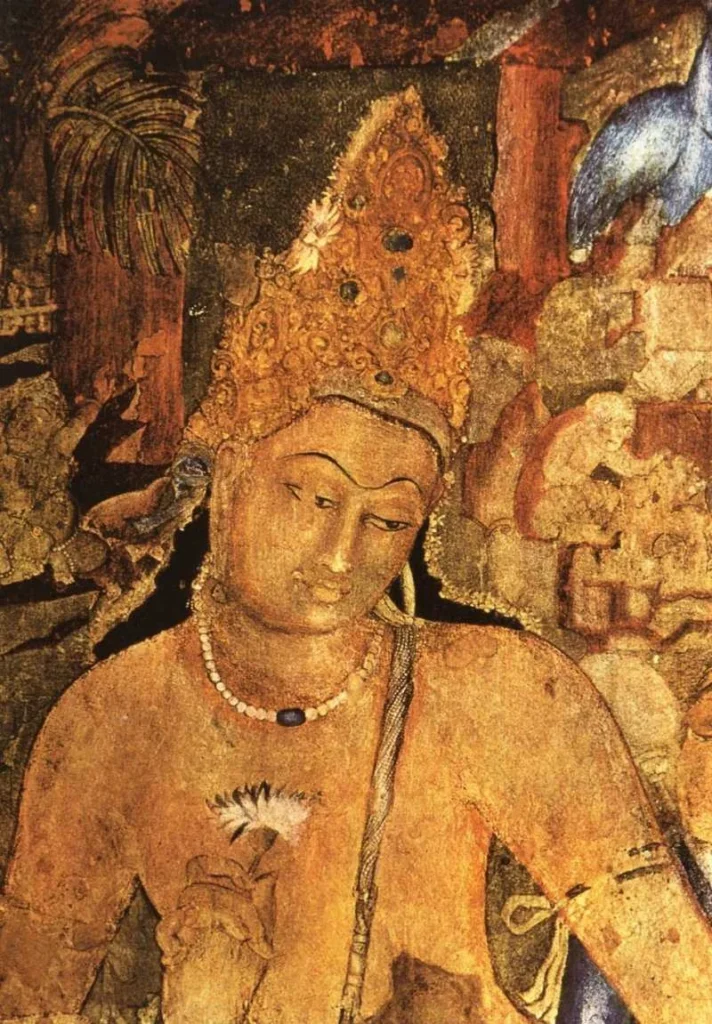
- The art of Mathura and Sarnath schools flourished, producing iconic images of Buddha and Hindu deities. The Ajanta caves, though developed under the Vakatakas, reflect the broader artistic excellence of the Gupta age through their mural paintings.
- Gupta architecture also included advancements in metallurgy, as seen in the rust-resistant iron pillar of Delhi, highlighting technological sophistication.
Overall, Gupta art is marked by simplicity, harmony, and spiritual depth, and it influenced Indian art for centuries.
Decline of the Gupta Empire
- The decline of the Gupta Empire was gradual and resulted from a combination of internal and external factors. After the reign of Skandagupta, weak successors failed to maintain central authority, leading to political fragmentation.
- One of the major external factors was the invasion of the Hunas, which weakened the empire’s military and economic base. At the same time, the rise of regional powers such as the Vakatakas and later the Maukharis challenged Gupta supremacy.
- Internally, the increasing practice of land grants reduced state revenue and strengthened local authorities, leading to decentralisation. Economic decline, particularly in trade and urban centres, further weakened the empire.
- By the mid-6th century CE, the Gupta Empire had fragmented into smaller regional kingdoms, marking the end of its political dominance.
Conclusion
The Gupta Period stands as a defining phase in Indian history, characterized by political stability, economic prosperity, and cultural brilliance. While it witnessed remarkable achievements in administration, art, and religion, it also laid the foundations for future socio-economic changes, including decentralisation and feudal tendencies.
FAQs
Q1. What is the Gupta Period in Indian history?
The Gupta Empire was a powerful empire that ruled large parts of northern India and is often referred to as the “Golden Age” due to its achievements in various fields.
Q2. Who were the major rulers of the Gupta Empire?
Important rulers included Chandragupta I, Samudragupta, and Chandragupta II.
Q3. Why is the Gupta Period called the Golden Age of India?
It witnessed remarkable progress in science, mathematics, astronomy, literature, art, and architecture, along with political stability and economic prosperity.
Q4. What were the key achievements of the Gupta Period?
Notable achievements include contributions by Aryabhata in mathematics and astronomy, development of classical Sanskrit literature, and advances in metallurgy such as the Iron Pillar of Delhi.
Q5. What led to the decline of the Gupta Empire?
The empire declined due to internal weaknesses, administrative decentralisation, and invasions by the Hunas.
Click on the question to see the Answers