India becomes world’s largest rice producer
Content
- Latest News
- Production Milestone
- Drivers of Growth
- Significance
- Rice: Crop Profile
- Challenges
- Way Forward
Latest News
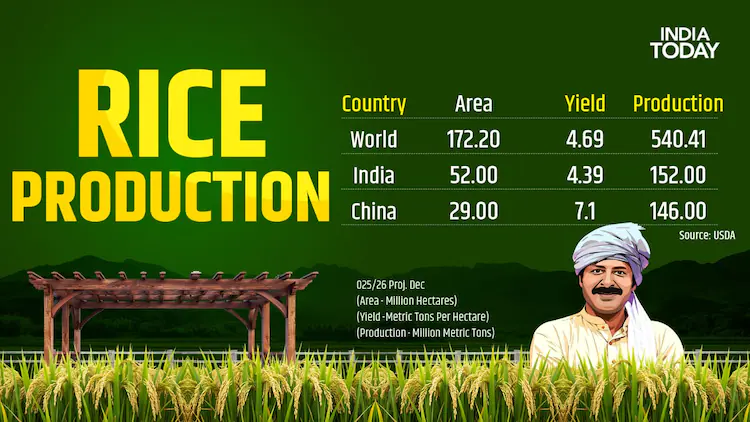
India has overtaken China to become the world’s largest producer of rice, marking a significant milestone in its agricultural output and food security journey. This achievement was officially announced by the Union Agriculture Minister, who confirmed that India’s rice production reached approximately 150.18 million tonnes in the 2024-25 crop year, surpassing China’s estimated output of about 145.28 million tonnes.
Production Milestone & Output Trends
- Record Output: India’s rice production touched a historic high of 150.18 million tonnes, making it the largest rice-producing country globally in 2025.
- Surpassing China: China, historically the top producer, now ranks second in rice production.
- Global Share: India accounts for more than 28% of global rice output, highlighting its dominance in the staple cereal’s production and supply chain.
- Exports: India is already one of the world’s leading rice exporters, with shipments to over 170 countries, driven by competitive pricing and diverse rice varieties.
Drivers of Growth
1. Improved Seed Varieties and Technology
The Indian Council of Agricultural Research (ICAR) has released high-yielding, climate-resilient rice varieties, contributing significantly to productivity gains.
2. Expansion of Cultivable Area
The harvested area under rice has expanded over the years in states like Punjab, Uttar Pradesh, West Bengal, and Telangana, supported by irrigation infrastructure and incentives.
3. Government Support and Pricing Policy
Procurement policies like Minimum Support Price (MSP) and incentives for farmers have encouraged higher rice cultivation and ensured remunerative returns, boosting production confidence.
Significance
National Food Security
Being the world’s largest rice producer reinforces India’s role as a critical food grain buffer, ensuring domestic supply for a population of over 1.4 billion.
Global Food Markets
India’s rice output stabilises global rice markets, especially for importing countries dependent on rice imports for food security.
Economic and Rural Impact
High production supports farmers’ incomes, rural livelihoods, agro-processing industries and creates synergies with allied sectors like milling, storage and exports.
Rice: Crop Profile
Rice is a Kharif cereal crop and the staple food for a large section of India’s population.
- Climate: Requires a hot and humid climate with temperatures of 20-35°C and 100-200 cm rainfall. It is a water-intensive crop, though irrigation supports cultivation in low-rainfall areas.
- Soils: Grows best in alluvial and clayey soils with high water-retention capacity; slightly acidic to neutral pH is ideal.
- Regions: Major rice-producing states include Uttar Pradesh, Telangana, West Bengal, Punjab, Andhra Pradesh, Tamil Nadu, Odisha, and Assam.
- Significance: Central to food security, PDS, farmer livelihoods, and exports, but excessive cultivation raises concerns over groundwater depletion and environmental sustainability.
Challenges and Sustainability Concerns
1. Water Intensity
Rice is a water-intensive crop, and its expansion in water-stressed regions like Punjab and Haryana is linked to groundwater depletion and sustainability concerns.
2. Diversification Needs
The focus on rice has implications for crop diversification, as excessive paddy cultivation can crowd out pulses and oilseeds, affecting soil health and nutritional balances.
3. Climate Vulnerability
Rice production remains susceptible to climate risks, such as erratic monsoons, floods and droughts, requiring resilient agronomic practices and adaptive strategies.
Way Forward
- Promote Sustainable Practices: Adoption of water-saving technologies and crop rotations can mitigate environmental strain.
- Enhance Value Addition: Upgrading processing infrastructure and quality standards will bolster India’s competitive edge in global rice trade.
- Balanced Food Policy: While ensuring food security, policy focus should encourage diversified cropping systems to reduce ecological stress and improve nutritional outcomes.
Conclusion
India’s ascent as the world’s largest rice producer is a landmark achievement in the nation’s agricultural history. It reflects persistent policy focus, technological advancements, and the resilience of Indian farmers. However, translating this achievement into sustainable and inclusive agricultural development will require balanced strategies that address resource constraints and promote diversification for long-term food and nutritional security.