India-EU Free Trade Agreement
Content
- Latest News
- Background
- Key Features of the India-EU FTA
- Economic Significance for India
- European Union’s Strategic Interests
- Global Implications
Latest News
The signing of the India-European Union Free Trade Agreement (FTA) marks a decisive moment in India’s economic diplomacy. After years of stalled negotiations and changing global priorities, the agreement reflects not merely a trade arrangement but a strategic recalibration of India-EU relations in an era defined by supply-chain disruptions, geopolitical fragmentation, and shifting centres of economic power.
For India, the FTA represents an opportunity to integrate more deeply with one of the world’s largest and most sophisticated markets, while for the European Union it offers access to one of the fastest growing major economies.
Background
Negotiations for an India-EU FTA began in 2007 but were suspended in 2017 due to deep differences over issues such as tariffs, intellectual property rights, labour standards, and market access. The global context at the time did not favour compromise Europe was dealing with the Eurozone crisis and Brexit, while India was cautious about opening sensitive sectors.
The revival of negotiations in 2022 must be understood against a transformed global backdrop. The COVID-19 pandemic exposed vulnerabilities in global supply chains, while rising geopolitical tensions pushed both India and the EU to diversify economic partnerships.
For the EU, reducing over-dependence on China became a strategic priority and for India, expanding export markets and attracting high-quality foreign investment aligned with its goals of Atmanirbhar Bharat and export-led growth. This convergence of interests ultimately paved the way for the conclusion of the FTA.
Key Features of the India-EU FTA
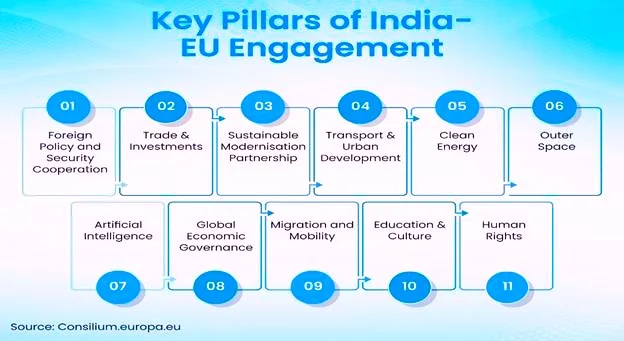
At its core, the agreement seeks to liberalise trade in goods and services, enhance investment flows, and promote regulatory cooperation.
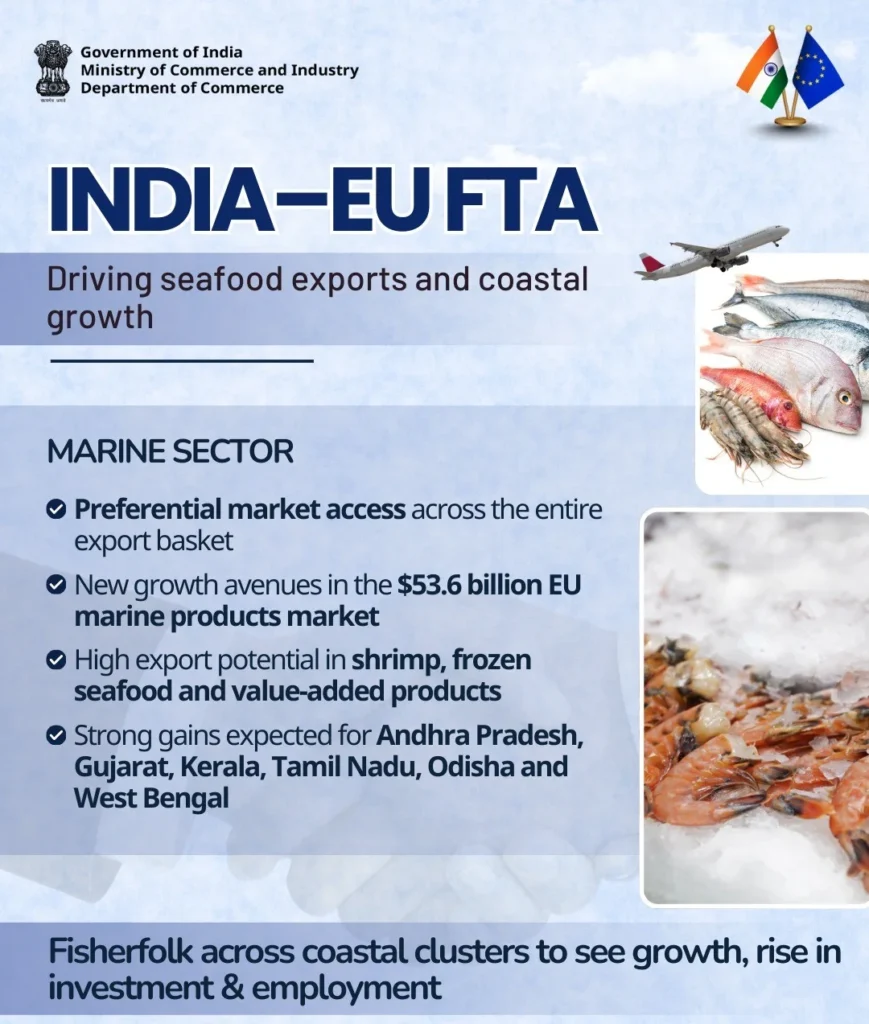
- A major highlight is the elimination or reduction of tariffs on a vast majority of traded goods. Nearly all Indian exports to the EU are expected to benefit from preferential access, particularly in labour-intensive sectors such as textiles, garments, leather, footwear, marine products, gems and jewellery, and engineering goods.
- These sectors employ millions in India and stand to gain significantly from improved competitiveness in European markets.
- On the services front, the agreement provides enhanced market access for Indian service providers, including in IT, professional services, business services, and consultancy.
- Provisions facilitating temporary movement of professionals, business visitors, and contractual service suppliers are especially significant for India, given the central role of services in its economy.
- Investment protection and regulatory transparency form another pillar of the agreement. By offering greater predictability and dispute-resolution mechanisms, the FTA will encourage European investment in Indian manufacturing, clean energy, digital infrastructure, and advanced technology sectors.
Economic Significance for India
- From India’s perspective, the FTA is a strategic tool to diversify export destinations and reduce reliance on traditional markets. The EU is already one of India’s largest trading partners, and preferential access can help Indian exporters move up global value chains rather than remain suppliers of low-value goods.
- The agreement will boost domestic manufacturing, particularly under initiatives such as Make in India and the Production Linked Incentive (PLI) schemes.
- Increased EU investment can bring not just capital, but also technology transfer, managerial expertise, and high environmental and quality standards, raising the overall competitiveness of Indian industry.
- Importantly, the FTA supports India’s long-term ambition of becoming a global hub for sustainable manufacturing and services, particularly in renewable energy, green hydrogen, and climate-friendly technologies areas where European firms possess advanced capabilities.



European Union’s Strategic Interests
For the European Union, India represents a vast and expanding consumer market with rising incomes and a growing middle class.
The FTA allows EU companies to gain improved access to sectors such as automobiles, machinery, pharmaceuticals, medical devices, and high-end manufactured goods.
Beyond economics, the agreement fits into the EU’s broader strategy of building trusted partnerships in the Indo-Pacific. Strengthening economic ties with India enhances Europe’s geopolitical presence in the region and supports its vision of a rules-based international economic order.
The EU also views India as a key partner in building resilient and diversified supply chains, especially in critical sectors like semiconductors, pharmaceuticals, and clean energy components..
Geopolitical and Global Implications
Beyond bilateral trade, the India-EU FTA carries wider global significance.
- Covering economies that together account for a substantial share of global GDP and population, the agreement sends a strong signal in favour of open trade, multilateralism, and strategic economic cooperation at a time when protectionism is on the rise.
- It also reinforces India’s image as a credible and stable economic partner, capable of concluding complex, high-standard trade agreements while safeguarding domestic interests.
Conclusion
The India-EU Free Trade Agreement is more than a commercial pact. It is a strategic reset in bilateral relations. If implemented effectively, it can drive export growth, attract investment, strengthen supply chains, and deepen India’s integration into the global economy. At the same time, careful policy management will be essential to ensure that the benefits are inclusive and aligned with India’s developmental priorities.
For UPSC aspirants, the agreement is important not only as a current-affairs topic but as an example of how trade policy, geopolitics, and development objectives intersect in contemporary international relations.