India-Israel Relations

Content
- Why in News
- Historical Evolution
- Dimensions of Cooperation
- Strategic Significance
- Challenges and Differences
- Future Prospects
- Conclusion
Why in News
India and Israel have elevated their bilateral ties significantly, with recent developments including the upgrade to a Special Strategic Partnership for Peace, Innovation, and Prosperity during Prime Minister Narendra Modi’s visit to Israel in February 2026.
This reflects a deepening of cooperation across defence, technology, trade, innovation, and regional security far transcending the traditional buyer-seller arms relationship that once defined the ties.
Historical Evolution of Bilateral Relations
India recognised Israel soon after its independence in 1950 but established full diplomatic relations only in 1992 due to Cold War geopolitics and India’s traditional support for the Palestinian cause. Diplomatic ties deepened gradually through market engagement and security cooperation.
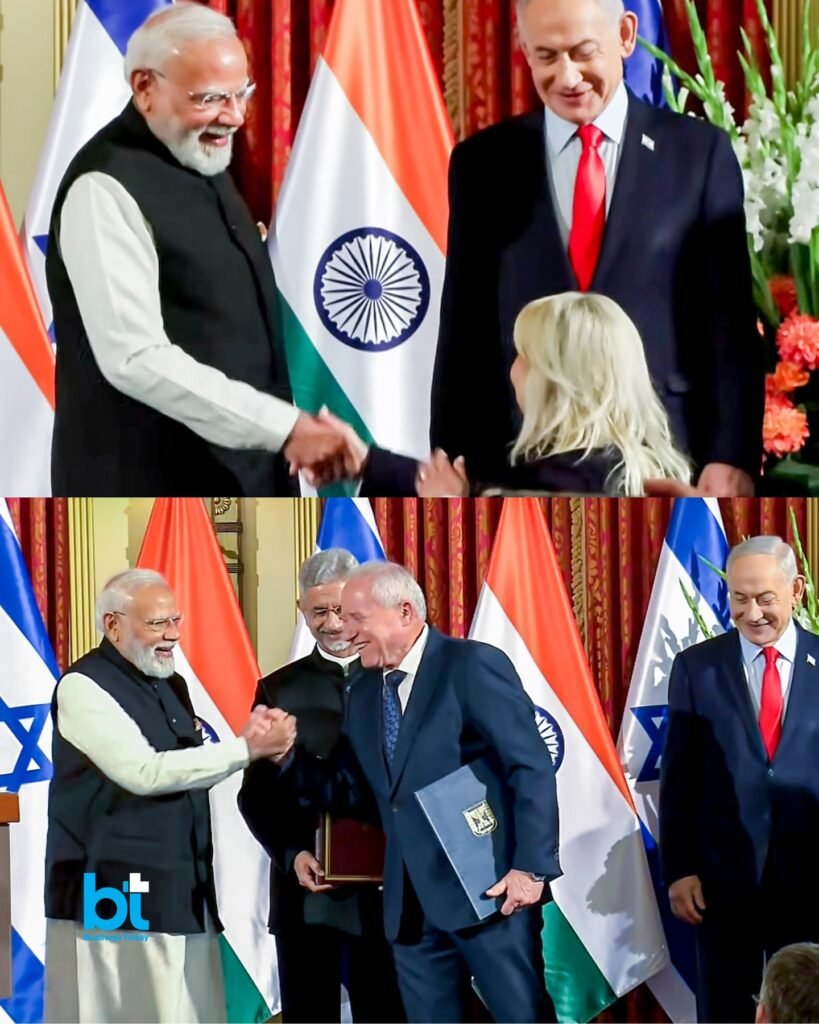
A major turning point occurred in 2017 with Prime Minister Modi’s visit to Israel, the first by an Indian head of government. This visit signalled a shift to a de-hyphenation policy, where India began treating its relations with Israel independently of the Israel-Palestine track.
Over the years, bilateral relations evolved through distinct phases:
- Phase I (Pre-1992): Limited engagement due to geopolitical constraints.
- Phase II (1992-2014): Establishment of formal diplomatic ties and growing defence purchases.
- Phase III (2014-2024): Strategic partnership crystallised with ideological convergence and technology cooperation.
- Phase IV (2024-Present): Special Strategic Partnership reflecting structural cooperation in emerging technologies and regional frameworks.
Key Dimensions of Cooperation
1. Defence and Security Collaboration
- Defence has been the cornerstone of India-Israel ties. India is among Israel’s largest defence partners, procuring critical systems such as drones, radar, missile defence systems, and surveillance technologies. Joint development projects like the Barak-8 surface-to-air missile system demonstrate transition from a pure buyer-seller dynamic to co-development and co-production.
- The relationship also includes counter-terrorism cooperation, intelligence sharing, and regular joint military exercises, enhancing India’s preparedness against diverse security threats. Recent announcements include advanced defence collaborations, joint technology development, and technology transfer agreements.
2. Economic Integration and Trade
- Bilateral trade between India and Israel has grown steadily since 1992, crossing USD 3.75 billion in 2025 with diverse products including machinery, chemicals, agricultural goods, diamonds and defence items.
- Negotiations for a Free Trade Agreement (FTA) have begun, with the first round in February 2026 focusing on goods, services, rules of origin, and technical barriers. India and Israel also signed a Bilateral Investment Treaty (BIT) in September 2025 to protect investors and enhance cross-border investment flows, reflecting a significant step toward deeper economic integration.
3. Technology, Innovation and Research
- India-Israel cooperation extends to frontier technologies such as artificial intelligence (AI), quantum computing, semiconductors, and cybersecurity under the Special Strategic Partnership framework. Joint initiatives such as the India-Israel Industrial R&D and Innovation Fund (I4F) promote co-development of technology and industrial innovation.
- Collaboration also spans space with joint research, satellite launches, and Earth observation systems and digital finance, where discussions include potential interoperability between India’s Unified Payments Interface (UPI) and Israeli systems.
4. Agriculture, Water and Environmental Cooperation
- Since 2006, India and Israel have partnered in agricultural technology through the Indo-Israel Agricultural Project (IIAP), establishing Centers of Excellence across Indian states. These centres focus on micro-irrigation, protected cultivation and drip irrigation, helping adapt water-conserving technologies to India’s varied agro-climatic conditions.
- Water cooperation includes joint efforts in desalination, wastewater treatment and integrated water resource management under an MoU on Water Resources signed in 2016.
5. Cultural and People-to-People Ties
- People-to-people connections, though less intense than in other bilateral relations, have expanded in recent years through tourism partnerships, educational exchanges, and labour mobility agreements. Initiatives promoting pilgrimage tourism to Israel and expanded work visas for Indian nationals highlight the soft dimension of the partnership.
Strategic Significance for India
1. Defence Modernisation and Aatmanirbhar Bharat
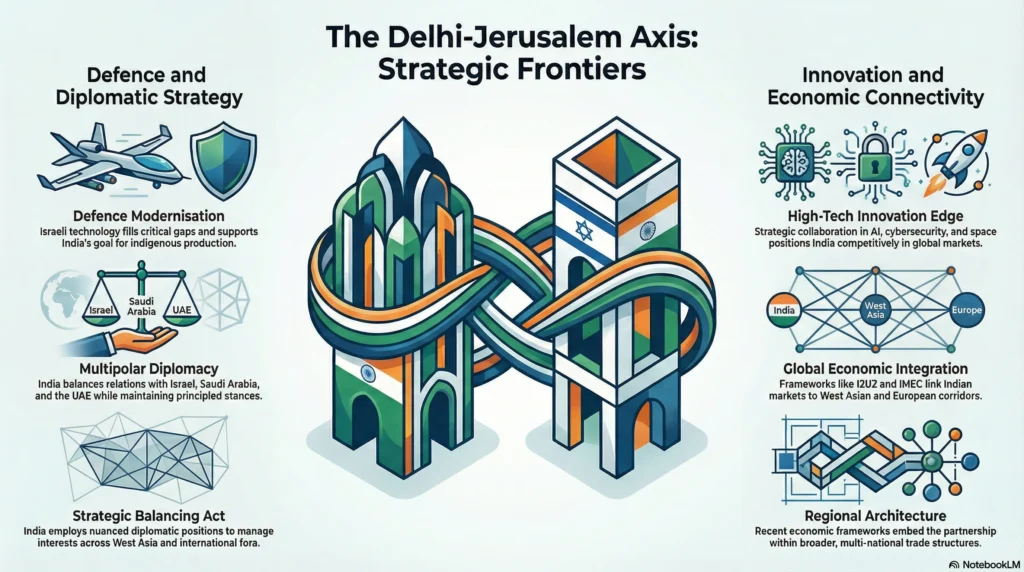
The Delhi-Jerusalem partnership assists India in modernising its defence capabilities. Access to Israeli technology fills critical gaps while joint R&D supports India’s Atmanirbhar Bharat goal, reducing dependence on imports and fostering indigenous production.
2. Regional Security and Multipolar Diplomacy
Cooperation with Israel complements India’s West Asia policy, balancing strategic interests with major regional partners such as Saudi Arabia, the UAE, and Afghanistan while maintaining a principled stance on Palestinian statehood. India’s nuanced diplomatic positions, such as abstaining or calibrating votes in international fora, exemplify this balancing act.
3. Technology Edge and Economic Growth
Strategic collaboration in AI, cybersecurity, space and other technologies positions India competitively in the global innovation landscape. Israel’s strength in high-tech sectors accelerates India’s capacity building in these domains.
4. Connectivity and Economic Corridors
Recent frameworks like I2U2 (India, Israel, USA, UAE) and India Middle East Europe Economic Corridor (IMEC) embed the partnership within broader regional economic architectures, linking India’s economic corridors to West Asian and European markets.
Challenges and Differences
Despite deepening ties, some areas of friction persist:
- Balancing Regional Diplomacy: India maintains historical support for a sovereign Palestinian state while deepening cooperation with Israel, requiring careful diplomatic balancing.
- Strategic Balancing with Iran: India’s engagement with Iran, including the Chabahar Port project, poses strategic complexities given Israel’s adversarial stance toward Tehran.
- Geopolitical Sensitivities: Regional tensions, including the Israel-Gaza context and broader Middle East instability, demand nuanced diplomatic positioning by India.
Future Prospects
The trajectory of India-Israel relations points toward broader and deeper cooperation:
- Implementation of FTA, once finalised, can significantly boost trade and investment flows.
- Expansion of technology partnerships in critical and emerging sectors will sustain strategic depth.
- Enhanced people-to-people engagement and cultural diplomacy could strengthen societal bonds.
- Linkages with regional multilateral frameworks will amplify geopolitical value for both nations.
Conclusion
India-Israel relations have evolved from modest diplomatic engagement to a Special Strategic Partnership characterised by multifaceted cooperation in defence, technology, trade, agriculture, water, and regional security. This partnership reflects a pragmatic pursuit of national interests while balancing complex geopolitical realities.
With ongoing negotiation of a Free Trade Agreement, expanded technological collaboration, and enhanced strategic dialogues, the bilateral relationship is poised to become a defining pillar of India’s foreign policy in the 21st century.