India-New Zealand Free Trade Agreement
Content
- Latest News
- Historical and Strategic Context
- Strategic Vision and Policy Frameworks
- Trade and Economic Engagement
- Defence and Maritime Cooperation
- Education and Knowledge Partnerships
- People-to-People and Cultural Ties
- India-New Zealand FTA
- Key Objectives
Latest News
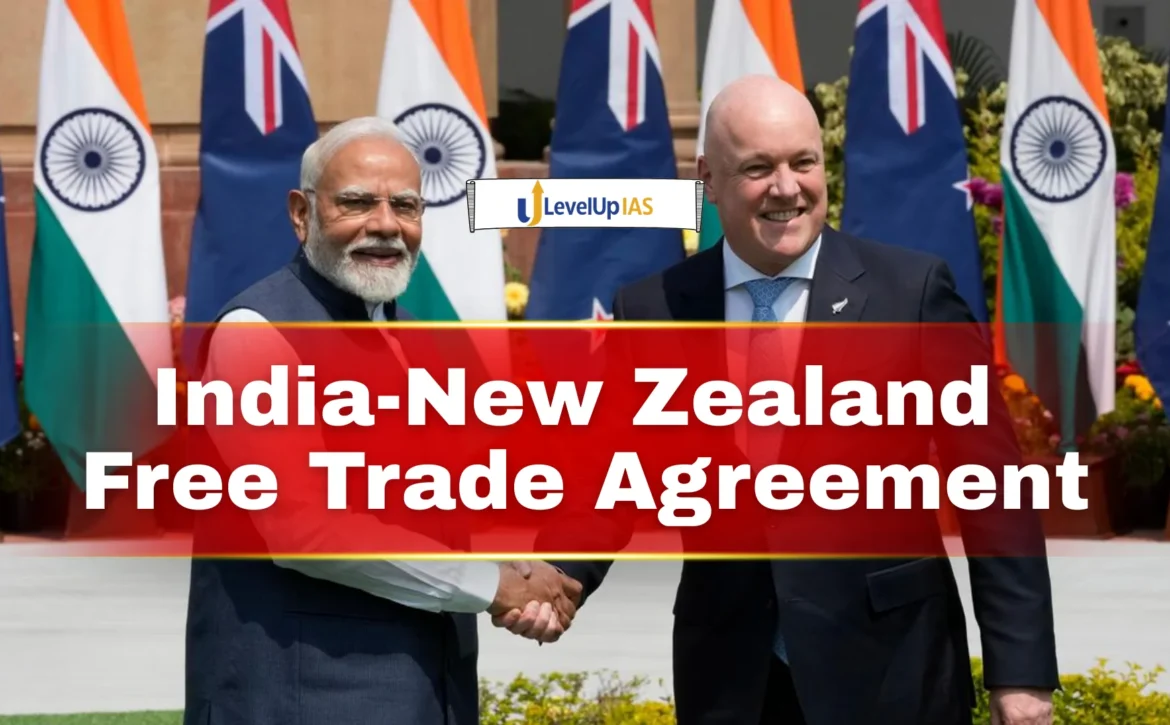
India and New Zealand have successfully concluded negotiations on a Free Trade Agreement (FTA). It marked a major milestone in their economic engagement and strategic partnership.
The agreement grants India tariff-free access to New Zealand’s market, is projected to attract $20 billion in investment over 15 years. And aims to double bilateral trade to $5 billion within the next five years. The FTA is scheduled for formal signing in the first half of 2026.
Bilateral Relations: Historical and Strategic Context
- India and New Zealand established diplomatic relations in 1952. That led the foundation for a relationship grounded in shared Commonwealth ties, common law traditions, and democratic governance frameworks. Over the decades, these shared institutional values have supported steady political engagement and mutual respect between the two countries.
- Sporting and societal connections have significantly deepened goodwill. With cricket, hockey, and mountaineering emerging as key pillars of people-to-people bonding. Tourism flows have further enhanced social familiarity, making each country an increasingly visible presence in the other’s public imagination.
Strategic Vision and Policy Frameworks
- New Zealand has identified India as a priority partner through targeted policy initiatives. Such as the “Opening Doors to India” strategy of 2011 and the broader NZ Inc. India Strategy. These frameworks signalled Wellington’s intent to expand economic, political, and cultural engagement with New Delhi in a structured manner.
- This strategic orientation was further consolidated through the “India–NZ 2025: Investing in the Relationship” roadmap, which envisages a more enduring and multi-dimensional partnership. The vision emphasises political dialogue, trade and investment, innovation, and people-centric cooperation as core drivers of the relationship.
Trade and Economic Engagement
- New Zealand ranks as India’s 11th largest two-way trading partner, underlining its significance within India’s wider Indo-Pacific economic outreach. In 2023–24, the total India-New Zealand bilateral trade stood at US$ 1.75 billion, reflecting both established linkages and untapped potential.
- The major sectors underpinning bilateral economic ties. That includes education, tourism, dairy, food processing, pharmaceuticals, renewable energy, and critical minerals. On the export front, India supplies pharmaceuticals, precious metals and gems, textiles, motor vehicles, and non-knitted apparel to New Zealand.
- In contrast, India’s key imports from New Zealand comprise logs, forestry products, wool, and edible fruits and nuts.
Defence and Maritime Cooperation
- Defence cooperation between India and New Zealand has been expanding in a gradual yet steady manner. Particularly in the maritime domain. Regular visits and port calls by Indian Navy ships to New Zealand, alongside reciprocal engagements, have helped institutionalise naval interaction.
- High-level exchanges between naval leaderships of both countries have contributed to enhanced operational understanding and strategic dialogue. Collaboration under Combined Task Force-150, where the Indian Navy has contributed personnel while New Zealand has assumed leadership roles, has further cemented practical cooperation in maritime security and Indo-Pacific stability.
Education and Knowledge Partnerships
- Education has emerged as a major pillar of the bilateral relationship. With India being the second-largest source of international students in New Zealand, numbering approximately 8,000. These students span a range of disciplines, contributing to academic diversity and long-term knowledge linkages.
- Institutional collaborations are also deepening. It includes the establishment of the NZ Centre at IIT Delhi and joint research initiatives in cutting-edge fields. Such as cancer research, robotics, cybersecurity, waste management, and medical technology. Complementing this are education cooperation arrangements with GIFT City and IIM Ahmedabad. Which anchor structured academic and skills-based engagements.
People-to-People and Cultural Ties
- The Indian-origin community in New Zealand is robust and growing. Numbering around 292,000 people, which makes it a significant diaspora group in the country. Reflecting this demographic presence, Hindi has emerged as the fifth most spoken language in New Zealand, signifying the cultural imprint of the Indian community.
- Vibrant celebrations of Indian festivals across New Zealand such as Diwali and Holi, along with active Indian cultural organisations, have helped sustain cultural visibility and intercultural understanding. Deep sporting ties, especially through cricket and a shared mountaineering legacy connected to Sir Edmund Hillary and the Himalayas, add a distinctive dimension to people-to-people bonds.
India-New Zealand FTA: A New Phase in Ties
- The conclusion of the India-New Zealand FTA negotiations marks the end of a negotiation process that formally commenced in March 2025. New Zealand Prime Minister Christopher Luxon launched the talks during his visit to India, providing strong top-level political backing to the initiative.
Remarkably, the agreement was finalised in a record period of nine months, underscoring both countries’ political will and shared objective of upgrading their bilateral engagement. The FTA is thus poised to serve as a cornerstone for a more comprehensive strategic partnership.
Key Objectives
- The India-New Zealand FTA is expected to double bilateral trade within five years, thereby significantly scaling up the current trade volume.
- Beyond trade in goods, the agreement aims to deepen overall economic engagement and strengthen cooperation in defence, education, sports, innovation, and people-to-people exchanges.
- By embedding economic integration within a wider strategic framework, the FTA aims to create a more resilient and diversified partnership architecture.
This holistic approach ensures that gains are not confined to tariff reductions alone but extend to long-term capacity-building and sectoral collaboration.
Investment and Market Access Gains
A central feature of the FTA is New Zealand’s commitment to invest $20 billion in India over a 15-year period, signalling strong confidence in India’s growth trajectory. This inflow is expected to support critical sectors, infrastructure development, and innovation-driven industries.
In the healthcare domain, the agreement includes a dedicated annex on health and traditional medicine, which is New Zealand’s first such arrangement with any country. This annex facilitates trade and collaboration in health services, including traditional systems of medicine, pioneering a new model for sector-specific cooperation.
Tariff Liberalisation and Sensitive Sectors
The FTA envisages extensive tariff liberalisation, with 95% of New Zealand’s exports benefiting from tariff elimination or reduction. This wide coverage is expected to significantly enhance trade flows and improve price competitiveness across multiple product categories.
In terms of timelines, 57% of New Zealand’s exports to India will become duty-free from day one of the FTA’s implementation. This figure is projected to rise to 82% once the agreement is fully implemented, while the remaining 13% of tariff lines will still see meaningful tariff cuts.
At the same time, India has carefully safeguarded its sensitive sectors by extending no concessions on dairy, onions, sugar, spices, edible oils, rubber, rice, wheat, and soya, thereby balancing liberalisation with domestic interests.
Employment, Exports, and Sectoral Gains
The FTA is expected to provide a significant boost to labour-intensive sectors within India. Sectors such as apparel, leather, textiles, rubber, footwear, and home décor are likely to benefit from improved market access and competitiveness.
Additionally, the agreement is anticipated to promote exports from high-value manufacturing segments including automobiles, auto components, machinery, electronics, electrical goods, and pharmaceuticals. Together, these sectors could generate employment, enhance value addition, and strengthen India’s export basket diversification towards New Zealand.
Mobility Provisions and Services Access
- A major component of the FTA relates to mobility and services. Under the agreement, New Zealand will provide 5,000 temporary employment visas annually for Indian professionals, with each visa being valid for up to three years.
- This provision is expected to facilitate greater movement of skilled workers and support business-to-business and institution-to-institution linkages.
- On the services side, India secures market access across 118 services sectors, coupled with Most Favoured Nation (MFN) status in 139 sectors. MFN status, a foundational principle under the WTO framework, requires a country to extend equal trading treatment to all its WTO partners, ensuring non-discriminatory access.
These measures collectively expand opportunities for Indian professionals and service providers.
Sectoral Coverage in Services and Professional Opportunities
The FTA’s services chapter covers a broad spectrum of sectors, including information technology, engineering, healthcare, education, and construction. This wide coverage is designed to harness India’s strengths in services and align them with New Zealand’s sectoral requirements and skill gaps.
In addition to mainstream professions, the agreement also encompasses niche roles such as AYUSH practitioners, yoga instructors, chefs, and music teachers. By recognising these categories, the FTA strengthens cultural and knowledge-based exchanges while promoting services trade and workforce mobility between the two partners.