India Tops the G20 Growth Outlook for 2026
Content
- Latest News
- Asia Leads Global Growth Momentum
- Slow Growth in Advanced Economies
- Why India Is Growing Faster
- Emerging vs Advanced Economies
- Implications for India
Latest News
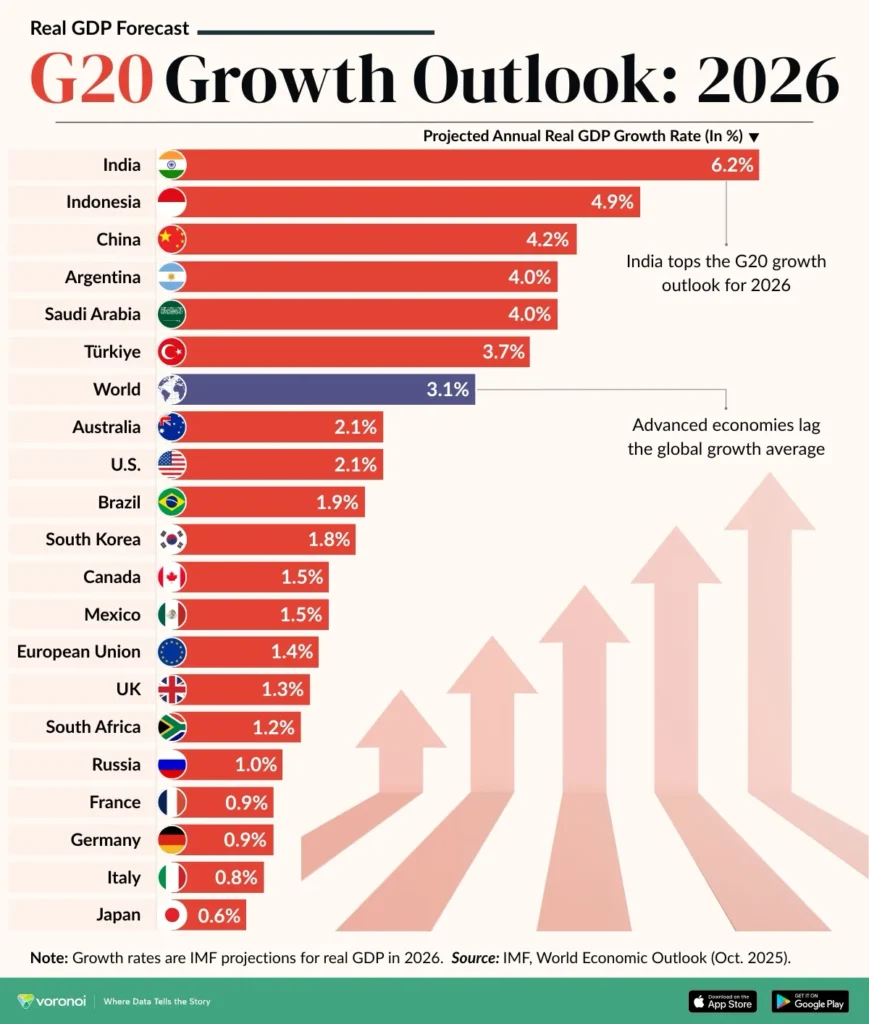
Recent projections on the G20 growth outlook for 2026 highlight a significant shift in the global economic landscape. According to IMF-based estimates presented by Visual Capitalist, India is expected to remain the fastest-growing economy among G20 nations, with a projected growth rate of 6.2%.
This places India well ahead of both advanced economies and most emerging markets, reinforcing its role as a key driver of future global growth.
Asia Leads Global Growth Momentum
- The broader trend shows that Asia will continue to dominate global economic expansion. Indonesia is projected to grow at 4.9%, supported by strong domestic consumption and favourable demographics.
- China is expected to record 4.2% growth, maintaining steady momentum despite structural adjustments in its economy.
- Together, India, Indonesia, and China underline Asia’s central role in shaping global economic trends in the coming decade.
Slow Growth in Advanced Economies
In contrast, most advanced economies are likely to witness relatively modest growth. The United States and Australia are projected to grow at around 2.1%, while major European economies such as Germany and France are expected to remain below 1%. Japan, with a forecast of just 0.6%, reflects deeper structural challenges, including ageing populations, weak productivity growth, and high fiscal pressures.
Why India Is Growing Faster
- India’s strong performance is driven by several structural factors. A large domestic market, rising investment in infrastructure, digital expansion, and a young workforce continue to support sustained economic momentum.
- Reforms in manufacturing, logistics, and financial inclusion have further strengthened growth prospects. Unlike export-dependent economies, India’s growth remains largely consumption-driven, providing resilience against global economic uncertainties.
Emerging vs Advanced Economies: A Widening Gap
The 2026 outlook highlights a widening gap between emerging and advanced economies. While developing countries benefit from demographic advantages and expanding markets, advanced economies face slower growth due to saturated markets, ageing populations, and fiscal constraints.
This divergence is reshaping global economic influence, with emerging economies gaining greater weight in global decision-making platforms like the G20.
Implications for India
For India, leading the G20 growth rankings enhances both its economic and strategic standing. Strong growth supports poverty reduction, job creation, and long-term development goals. It also strengthens India’s voice in global economic governance, aligning with the vision of becoming a developed economy by 2047.