India – US Interim Trade Agreement
Content
- Why in News?
- Why an Interim Agreement?
- Core Components
- Strategic Rationale for India
- Challenges and Concerns
- The Way Forward
Why in News?
In February 2026, India and the United States announced a framework for an Interim Trade Agreement (ITA), marking a significant milestone in their economic engagement. This agreement represents an early harvest from ongoing negotiations toward a comprehensive US-India Bilateral Trade Agreement (BTA), which was formally launched in February 2025 during high-level discussions between Prime Minister Narendra Modi and US leadership.
In an era defined by changing global economic power balances, supply-chain realignments, and geopolitical competition, particularly against a backdrop of US-China tensions. The ITA serves both as a pragmatic trade instrument and as a strategic economic partnership tool that aligns with India’s broader geopolitical and development goals.
Why an Interim Agreement?
The need for an interim trade deal arose from longstanding disagreements over market access, tariffs, non-tariff barriers, digital trade, and agricultural products. Earlier, the United States had imposed steep tariffs at times effectively up to 50% on many Indian products, partly linked to diplomatic tensions including India’s energy procurement choices.
Full negotiations for a comprehensive BTA were progressing slowly because of complex issues such as intellectual property protections, labour and environmental standards, agricultural market access, and digital services regulations. In this context, both sides agreed to an interim framework to deliver concrete benefits early, build trust, and reduce current trade frictions while continuing discussions on broader issues.
Core Components of the Agreement
The Interim Trade Agreement is both reciprocal and strategic in design. Its major components include tariff restructuring, regulatory and non-tariff barrier reforms, supply chain cooperation, and commitments on technology and market access.
Tariff Rationalisation
- India’s Tariff Commitments: India has agreed to eliminate or reduce tariffs on all US industrial goods and a wide range of American agricultural and food products, including items such as dried distillers’ grains, red sorghum, tree nuts, fresh and processed fruits, soybean oil, wine, and spirits.
- US Tariff Commitments: The United States, in turn, has agreed to cut punitive tariffs on Indian exports bringing the effective rate down to approximately 18% from previously punitive levels (sometimes as high as 50%). US duties on certain Indian exports such as generic pharmaceuticals, gems and diamonds, and aircraft parts are to be removed entirely in some categories or subject to extremely low tariffs under the interim framework.
This reciprocal tariff structure aims to reset the bilateral trading system and enhance predictability for exporters on both sides.
Addressing Non-Tariff Barriers and Regulatory Alignment
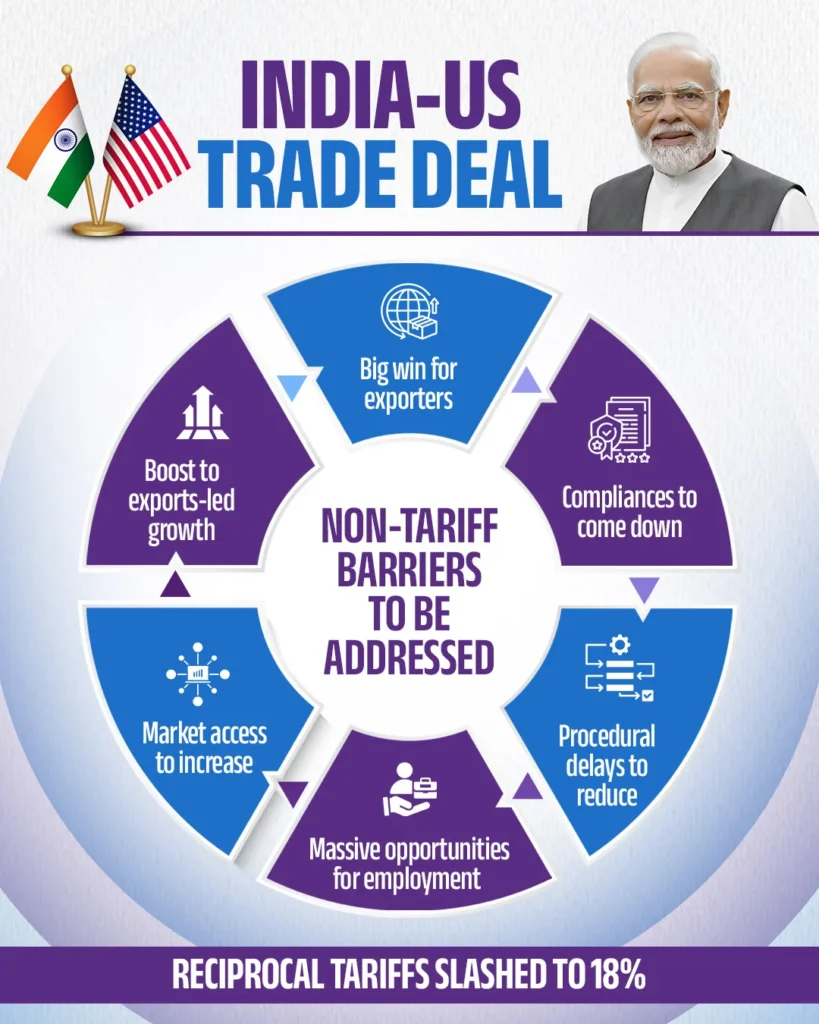
Beyond tariffs, the agreement emphasises the removal or reduction of non-tariff barriers (NTBs) that have historically complicated bilateral trade. India has committed to tackling import licensing delays, standards-related restrictions, and barriers affecting products in sectors such as medical devices, information and communication technology (ICT), and certain agricultural goods.
Under the pact, India will consider aligning with US or international standards for sectors where standards disputes have been a longstanding irritant, with a six-month timeline for conclusions in key areas.
Supply Chain and Strategic Economic Cooperation
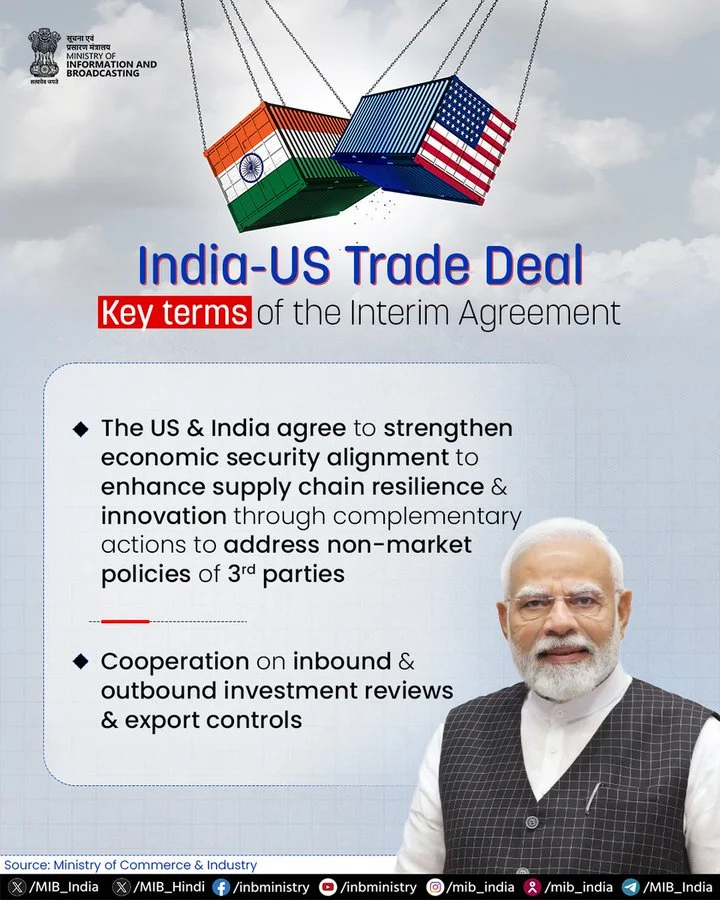
- A distinctive feature of the interim framework is its linkage to strategic supply chain cooperation.
- Both countries have underscored the importance of resilient supply chains in key sectors, including energy, technology hardware, aviation, and critical minerals areas increasingly viewed through the lens of economic security.
- India has indicated plans to purchase $500 billion worth of US goods over five years, spanning energy products, aircraft and aircraft parts, precious metals, technology products, and coke coal.
This move signals a deliberate shift toward diversification of sources, aligning with India’s broader goals of reducing dependencies on specific partners and strengthening domestic industrial capacities through predictable import flows.
Digital Trade and Technology Collaboration
- An important aspect of the framework is its emphasis on digital trade rules and technology cooperation. Both nations have agreed to work on digital trade issues, including cross-border data flows, e-commerce regulations, and shared standards for digital services a crucial area given the growing role of digital economies in bilateral trade.
- Joint engagement on technology goods such as graphics processing units (GPUs) and data-centre equipment reflects a mutual interest in leveraging India’s burgeoning tech ecosystem and the US’s advanced technology base.
Strategic Rationale for India
The Interim Trade Agreement holds multiple strategic benefits for India:
1. Enhanced Market Access
The US is one of India’s largest export destinations. Reducing tariffs to competitive levels (around 18% or lower for key goods) improves Indian exporters’ competitiveness and opens access to high-value consumer markets, especially for goods like pharmaceuticals, textiles, gems and jewellery, and automotive parts.
2. Integration with Global Value Chains
By aligning regulatory standards and improving market predictability, the agreement enhances India’s integration into global value chains, aligning with the vision of “Make in India” and its aspirations to become a manufacturing and export hub.
3. Diversification of Imports
Reducing tariffs on imported US industrial and agricultural products helps Indian industries access critical inputs at competitive prices, boosting domestic manufacturing and reducing costs.
4. Geopolitical Alignments
Strategically, deepening economic ties with the US fits within India’s broader geopolitical goals, including cooperation on supply chain resilience, countering over-dependence on single sources (especially China), and enhancing India’s role in the global economic architecture.
Challenges and Concerns
Despite its promise, the interim agreement raises several concerns that require careful policy calibration:
1. Impact on Sensitive Sectors
Opening markets to US agricultural imports could impact Indian farmers. Although the government has assured protection for sensitive products, concerns persist among farming communities and political groups, leading to protests and demands for transparency.
2. Reciprocal Tariffs and Export Competitiveness
While reduced US tariffs help Indian exporters, certain sectors will face a reciprocal tariff structure that might blunt competitive advantages, especially in labour-intensive industries like textiles and leather.
3. Regulatory and Standards Alignment
Aligning product standards and digital trade rules involves complex reforms and may require India to adapt its regulations in ways that raise domestic policy debates, particularly about data sovereignty and consumer protections.
4. Broader Strategic Autonomy
Some critics argue that deep trade ties with the US could constrain India’s strategic autonomy, especially around foreign policy decisions linked to energy and security cooperation.
The Way Forward
The Interim Trade Agreement is intended as a step towards a comprehensive Bilateral Trade Agreement (BTA) that would address deeper regulatory, investment, and digital trade issues. Key future actions include:
- Timely implementation of interim commitments to build trust and deliver early economic gains.
- Stakeholder consultations to ensure protection of sensitive sectors such as agriculture and small-scale industries.
- Institutional mechanisms for dispute resolution and regulatory cooperation.
Finalisation of the full BTA, incorporating robust digital trade rules, investment protection standards, and deeper market access provisions.